See Disclaimer Below.

Archive for the ‘Fiction’ Category

Allen Mendenhall Interviews Julie Cantrell

In Arts & Letters, Book Reviews, Creative Writing, Fiction, Humanities, Literature, News and Current Events, Novels, Southern Literary Review, The South, Writing on February 29, 2012 at 6:10 am

Julie Cantrell was editor-in-chief of the Southern Literary Review.  She teaches English as a second language to elementary school students and is a freelance writer who has published two children’s books. Julie and her family run Valley House Farm in Mississippi.  Her first novel, Into the Free, was released by David C. Cook in 2012.


Julie, so glad to be doing this interview.  First of all, congratulations on the publication of Into the Free, which, at the moment, is number 23 on the Amazon Kindle bestseller list.  What does it feel like to have completed your first novel?

It’s amazing! The entire journey has been joyful for me, but to see it reach readers across the world is incredible. Having it become a bestseller is simply surreal. I admit I’m a bit numb watching it climb the charts, and I keep thinking it will end in a few minutes – a strange little bubble of joy that is about to pop. For that reason, I’ve been doing the happy dance nonstop and am just going to enjoy the fun while it lasts.

The main character of the book is Millie Reynolds.  How did you come up with Millie?  Did you know what she would be like—her personality, her attitudes, her struggles—before you started writing, or did she sort of come to you as you worked?

Well, to be honest, I never intended to write from a child’s point of view. I originally set out to write about the “Gypsy Queen,” but it just wasn’t the voice I heard. Then I saw a scene of a poor, depressed woman standing on a porch watching the Travelers leave town. She wanted to leave with them, but she was too afraid to take the first step. So I sat down to write her story, but it wasn’t her voice I heard either. Instead, Millie sat in her tree and told me her story. I know it sounds kooky, but I guess I just have a very vivid imagination. I’m happy to introduce Millie to readers, and I hope they love her as much as I do.
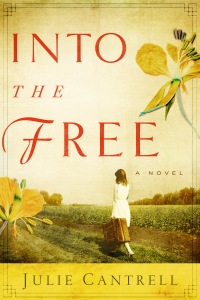
You once told me that you had two kids, four cows, three goats (two of which were then due with babies that you’d have to bottle feed), two dogs, two cats (one stray that arrived pregnant), a horse that likes a lot of attention, a flock of hens, a newly arrived carton of chicks, a husband, and a full-time job as a speech therapist.  How did you ever manage to finish writing Into the Free

It sounds crazy, doesn’t it? In fact, we’ve grown bigger since then! I still work in an elementary school, but now I teach English as a Second Language, so I was able to reduce my hours to part-time this year. With a full-time farm, a teaching job (which is never really part-time, as any teacher will tell you), two kids, a wonderful hubby, freelance gigs, and an active community life, we stay very busy. I usually write between the hours of 3 am and 5 am, when the rest of the world is sleeping. I just love it more than sleep.

Tell us a little about your choice of setting for the novel?

I am a southern girl, through and through. I spent my childhood in Louisiana before leaving the south after graduate school. I loved living in various states across the country, but our family relocated to Mississippi seven years ago, returning to our southern roots. I find this state incredibly rich with everything needed to whip up a story. I never considered setting it anywhere other than Mississippi. However, I like to mix things up a bit, so let’s see where the sequel takes us.

Any advice for aspiring novelists who might come across this interview?

Yes. I say, Go for it! If writing is what you love, be willing to make sacrifices to keep that in your life. Only you know what you were born to do, and only you know how to live the life that makes you happy. Life is short. Choose wisely.

Thank you, Julie.  This has been a great interview.  I’m thrilled to see the success of Into the Free, and I would encourage readers of this site to purchase a copy right away. 

Thank you, Allen. I am honored to be interviewed here on a site I have always loved. You’ve done a fabulous job with Southern Literary Review, and I know your readers all agree. Kudos!

10 Literary Lawyers We Wish Were Real

In Arts & Letters, Fiction, Film, Humanities, Law, Law-and-Literature, Television, Wallace Stevens on February 22, 2012 at 8:10 am

Allen Mendenhall

A reader of this site has emailed me to point out a post at Criminaljusticedegreesguide.com.  The post, available here, is titled, “10 Literary Lawyers We Wish Were Real.”  Here’s the list:

1.  Atticus Finch

2.  Rudy Baylor

3.  Perry Mason

4.  Portia as Balthazar

5.  Joel Litvinoff

6.  Horace Rumpole

7.  The Man of Law

8.  Wallace Stevens (a strange selection indeed, since Stevens was real, but the author has put an interesting twist on Stevens)

9.  Henry Drummond

10.  Jake Brigance

Readers should view the article to see why the (unnamed) author believes that these figures “should be real.”


Book Review: Paul Cantor and Stephen Cox’s Literature and the Economics of Liberty

In Arts & Letters, Austrian Economics, Book Reviews, Communism, Conservatism, Economics, Essays, Fiction, History, Humane Economy, Humanities, Law-and-Literature, Liberalism, Libertarianism, Literary Theory & Criticism, Literature, Novels, Philosophy, Politics, Western Civilization, Western Philosophy on January 23, 2012 at 4:53 am

Allen Mendenhall

The following book review originally appeared here in the Fall 2010 issue of The Independent Review.

Humans are not automated and predictable, but beautifully complex and spontaneous. History is not linear. Progress is not inevitable. Our world is strangely intertextual and multivocal. It is irreducible to trite summaries and easy answers, despite what our semiliterate politicians would have us believe. Thinking in terms of free-market economics allows us to appreciate the complicated dynamics of human behavior while making sense of the ambiguities leading to and following from that behavior. With these realities in mind, I applaud Paul Cantor and Stephen Cox for compiling the timely collection Literature and the Economics of Liberty, which places imaginative literature in conversation with Austrian economic theory.

Cantor and Cox celebrate the manifold intricacies of the market, which, contrary to popular opinion, is neither perfect nor evil, but a proven catalyst for social happiness and well-being. They do not recycle tired attacks on Marxist approaches to literature: they reject the “return to aesthetics” slogans of critics such as Allan Bloom, Harold Bloom, and John M. Ellis, and they adopt the principles, insights, and paradigms of the Austrian school of economics. Nor do Cantor and Cox merely invert the privilege of the terms Marxist and capitalist (please excuse my resort to Derridean vocabulary), although they do suggest that one might easily turn “the tables on Marxism” by applying “its technique of ideology critique to socialist authors, questioning whether they have dubious motives for attacking capitalism.” Cantor and Cox are surprisingly the first critics to look to Austrian economics for literary purposes, and their groundbreaking efforts are sure to ruffle a few feathers—but also to reach audiences who otherwise might not have heard of Austrian economics.

Cantor and Cox submit that the Austrian school offers “the most humane form of economics we know, and the most philosophically informed.” They acknowledge that this school is heterodox and wide ranging, which, they say, are good things. By turning to economics in general, the various contributors to this book—five in all—suggest that literature is not created in a vacuum but rather informs and is informed by the so-called real world. By turning to Austrian economics in particular, the contributors seek to secure a place for freedom and liberty in the understanding of culture. The trouble with contemporary literary theory, for them, lies not with economic approaches, but with bad economic approaches. An economic methodology of literary theory is useful and incisive so long as it pivots on sound philosophies and not on obsolete or destructive ideologies. Austrian economics appreciates the complexity and nuance of human behavior. It avoids classifying individuals as cookiecutter caricatures. It champions a humane-economy counter to mechanistic massproduction, central planning, and collectivism. Marxism, in contrast, is collectivist, predictable, monolithic, impersonal, linear, reductive–in short, wholly inadequate as an instrument for good in an age in which, quite frankly, we know better than to reduce the variety of human experience to simplistic formulae. A person’s creative and intellectual energies are never completely products of culture or otherwise culturally underwritten. People are rational agents who choose between different courses of action based on their reason, knowledge, and experience. A person’s choices, for better or worse, affect lives, circumstances, and communities. (“Ideas have consequences,” as Richard Weaver famously remarked.) And communities themselves consist of multiplicities that defy simple labels. It is not insignificant, in light of these principles, that Michel Foucault late in his career instructed his students to read the collected works of Ludwig von Mises and F. A. Hayek. Read the rest of this entry »

Allen Mendenhall Interviews J. Neil Schulman, Prometheus Award–Winning Author of Alongside Night

In Artist, Arts & Letters, Austrian Economics, Creative Writing, Creativity, Economics, Fiction, Film, Humanities, Imagination, Libertarianism, Literary Theory & Criticism, Literature, News and Current Events, Novels, Philosophy, Screenwriting, Television, Television Writing, Writing on January 17, 2012 at 9:00 am

J. Neil Schulman

J. Neil Schulman is a novelist, actor, filmmaker, journalist, composer, and publisher.  Among his many books are Alongside Night and The Rainbow Cadenza, both of which won the Prometheus Award.  Visit his website at http://jneilschulman.rationalreview.com/.


The following interview originally appeared here at Prometheus Unbound: A Libertarian Review of Fiction and Literature.

AM:  Right off the bat, it strikes me that I don’t know what to call you.  Will Neil work?

JNS:  Sure. It’s J. Neil Schulman in credits, and Neil in person.

AM:  Anyway, thank you for doing this interview, Neil.  You’ve had a fascinating and unique career.  You’ve written novels, short fiction, nonfiction, screenplays, and other works.  Which of your works is your favorite and why?

JNS:  Every artist gets asked this question sooner or later. I asked it of Robert A. Heinlein when I interviewed him in 1973, and his answer was, “The latest one I’ve been working on.”

I’ve only completed one movie so far — Lady Magdalene’s — so it’s a Hobson’s Choice on that one. Ask me again when I’ve made two! But a lot of people also seem to like the script I wrote for The Twilight Zone, “Profile in Silver.”

I’ve written three novels. My first, Alongside Night [editor’s note: free in pdf], seems to be my most accessible and popular. I consider my second novel, The Rainbow Cadenza, to be my most layered, literary, and richest in explicit philosophy. My third novel, Escape from Heaven, is my favorite. It may not be as timely as my first novel or literary as my second novel, but it’s the one that’s closest to my heart…both the funniest thing I’ve ever written, and the one which is most deceptively simple. It appears to be a lightweight piece of comic fantasy, but it’s full of ideas that if examined more closely turn both traditional theology and rationalist philosophy on their heads.

Short stories? I’ll pick a few: “The Musician,” “Day of Atonement,” and “When Freemen Shall Stand” — all in my collection Nasty. Brutish, and Short Stories — and my latest short story, “The Laughskeller,” published on my blog, J. Neil Schulman @ Rational Review.

AM:  Your worldview is, in a word, libertarian.  Why is that?  How does libertarianism come across in your writing?

JNS:  In my nonfiction essays it comes across explicitly. In fiction, drama, and comedy, I try to examine libertarian themes without preaching. I was probably most subtle doing this in The Rainbow Cadenza. The utilitarian politics advocated by the chief villain, Burke Filcher, is so self-consistent that a lot of readers have thought this character speaks for the author. In fact, I wrote the novel to attack utilitarianism as a nullification of the natural individual rights I believe in. The novel reduces utilitarianism to absurdity — it’s a formal satire of it.

Alongside Night is less subtle, though I’m probably more successful in the new movie script than the 1970s novel when it comes to letting the audience make up its own mind. I have learned some refinements of my craft in the last three decades.

Alongside Night by J. Neil SchulmanAM:  I recently noticed that you commented on a post at the Austrian Economics and Literature blog edited by my good friend Troy Camplin.  Tell me about the influence that Austrian economics has had on you.

JNS:  I would say that Austrian economics — and more fundamentally, the analytical tools of praxeology and games theory — have been fundamental to my work for my entire professional career. They’re not the only tools in my kit, but they get shopworn as much as any of them. Austrian economics is most explicit in Alongside Night, projecting the social and political consequences of fiat money hyperinflation — but I used games theory in plotting “Profile in Silver” and applied praxeology to the afterlife in Escape from Heaven. Read the rest of this entry »

How I Taught Sustainability

In Arts & Letters, Communication, Emerson, Fiction, Humanities, Literature, Nineteenth-Century America, Pedagogy, Rhetoric, Rhetoric & Communication, Teaching, Writing on January 9, 2012 at 1:12 am

Allen Mendenhall

Last spring I learned that I had been assigned to teach a freshman writing course on sustainability.  I don’t know much about sustainability, at least not in the currently popular sense of that term, and for many other reasons I was not thrilled about having to teach this course.  So I decided to put a spin on the subject.  What follows is an abridged version of my syllabus.  I owe more than a little gratitude to John Hasnas for the sections called “The Classroom Experience,” “Present and Prepared Policy,” and “Ground Rules for Discussion.”  He created these policies, and, with a few exceptions, the language from these policies is taken from a syllabus he provided during a workshop at a July 2011 Institute for Humane Studies conference on teaching and pedagogy.

Sustainability and American Communities

What is sustainability?  You have registered for this course about sustainability, so presumably you have some notion of what sustainability means.  The Oxford English Dictionary treats “sustainability” as a derivative of “sustainable,” which is defined as

  1. Capable of being borne or endured; supportable, bearable.
  2. Capable of being upheld or defended; maintainable.
  3. Capable of being maintained at a certain rate or level.

Recently, though, sustainability has become associated with ecology and the environment.  The OED dates this development as beginning in 1980 and trending during the 1990s.  The OED also defines “sustainability” in the ecological context as follows: “Of, relating to, or designating forms of human economic activity and culture that do not lead to environmental degradation, esp. avoiding the long-term depletion of natural resources.”  With this definition in mind, we will examine landmark American authors and texts and discuss their relationship to sustainability.  You will read William Bartram, Thomas Jefferson, Emerson, Thoreau, Hawthorne, Whitman, Mark Twain, and others.  Our readings will address nature, community, place, stewardship, husbandry, and other concepts related to sustainability.  By the end of the course, you will have refined your understanding of sustainability through the study of literary texts. 

Course Objectives

I have designed this course to help you improve your reading, writing, and thinking skills.  In this course, you will learn to write prose for general, academic, and professional audiences.  ENGL 1120 is a writing course, not a lecture course.  Plan to work on your writing every night.  You will have writing assignments every week. Read the rest of this entry »

Joyce Corrington Publishes New E-Books

In Arts & Letters, Creative Writing, Fiction, Humanities, John William Corrington, Law, Literature, News and Current Events, News Release, Novels, Writing on January 4, 2012 at 9:00 pm

Allen Mendenhall

Joyce Corrington, a long-term friend and supporter of this site whose interview with me appeared back in September, recently republished, in e-book format, the four New Orleans mysteries she wrote in a series with her late husband John William Corrington.  The books are available at the following links:

So Small a Carnival

A Project Named Desire

A Civil Death

The White Zone

Joyce’s latest novel, Fear of Dying, the fifth in the series, came out in 2011.

Allen Mendenhall Interviews Ace Atkins

In Artist, Arts & Letters, Book Reviews, Creative Writing, Fiction, Humanities, News and Current Events, Novels, Southern Literary Review, Writing on December 12, 2011 at 8:46 am

Ace Atkins is the author of nine novels, most recently The Ranger and Infamous.  A former journalist at The Tampa Tribune, Atkins has been nominated for a Pulitzer Prize for his investigation into a 1950s murder.  He lives on a farm outside Oxford, Mississippi.

The following interview first appeared here at Southern Literary Review.

AM: What I suspect everyone wants to know is, how do you stay so prolific?  How do you write so much, so quickly?

AA: I’m very fortunate to be a full-time novelist. I’ve been writing full time since 2001 and that gives me the freedom to concentrate completely on my stories. Many terrific writers I know have to carve out time from from their jobs to work on a book. I am able to go to my office every day and work on that new novel. I feel pretty damn lucky and that in turn means I get to work on more projects.

AM: You seem to have located The Ranger in regions of the South that you know well.  Would you call this book “Southern literature”? 

AA: Absolutely. I don’t get into working in a certain genre—that’s up to readers and critics—and can hurt the writer and reader. My new series of novels could not be set anywhere else but the South and certainly centers on many Southern themes. I gain a lot of inspiration from the gritty world of Faulkner’s crime stories and turn my attention to the descendants of those people. 

AM:    I noticed that country music and country musicians appear throughout The Ranger.  Can you tell us about the significance of this to the novel?

AA: My first four novels were stylistically and thematically about blues. I always wanted to work on a novel that felt like an old Johnny Cash ballad—a solider returning home to town, unrequited love, guns and violence. I listened to a lot of Johnny Cash and also tons of Outlaw Country—Waylon, Merle, etc.—when coming up with the background of Quinn Colson.

AM: Who is Colonel George Reynolds?  I noticed his name in the Acknowledgments. 

George is the guy who saved my ass. I had contracted to write a novel about a U.S. Army soldier without knowing enough about the modern war in Afghanistan. Colonel Reynolds contacted me from Camp Phoenix in Afghanistan about signing a copy of my novel, Devil’s Garden. He offered help if I ever needed. It turned out, I needed help immediately. He offered terrific insight direct from the battle front and introduced me to the real Ranger who provided the background for Quinn Colson. 

I could not have written the book without him and he still provides me with a ton of answers to picky questions. Read the rest of this entry »

Review of Forensic Fictions by Jay Watson

In Arts & Letters, Book Reviews, Fiction, Georgia, Humanities, Jurisprudence, Justice, Law, Law-and-Literature, Literary Theory & Criticism, Literature, Novels, Rhetoric, Rhetoric & Communication, Southern History, Southern Literary Review, The South, Writing on December 5, 2011 at 10:56 pm

Allen Mendenhall

The following review originally appeared here at the Southern Literary Review.  If you enjoy this review, please consider subscribing to the Southern Literary Review.  I became the managing editor of the Southern Literary Review in November.


Kudos to the University of Georgia Press for this recent reprint of Jay Watson’s Forensic Fictions, which has become something of a classic among law-and-literature scholars.  A pioneering project, Forensic Fictions stands as the first critical work to interrogate the lawyer figure in Faulkner’s oeuvre.

Watson submits that law is vast and multidimensional, “at once a deeply normative cultural system, a vehicle of ideology (in its constructive and destructive manifestations), a force of social stability and control, an entrenched and often blindly self-interested institution, and not least of all a human vocation, a form of practice that in some instances achieves the status of a calling.” 

In Faulkner’s fiction, law helps to highlight the complexity, sometimes liberating and sometimes disorienting, of the “everyday” aspects of Southern culture, institutions, and traditions.  Law is more than bills, statutes, judge-made opinions, codes, and the like.  Law isn’t a monolithic animal but a multiplicity of people and institutions; a product of self-serving performances by lawyers, judges, and politicians; and an accumulation of arguments couched in topoi of guilt and innocence, right and wrong, justice and equality.  Law is, simply put, a network of human relations and a collection of stories. 

Watson’s book examines how lawyers and laws constitute and presuppose authority in the microcosm of Yoknapatawpha.  “Lawyers of course advocate by narrating,” Watson explains, “by telling their clients’ stories in the language of the law.”  Lawyers, then, are raconteurs, and laws are products of language, even as they institute language.

Watson suggests that Faulkner internalized the “conspicuous and complicated presence” of real-life lawyers—Dean R.J. Farley, Governor Lee M. Russell, General James Stone, Ben Wasson, Jim Kyle Hudson, and Lucy Somerville Howorth, to name just a few—and then expressed mixed feelings about lawyers and the legal community in his writings.  Although not a lawyer himself, Faulkner could boast of a legal pedigree, having been born into a family and a society overflowing with attorneys.  Faulkner’s multifaceted and often contradictory ideas about law reflect these cultural associations.

Watson uses the term “forensic fictions” to refer to Faulkner’s depictions “of the legal vocation and the practice of law, a practice that extends from the official space of the courtroom and the professional space of the law office to the farthest reaches of the community.”  Thus conceived, law is not only a communicative vehicle but also a way of life, as mundane as it is exciting. 

Watson works out of the paradigms of forensic discourse.  He treats law as a theater of differences and disparate perspectives and as a vast system of interrelated parts.  An “important subtext” for Faulkner’s forensic fictions, according to Watson, “is the conviction that the values and concerns of the storyteller can and must carry over from a limited, private, aesthetic realm into a public world outside, where verbal creations can reinforce, challenge, or otherwise inform social norms.”

Three novels—Intruder in the Dust, Knight’s Gambit, and Requiem for a Nun—make up what Watson dubs Faulkner’s “forensic trilogy.”  These novels portray the lawyer as citizen-spokesperson, able to appropriate the public sphere as a space for social celebration or critique. Read the rest of this entry »

Southern Literary Review

In Arts & Letters, Creative Writing, Essays, Fiction, Humanities, Literary Theory & Criticism, Literature, News and Current Events, News Release, Novels, Poetry, Writing on November 13, 2011 at 12:01 pm

Allen Mendenhall

I have become the managing editor of the Southern Literary Review.  Writer and editor Phil Jason will serve as editor and publisher of the journal.  Former editors Julie Cantrell and Adele Annesi  have stepped down after a successful tenure.  They increased readership and brought on new contributors, including Sean Ennis, Kerry Madden, Matthew Simmons, Donna Meredith, Christopher Bundrick, Peter Schmitt, Paul Yarbrough, Rhett DeVane, Danielle Sellers, Abigail Greenbaum, Patricia O’Sullivan, Peggy Kassees, Heather Cousins, Niles Reddick, and Andrew McFadyen-Ketchum.

Founded in 2009, the Southern Literary Review celebrates southern authors and their contributions to American literature in general and Southern literature in particular. We feature the classic writers who have defined Southern literature, and we highlight emerging authors through interviews, profiles, and book reviews.  Please check out the journal by clicking here.  The journal will undergo updates and upgrades in the coming weeks.

BOOK REVIEW: Killing Time by John Holloway and Ronald M. Gauthier

In Advocacy, Art, Arts & Letters, Book Reviews, Creative Writing, Criminal Law, Fiction, Justice, Law, Literary Theory & Criticism, Literature, Prison, Southern History, Writing on November 8, 2011 at 9:05 pm

Allen Mendenhall

The following review originally appeared here at The Southern Literary Review just over a year ago.  Click here to view the original version in PDF.

John Hollway and Ronald M. Gauthier have written a thriller.  Unlike other thrillers, Killing Time: An 18-Year Odyssey from Death Row to Freedom (Skyhorse Publishing, 2010) is not fiction.  It is, in the authors’ words, “a true story” told in “narrative style.”  There’s an old saying: reality is stranger than fiction.  Here’s a book that proves reality is not only stranger than fiction but also, in some cases, more terrifying.  

The plot is as chilling as it is plain.  Or perhaps it is chilling because it seems plain.  An unknown man murders an Italian-American hotelier named Ray Liuzza.  Police, witnesses, and prosecutors mistake the killer for an innocent man: John Thompson, a twenty-two-year-old African American.  The crime occurs outside Ray’s apartment.  The year is 1984.  The city is New Orleans.  What follows is the bulk of the book: a police investigation, arrest, trial, sentencing, conviction, appeal, and so forth. 

Using court transcripts, depositions, media reports, interviews, letters, and other records, Hollway and Gauthier piece together a stunning story of power, law, race, and justice.  The result is a book that increasingly calls into question the instrumentalities of our criminal justice system, redeemed, at last, by two Philadelphia lawyers, Michael Banks and Gordon Cooney, who undertake Thompson’s case pro bono and who spend millions of dollars in foregone legal fees. 

Without the intervention of these two men, Thompson, who was wrongly convicted and sentenced to death, might not be alive today.  Released from prison after his exoneration, Thompson resides in Louisiana, where he is involved with Resurrection After Exoneration (REA), an organization he founded.          Read the rest of this entry »