See Disclaimer Below.

Posts Tagged ‘Literature’

The Emersonian Oliver Wendell Holmes Jr.

In American History, Art, Arts & Letters, Emerson, History, Humanities, Jurisprudence, Law, Law-and-Literature, Literary Theory & Criticism, Literature, Nineteenth-Century America, Oliver Wendell Holmes Jr., Philosophy, Poetry, Pragmatism, Rhetoric, The Supreme Court, Western Civilization, Western Philosophy, Writing on October 26, 2011 at 9:16 am

Allen Mendenhall

Writers on Holmes have forgotten just how influential poetry and literature were to him, and how powerfully literary his Supreme Court dissents really are.  The son of the illustrious poet by the same name, young Holmes, or Wendell, fell in love with the heroic tales of Sir Walter Scott, and the “enthusiasm with which Holmes in boyhood lost himself in the world of Walter Scott did not diminish in maturity.”[1]  Wendell was able to marry his skepticism with his romanticism, and this marriage, however improbable, illuminated his appreciation for ideas past and present, old and new.  “His aesthetic judgment,” says Mark DeWolfe Howe, author of the most definitive biography of Holmes and one of Holmes’s former law clerks, “was responsive to older modes of expression and earlier moods of feeling than those which were dominant at the fin de siècle and later, yet his mind found its principle nourishment in the thought of his own times, and was generally impatient of those who believe that yesterday’s insight is adequate for the needs of today.”[2]  Holmes transformed and adapted the ideas of his predecessors while transforming and adapting—one might say troping—milestone antecedents of aestheticism, most notably the works of Emerson.  “[I]t is clear,” says Louis Menand, “that Holmes had adopted Emerson as his special inspiration.”[3]      

Classically educated at the best schools, Wendell was subject to his father’s elaborate discussions of aesthetics, which reinforced the “canons of taste with the heavier artillery of morals.”[4]  In addition to Scott, Wendell enjoyed reading Sylvanus Cobb, Charles Lamb’s Dramatic Poets, The Prometheus of Aeschylus,[5] and Plato’s Dialogues.[6]  Wendell expressed a lifelong interest in art, and his drawings as a young man exhibit a “considerable talent.”[7]  He declared in his Address to the Harvard Alumni Association Class of 1861 that life “is painting a picture, not doing a sum.”[8]  He would later use art to clarify his philosophy to a friend: “But all the use of life is in specific solutions—which cannot be reached through generalities any more than a picture can be painted by knowing some rules of method.  They are reached by insight, tact and specific knowledge.”[9]     

At Harvard College, Wendell began to apply his facility with language to oft-discussed publications in and around Cambridge.  In 1858, the same year that Dr. Oliver Wendell Holmes Sr. gifted five volumes of Emerson to Wendell,[10] Wendell published an essay called “Books” in the Harvard undergraduate literary journal.[11]  Wendell celebrated Emerson in the piece, saying that Emerson had “set him on fire.”  Menand calls this essay “an Emersonian tribute to Emerson.”[12] 

Holmes had always admired Emerson.  Legend has it that, when still a boy, Holmes ran into Emerson on the street and said, in no uncertain terms, “If I do anything, I shall owe a great deal to you.”  Holmes was more right than he probably knew. 

Holmes, who never gave himself over to ontological (or deontological) ideas about law as an existent, material, absolute, or discoverable phenomenon, bloomed and blossomed out of Emersonian thought, which sought to “unsettle all things”[13] and which offered a poetics of transition that was “not a set of ideas or concepts but rather a general attitude toward ideas and concepts.”[14]  Transition is not the same thing as transformation.  Transition signifies a move between two clear states whereas transformation covers a broader and more fluent way of thinking about change.  Holmes, although transitional, was also transformational.  He revised American jurisprudence until it became something it previously was not.  Feeding Holmes’s appetite for change was “dissatisfaction with all definite, definitive formulations, be they concepts, metaphors, or larger formal structures.”[15]  This dissatisfaction would seem to entail a rejection of truth, but Emerson and Holmes, unlike Rorty and the neopragmatists much later, did not explode “truth” as a meaningful category of discourse.  Read the rest of this entry »
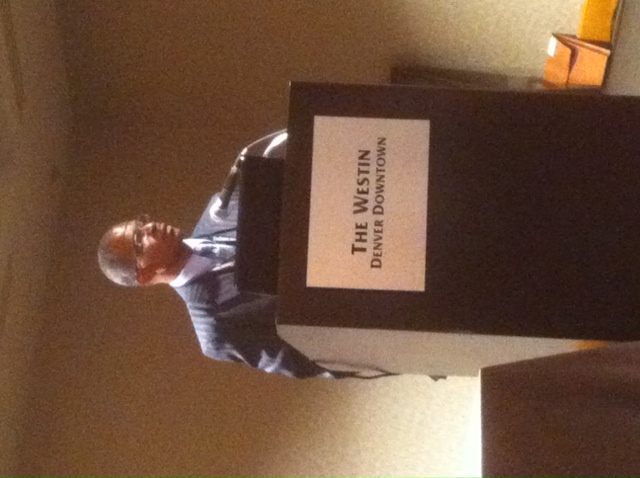
Allen Mendenhall Interviews Richard Miles

In Advocacy, Arts & Letters, Communication, Ethics, Law, News and Current Events, Politics, Prison, Rhetoric, Rhetoric & Communication, Teaching, Writing on September 14, 2011 at 9:23 am

Richard Miles spent years in prison after being wrongly convicted and sentenced to 80 years.  He lives in Texas and speaks about false imprisonment.

Richard, thanks for doing this interview.  You and I have gotten to know each other through email correspondence.  I believe you first contacted me after reading my review of Dorothy and Peyton Budd’s Tested: How Twelve Wrongly Imprisoned Men Held Onto Hope (Dallas, TX: Brown Books Publishing Group, 2010).  You are one of those twelve men.  Tell us how you became part of the book.  What do you think of the book, now that you’ve seen the final product?

The first time anyone heard of or read anything about Richard Ray Miles was in The Dallas Morning NewsI remember that morning as if it was yesterday.  To be arrested for murder and attempted murder, at the age of 19, was a horrific experience, but to wake up Monday morning and read that I was the shooter, in a murder I didn’t commit, tore out my insides.  Mr. Mendenhall, my fight for innocence was not just for me—I knew I was innocent—but for my mom and dad.  I didn’t want the story to be the last thing that my father—a minister in the neighborhood who had to hear accusations about his son—to read.  So, when the book Tested was completed, it was like a dream come true: now Dallas residents could read about MY INNOCENCE. 

You’ve been through a lot.  Would you mind telling us your story?  Start wherever you want to start.

I was born in Dallas to Thelma Malone and Richard Miles.  My parents split when I was young, but not long after my mom met William Lloyd and married him.  I was probably about five when that happened, so to say I was without a father is false.  My dad, William, became a minister when I was still young, so I grew up in a very strict, religious household.  Going to church every day was not out of the ordinary.  For the most part, my older sister, two younger brothers and I had a very good upbringing.

As far as schooling goes, I was very smart and interested in learning.  I went to an academy for middle school and then to Skyline High School, which was one of the most prestigious schools at the time.  When I made it to Skyline, I began to feel something different.  I felt that my parents were way too strict on me.  As young children do, I began to rebel—nothing too extreme, but rebellious nevertheless.  I was kicked out of Skyline at the end of 11th grade and was transferred to Kimball.  Kimball and Skyline were two totally different places to learn.  To be more precise, Kimball was a Hood School; its reputation preceded itself.

By the time I got into Kimball and got ready to take my senior exams, I got a reputation for coming to school drunk.  Mind you, I was not a drinker, so any little thing was not good.  The long and short is that I made it all the way to the 12th grade, but did not graduate.  I left home a little after that, never to be in the streets or in a gang because I was working at McDonalds, and I actually liked the idea of having a job.  All that changed when my friend came to pick me up from my parents’ house.  He asked me about selling drugs.  I had never been introduced to that, and by mere peer pressure, my entire life was turned around.

I struggled on the streets for probably one year, but that was enough to experience a life I will never return to.  On May 15th, I was walking home, not knowing there was a shooting miles away, and I got picked up for a murder and an attempted murder.  I have never shot a gun in my life, nor ever thought about stealing or tried to steal someone’s things by force.  So, I knew I would be going home soon. The whole interrogation lasted probably five or six hours.  Because my friend had driven me home and wasn’t with me when I was walking and got picked up, I gave the detective phone numbers of people who could identify my whereabouts.  My friend had gone to his girlfriend’s place.  That’s why I was walking by myself.  All in all, I gave the detective four phone numbers of people who could verify my whereabouts and confirm that I was not the shooter. The detective left and came back about an hour later.  He said, “Your story checked out, but you killed that man, and you’re going to prison.”  I was lost at that point.

I stayed in the county jail for 17 months before I went to trial.  I was given a court-appointed lawyer. In August 1995, I had a jury trial.  

There were ten witnesses, nine of whom said I was not the shooter.  No weapon was ever found, and the fingerprints that were retrieved were neither mine nor the victims’. One person who was shot testified that I did not look like the shooter, and my alibis came as well.  Nevertheless, I was found guilty of murder and attempted murder and sentenced to 80 years in prison. 

After I had sent out numerous letters and spent 14 years in prison, I was contacted by an organization out of Princeton, New Jersey, that picked up my case and found in the police record an anonymous phone record received before I went to trial.  This record mentioned the real shooter as well as other confidential information.  This stuff had never been turned in.  Based on that and other exculpatory evidence, I was released in October 2009; I was the first non-DNA release under District Attorney Craig Watkins

Now I’m awaiting full exoneration, even though the DA and my judge pronounced me innocent. Read the rest of this entry »

Dragon*Con Convention in Atlanta

In Arts & Letters, Fiction, Georgia, Humanities, Literature, News and Current Events, News Release, Writing on August 31, 2011 at 8:25 am

Allen Mendenhall

The Dragon*Con convention will take place in Atlanta from September 2 through September 5.  The convention features events and workshops about science fiction and fantasy, gaming, comics, literature, art, music, and film.

Power Made Perfect in Weakness

In Art, Arts & Letters, Communication, Creative Writing, Emerson, Essays, Humanities, Law, Literature, Poetry, Shakespeare, Teaching on August 28, 2011 at 1:30 pm

Allen Mendenhall

I wrote the following piece about three weeks ago, while I was vacationing in Destin, Florida, with my family.

If we expect others to rely on our fairness and justice we must show that we rely on their fairness and justice.

Calvin Coolidge

My wife and I are on vacation in Florida.  Yesterday morning, over a cup of coffee and a doughnut, sitting on the balcony and reading the newspaper amid sounds of seagulls and the grating roll of morning waves, I noted that one Michael Stone—a blind man, XTERRA champion, and 10-time Ironman triathlete who recently published a book, Eye Envy—will speak at the University of North Florida on August 13.  I haven’t read Stone’s book, but it’s apparently a resource not only for those suffering from vision-loss any degenerative disease.

Stone began to lose his sight in 2004.  His blindness is a result of a rare disease called cone-rod dystrophy.  Despite his handicap, he has accomplished amazing things, but not without the help of others.  During races, he relies on guides, who shout directions and warnings to him.

I’ll never understand why God makes some people handicapped and others not, why some must rely on others, and some must be relied on.  Someday and for a time, everyone relies on someone or something and is relied on by someone or something.      Read the rest of this entry »

Law & Literature: A Basic Bibliography

In American History, Arts & Letters, Law-and-Literature, Legal Education & Pedagogy, Literary Theory & Criticism, Nineteenth-Century America, Novels, Pedagogy, Politics, Rhetoric, Rhetoric & Communication, Semiotics, Slavery, The Literary Table, The Supreme Court, Western Civilization on April 2, 2011 at 9:16 pm

Patrick S. O’Donnell compiled this bibliography in 2010.  He teaches philosophy at Santa Barbara City College in California.  This bibliography first appeared over at The Literary Table

Amsterdam, Anthony G. and Jerome Bruner. Minding the Law. Cambridge, MA: Harvard University Press, 2000.

Atkinson, Logan and Diana Majury, eds. Law, Mystery, and the Humanities: Collected Essays. Toronto: University of Toronto Press, 2008.

Ball, Milner S. The Word and the Law. Chicago, IL: University of Chicago Press, 1993.

Bergman, Paul and Michael Asimow. Reel Justice: The Courtroom Goes to the Movies.  Kansas  City, MO: Andrew McMeels Publ., revised ed., 2006.

Best, Stephen M. The Fugitive’s Properties: Law and the Poetics of Possession. Chicago, IL: University of Chicago Press, 2004.

Binder, Guyora and Robert Weisburg. Literary Criticisms of Law. Princeton, NJ: Princeton University Press, 2000.

Biressi, Anita. Crime, Fear and the Law in True Crime Stories. New York: Palgrave, 2001.

Black, David A. Law in Film: Resonance and Representation. Urbana, IL: University of Illinois Press, 1999.

Brooks, Peter. Troubling Confessions: Speaking Guilt in Law and Literature. Chicago, IL: University of  Chicago Press, 2001.

Brooks, Peter and Paul Gewirtz, eds. Law’s Stories: Narrative and Rhetoric in the Law. New Haven, CT: Yale University Press, 1998 ed. Read the rest of this entry »

Literature and the Economics of Liberty

In Arts & Letters, Austrian Economics, Book Reviews, Communication, E.M. Forster, Law-and-Literature, Libertarianism, Literary Theory & Criticism on February 5, 2011 at 10:53 pm

Allen Mendenhall

Recently Jeffrey Tucker, editorial vice president of the Ludwig Von Mises Institute, interviewed me about capitalism, the free market, and literature.  We discussed, among other things, Marxism in literature and humanities departments.  Just days later, a review titled “Marx’s Return” appeared in the London Review of Books.  That shows how relevant my interview was and is.  The interview is below:

Austrian Economics and Literature

In Arts & Letters, Austrian Economics, Communication, Libertarianism, Literary Theory & Criticism, Rhetoric, Rhetoric & Communication on October 18, 2010 at 3:37 pm

I will be blogging at a new site created by Dr. Troy Camplin. The name of the site, which was inspired by Paul Cantor & Stephen Cox’s Literature & the Economics of Liberty, is Austrian Economics and Literature.