See Disclaimer Below.

Archive for the ‘Southern History’ Category

Book Synopsis: Miller, William Lee. Arguing About Slavery: The Great Battle in the United States Congress. New York: Alfred A. Knopf, 1996.

In America, American History, Arts & Letters, Book Reviews, Books, Historicism, History, Humanities, Law, Nineteenth-Century America, Politics, Scholarship, Slavery, Southern History, The South on October 30, 2013 at 8:45 am

Allen 2

This is the story of America’s struggle to end slavery without destroying the union.  The book deliberately focuses on the rhetoric of white male politicians and thus does not purport to tell the “whole” story, but only that part of the story which is most recoverable and hence most knowable.  Many early 19th century politicians averred that the Northern textile industry, which was roughly as powerful as today’s oil industry, depended on Southern slavery.  An industry with such power and control over the financial interests of the country can, Miller argues, cause social changes to come about more slowly.  When talking about slavery, Miller submits, American politicians of the time had to deal with inherent contradictions in the American tradition: a nation that celebrated equality and the virtues of the “common man” had to come to terms with the fact that African slaves, officially excluded from citizenry, embodied the “common man” ideal but were not permitted to climb the social and economic ladder.  Most politicians did not believe slavery could end abruptly but would end gradually as economic dependence turned elsewhere.  Slavery went against all the principles and rhetoric of America’s founding documents, and yet there it was, a thriving and ubiquitous industry.

The book begins in 1835, when Congress deliberated over petitions to abolish slavery in the District of Columbia.  Congress took on these petitions reluctantly, unwilling to address a contentious and divisive issue that would disrupt congressional and governmental harmony.  Congress wished the issue would just go away—but realized that it could not.  During this congressional session, most of the speechmaking came from proslavery Southerners, since Northern politicians were, generally, too afraid to take a stand one way or the other.

Major figures from this session include the following:

President Andrew Jackson

John Fairfield: Congressman from Vermont who introduces the petitions to abolish slavery in D.C.

Franklin Pierce: Eventually the fourteenth President, he is, at this time, serving in the U.S. House of Representatives.  He is a Northerner with Southern sympathies.

James Henry Hammond: Congressman from South Carolina who opposed Fairfield and Adams.

John Quincy Adams: A former president (the nation’s sixth), he is, at this time, a U.S. Representative from Massachusetts.

Henry Laurens Pinckney: A Congressman from South Carolina who opposed Fairfield and Adams but who also did not get along with John C. Calhoun.

John C. Calhoun: A U.S. Senator from South Carolina, having resigned from the Vice Presidency.

Martin Van Buren: Eventually a U.S. President (the nation’s eighth), he is, at this time, the Vice President under Andrew Jackson.

James K. Polk: Eventually a U.S. President (the nation’s eleventh), he is, at this time, a member of the U.S. House from the State of Tennessee.

The debates in Congress were fueled by abolitionist literature (written by people like John Greenleaf Whittier, William Lloyd Garrison, and Elizur Wright, Jr.) and oration that maintained not only that slavery was wrong (as people had maintained for decades) but also that its demise was the nation’s highest priority.  Congress could not “sit on its hands” while abolitionists protested and demanded change; it had to respond, albeit reluctantly, to an institution that many congressmen assumed was already doomed.  The demise of slavery was supposed to be inevitable, according to the common logic, yet it persisted; therefore, the abolitionists forced Congress to address slavery, the demise of which, the abolitionists argued, was not as inevitable as people supposed.

The Senate also faced petitions.  Senator Calhoun became the most colorful and powerful figure opposing these positions.  Calhoun and his followers often employed “liberal” rhetoric on the Senate floor.  Henry Laurens Pinckney authored the gag rule, which was an attempt to stop citizens from submitting antislavery petitions.  (Calhoun despised Pinckney so much that he endorsed unionist candidates to take over Pinckney’s Congressional seat.)  The gag rule was adopted by a 117-68 vote, thus suggesting that the nation was more united on the issue of slavery than popular thought maintains.  The gag rule required congressmen to set aside slavery petitions immediately, without so much as printing them.  John Quincy Adams would spend the following years in Congress battling the so-called gag rule.

At this point in the book, Adams becomes the central figure.  Adams, then a distinguished ex-president, was in his 60s and 70s as he fought against the gag order.  He maintained that not only abolitionists but also slaves could petition.  Miller argues that this position shows the extent to which Adams was willing to risk his reputation and what was left of his career in order to stand up to the Southern gag order.  Other congresspersons were slow to join Adams in his fight.  During these debates, very little was said of African Americans, and most of the debates focused on the rights and roles of government and ignored the human persons that that government was supposed to serve and protect.

After Martin Van Buren became president, succeeding Andrew Jackson, he announced that he would veto any bill involving the issue of slavery in D.C. or the slave states.  Nevertheless, the petitions continued to pour in.  Adams himself began submitting petitions.  The gag resolutions had to be passed each session, but a gag rule was announced in 1840 that, in essence, made the “gagging” permanent.  Adams led the effort to rescind this rule.  He grew closer and closer to the abolitionists as he precipitated disarray in the House.  He also made several speeches despite threats against his life.  Adams’s opponents tried to get the entire House to censure him, but they failed.  Adams used the censure trials as an occasion to bring slavery to the forefront of Congressional debate.  In 1844, Adams succeeded in having the gag rule abolished.

John William Corrington, A Literary Conservative

In American History, Arts & Letters, Conservatism, Creative Writing, Essays, Fiction, History, Humanities, John William Corrington, Joyce Corrington, Law, Literary Theory & Criticism, Literature, Modernism, Southern History, Southern Literature, Television, Television Writing, The Novel, The South, Western Philosophy, Writing on October 23, 2013 at 8:45 am


Allen 2


An earlier version of this essay appeared here at Fronch Porch Republic.

Remember the printed prose is always

half a lie: that fleas plagued patriots,

that greatness is an afterthought

affixed by gracious victors to their kin.


—John William Corrington


It was the spring of 2009.  I was in a class called Lawyers & Literature.  My professor, Jim Elkins, a short-thin man with long-white hair, gained the podium.  Wearing what might be called a suit—with Elkins one never could tell—he recited lines from a novella, Decoration Day.  I had heard of the author, John William Corrington, but only in passing.

“Paneled walnut and thick carpets,” Elkins beamed, gesturing toward the blank-white wall behind him, “row after row of uniform tan volumes containing between their buckram covers a serial dumb show of human folly and greed and cruelty.”  The students, uncomfortable, began to look at each other, registering doubt.  In law school, professors didn’t wax poetic.  But this Elkins—he was different.  With swelling confidence, he pressed on: “The Federal Reporter, Federal Supplement, Supreme Court Reports.  Two hundred years of our collective disagreements and wranglings from Jay and Marshall through Taney and Holmes and Black and Frankfurter—the pathetic often ill-conceived attempts to resolve what we have done to one another.”

Elkins paused.  The room went still.  Awkwardly profound, or else profoundly awkward, the silence was like an uninvited guest at a dinner party—intrusive, unexpected, and there, all too there.  No one knew how to respond.  Law students, most of them, can rattle off fact-patterns or black-letter-law whenever they’re called on.  But this?  What were we to do with this?

What I did was find out more about John Willliam Corrington.  Having studied literature for two years in graduate school, I was surprised to hear this name—Corrington—in law school.  I booted up my laptop, right where I was sitting, and, thanks to Google, found a few biographical sketches of this man, who, it turned out, was perplexing, riddled with contradictions: a Southerner from the North, a philosopher in cowboy boots, a conservative literature professor, a lawyer poet.  This introduction to Corrington led to more books, more articles, more research.  Before long, I’d spent over $300 on Amazon.com.  And I’m not done yet.

***

Born in Cleveland, Ohio, on October 28, 1932, Corrington—or Bill, as his friends and family called him—passed as a born-and-bred Southerner all of his life.  As well he might, for he lived most of his life below the Mason-Dixon line, and his parents were from Memphis and had moved north for work during the Depression.  He moved to the South (to Shreveport, Louisiana) at the age of 10, although his academic CV put out that he was, like his parents, born in Memphis, Tennessee.  Raised Catholic, he attended a Jesuit high school in Louisiana but was expelled for “having the wrong attitude.”  The Jesuit influence, however, would remain with him always.  At the beginning of his books, he wrote, “AMDG,” which stands for Ad Majorem Dei Gloriam—“for the greater glory of God.”  “It’s just something that I was taught when I was just learning to write,” he explained in an interview in 1985, “taught by the Jesuits to put at the head of all my papers.”

Bill was, like the late Mark Royden Winchell, a Copperhead at heart, and during his career he authored or edited, or in some cases co-edited, twenty books of varying genres.  He earned a B.A. from Centenary College and M.A. in Renaissance literature from Rice University, where he met his wife, Joyce, whom he married on February 6, 1960.  In September of that year, he and Joyce moved to Baton Rouge, where Bill became an instructor in the Department of English at Louisiana State University (LSU).  At that time, LSU’s English department was known above all for The Southern Review (TSR), the brainchild of Cleanth Brooks and Robert Penn Warren, but also for such literary luminaries as Robert Heilman, who would become Bill’s friend.

In the early 1960s, Bill pushed for TSR to feature fiction and poetry and not just literary criticism.  He butted heads with then-editors Donald E. Stanford and Lewis P. Simpson, who thought of the journal as scholarly, not creative, as if journals couldn’t be both scholarly and creative.  A year after joining the LSU faculty, Bill published his first book of poetry, Where We Are.  With only 18 poems and 225 first edition printings, the book hardly established Bill’s reputation as Southern man of letters.  But it invested his name with recognition and gave him confidence to complete his first novel, And Wait for the Night (1964).

Bill and Joyce spent the 1963-64 academic year in Sussex, England, where Bill took the D.Phil. from the University of Sussex in 1965.  In the summer of 1966, at a conference at Northwestern State College, Mel Bradford, that Dean of Southern Letters, pulled Bill aside and told him, enthusiastically, that And Wait for the Night (1964) shared some of the themes and approaches of William Faulkner’s The Unvanquished.  Bill agreed.  And happily.

***

Of Bill and Miller Williams, Bill’s colleague at LSU, Jo LeCoeur, poet and literature professor, once submitted, “Both men had run into a Northern bias against what was perceived as the culturally backward South.  While at LSU they fought back against this snub, editing two anthologies of Southern writing and lecturing on ‘The Dominance of Southern Writers.’  Controversial as a refutation of the anti-intellectual Southern stereotype, their joint lecture was so popular [that] the two took it on the road to area colleges.”

In this respect, Bill was something of a latter-day Southern Fugitive—a thinker in the tradition of Donald Davidson, Allan Tate, Andrew Nelson Lytle, and John Crowe Ransom.  Bill, too, took his stand.  And his feelings about the South were strong and passionate, as evidenced by his essay in The Southern Partisan, “Are Southerners Different?” (1984).  Bill’s feelings about the South, however, often seemed mixed.  “[T]he South was an enigma,” Bill wrote to poet Charles Bukowski, “a race of giants, individualists, deists, brainy and gutsy:  Washington, Jefferson, Madison, Jackson (Andy), Davis, Calhoun, Lee, and on and on.  And yet the stain of human slavery on them.”  As the epigraph (above) suggests, Bill was not interested in hagiographic renderings of Southern figures.  He was interested in the complexities of Southern people and experience.  In the end, though, there was no doubt where his allegiances lay.  “You strike me as the most unreconstructed of all the Southern novelists I know anything about,” said one interviewer to Bill.  “I consider that just about the greatest compliment anyone could give,” Bill responded.

While on tour with Williams, Bill declared, “We are told that the Southerner lives in the past.  He does not.  The past lives in him, and there is a difference.”  The Southerner, for Bill, “knows where he came from, and who his fathers were.”  The Southerner “knows still that he came from the soil, and that the soil and its people once had a name.”  The Southerner “knows that is true, and he knows it is a myth.”  And the Southerner “knows the soil belonged to the black hands that turned it as well as it ever could belong to any hand.”  In short, the Southerner knows that his history is tainted but that it retains virtues worth sustaining—that a fraught past is not reducible to sound bites or political abstractions but is vast and contains multitudes.

***

In 1966, Bill and Joyce moved to New Orleans, where the English Department at Loyola University, housed in a grand Victorian mansion on St. Charles Avenue, offered him a chairmanship.  Joyce earned the M.S. in chemistry from LSU that same year.  By this time, Bill had written four additional books of poetry, the last of which, Lines to the South and Other Poems (1965), benefited from Bukowski’s influence.  Bill’s poetry earned a few favorable reviews but not as much attention as his novels—And Wait for the Night (1964), The Upper Hand (1967), and The Bombardier (1970).  Writing in The Massachusetts Review, Beat poet and critic Josephine Miles approvingly noted two of Bill’s poems from Lines, “Lucifer Means Light” and “Algerien Reveur,” alongside poetry by James Dickey, but her comments were more in passing than in depth.  Dickey himself, it should be noted, admired Bill’s writing, saying, “A more forthright, bold, adventurous writer than John William Corrington would be very hard to find.”

Joyce earned her PhD in chemistry from Tulane in 1968.  Her thesis, which she wrote under the direction of L. C. Cusachs, was titled, “Effects of Neighboring Atoms in Molecular Orbital Theory.”  She began teaching chemistry at Xavier University, and her knowledge of the hard sciences brought about engaging conservations, between her and Bill, about the New Physics.  “Even though Bill only passed high school algebra,” Joyce would later say, “his grounding in Platonic idealism made him more capable of understanding the implications of quantum theory than many with more adequate educations.”

By the mid-70s, Bill had become fascinated by Eric Voeglin.  A German historian, philosopher, and émigré who had fled the Third Reich, Voegelin taught in LSU’s history department and lectured for the Hoover Institution at Stanford University, where he was a Salvatori Fellow.  Voeglin’s philosophy, which drew from Friedrich von Hayek and other conservative thinkers, inspired Bill.  In fact, Voegelin made such a lasting impression that, at the time of Bill’s death, Bill was working on an edition of Voegelin’s The Nature of the Law and Related Legal Writings.  (After Bill’s death, two men—Robert Anthony Pascal and James Lee Babin—finished what Bill had begun.  The completed edition appeared in 1991.)

By 1975, the year he earned his law degree from Tulane, Bill had penned three novels, a short story collection, two editions (anthologies), and four books of poetry.  But his writings earned little money.  He also had become increasingly disenchanted with the political correctness on campus:

By 1972, though I’d become chair of an English department and offered a full professorship, I’d had enough of academia. You may remember that in the late sixties and early seventies, the academic world was hysterically attempting to respond to student thugs who, in their wisdom, claimed that serious subjects seriously taught were “irrelevant.” The Ivy League gutted its curriculum, deans and faculty engaged in “teach-ins,” spouting Marxist-Leninist slogans, and sat quietly watching while half-witted draft-dodgers and degenerates of various sorts held them captive in their offices. Oddly enough, even as this was going on, there was a concerted effort to crush the academic freedom of almost anyone whose opinions differed from that of the mob or their college-administrator accessories. It seemed a good time to get out and leave the classroom to idiots who couldn’t learn and didn’t know better, and imbeciles who couldn’t teach and should have known better.

Bill joined the law firm of Plotkin & Bradley, a small personal injury practice in New Orleans, and continued to publish in such journals as The Sewanee Review and The Southern Review, and in such conservative periodicals as The Intercollegiate Review and Modern Age.  His stories took on a legal bent, peopled as they were with judges and attorneys.  But neither law nor legal fiction brought him fame or fortune.

So he turned to screenplays—and, at last, earned the profits he desired.  Viewers of the recent film I am Legend (2007), starring Will Smith, might be surprised to learn that Bill and Joyce wrote the screenplay for the earlier version, Omega Man (1971), starring Charlton Heston.  And viewers of Battle for the Planet of the Apes (1973) might be surprised to learn that Bill wrote the film’s screenplay while still a law student.  All told, Bill and Joyce wrote five screenplays and one television movie.  Free from the constraints of university bureaucracy, Bill collaborated with Joyce on various television daytime dramas, including Search for Tomorrow, Another World, Texas, Capitol, One Life to Live, Superior Court, and, most notably, General Hospital.  These ventures gained the favor of Hollywood stars, and Bill and Joyce eventually moved to Malibu.

Bill constantly molded and remolded his image, embracing Southern signifiers while altering their various expressions.  His early photos suggest a pensive, put-together gentleman wearing ties and sport coats and smoking pipes.  Later photos depict a rugged man clad in western wear.  Still later photos conjure up the likes of Roy Orbison, what with Bill’s greased hair, cigarettes, and dark sunglasses.

Whatever his looks, Bill was a stark, provocative, and profoundly sensitive writer.  His impressive oeuvre has yet to receive the critical attention it deserves.  That scholars of conservatism, to say nothing of scholars of Southern literature, have ignored this man is almost inconceivable.  There are no doubt many aspects of Bill’s life and literature left to be discovered.  As Bill’s friend William Mills put it, “I believe there is a critique of modernity throughout [Bill’s] writing that will continue to deserve serious attentiveness and response.”

On Thanksgiving Day, November 24, 1988, Bill suffered a heart attack and died.  He was 56.  His last words, echoing Stonewall Jackson, were, “it’s all right.”


Why the Union Soldiers Fought

In America, American History, Arts & Letters, Book Reviews, Books, Historicism, History, Humanities, Nineteenth-Century America, Politics, Southern History, The South on August 28, 2013 at 8:45 am

This review originally appeared here in The University Bookman.

Allen Mendenhall

Nearly every Southerner was raised studying the Civil War, or, as some here call it, the War Between the States. By the time I entered the public school system in Marietta, Georgia, in the 1980s, the War had long been a cornerstone of the curriculum, although Lost Cause mythology had dissipated and the Confederacy was hardly treated with tones of admiration. It became clear, however, that the War was more complicated than my teachers let on, that the events leading to and following this great conflict represented more than a morality play between competing forces of good and evil. There was, for example, the case of the Roswell Mill. Decades and decades ago, at this mill, the wives, mothers, sisters, daughters, and young sons of Confederate soldiers labored while the soldiers were off at war. One day Sherman’s Army showed up at the mill and absconded with the women and children. When the Confederate soldiers returned home, their women and children were gone. No one knows exactly what happened to the women and children of the mill, which is why they are still, to this day, called “The Lost Women and Children of Roswell.”

Recently trends in scholarship about the War have been uncritical in their assessments (or lack of assessments) of Union ideology as a contributing factor to the War. Gary Gallagher’s recent The Union War, a companion text to Gallagher’s earlier book The Confederate War (Harvard University Press 1997), corrects this trend.

This book is a restorative history, and a timely one at that. The year 2011 marks the 150th anniversary of the War, and for the last four decades, Gallagher notes, scholarship on the War has neglected to emphasize the ideology of Unionism.

Unionism is central to any understanding of the War. As Gallagher explains, “[T]he focus on emancipation and race sometimes suggests the War had scant meaning apart from these issues—and especially that Union victory had little or no value without emancipation.” Although Union soldiers may have understood that issues related to slavery precipitated fighting in 1861, for them that is not what the war was “about.” Gallagher adds that a “portrait of the nation that is dominated by racism, exclusion, and oppression obscures more than it reveals,” not least of all because it ignores the vast influx of immigrants and the relative receptivity toward different cultures that Americans championed to varying degrees, even at that time.

Gallagher’s goal in this book is to disabuse readers of the notion that the War was, for the typical Union citizen-solder, “about slavery.” The book asks three fundamental questions: “What did the war for Union mean in mid-nineteenth century America? How and why did emancipation come to be part of the war for Union? How did armies of citizen-soldiers figure in conceptions of the war, the process of emancipation, and the shaping of national sentiment?” In answering these questions, Gallagher’s focus is on “one part of the population in the United States—citizens in the free states and four loyal slaveholding states who opposed secession and supported a war to restore the Union.” Gallagher concludes that the War was, for the aforementioned citizens, one for Union, and that it only happened to bring about the emancipation of slaves. Emancipation was never the goal; it was a result.

“From the perspective of loyal Americans,” Gallagher explains, “their republic stood as the only hope for democracy in a western world that had fallen more deeply into the stifling embrace of oligarchy since the failed European revolutions of the 1840s.” According to this reading, Southern slaveholders of the planter classes represented the aristocracy that was responsible for the creation of the Confederacy. The Southern elite seemed like a throwback to monarchy. Citizen-soldiers of the Union Army believed that by taking on the Confederacy, they were restoring democratic principles and preserving the “Union,” a term that contemporary readers who lack historical perspective will have trouble understanding. Miseducated by Hollywood fantasies and adorations—consider the films Glory and Gettysburg—the average American today has lost all constructive sense of Unionism as it was understood to mid-nineteenth century Americans, especially in the North.

In five short chapters totaling 162 pages—notes excluded—Gallagher repeatedly identifies problems in the recent historical record, and then reworks and revises those problems, improving the record. He criticizes the tunnel-vision of scholars who write about The Grand Review as an exercise in racial exclusion, for instance, and he suggests that instead nineteenth-century descriptions of this procession indicate that “Unionism” meant something like “nation” and “America,” signifiers that stood in contradistinction to oligarchy and that were only tangentially related to racial ideology. By systematically picking apart various histories while summarizing and synthesizing a wealth of recent scholarship, Gallagher has produced what could be called a prolonged bibliographical or historiographical essay with extended asides about what is wrong in his field.

What is wrong, he suggests, is imposing contemporary preoccupations with race onto the mindsets of nineteenth-century Americans. Against this tendency, Gallagher reminds us of forgotten facts—for instance, that the passage of the Thirteenth Amendment had more to do with political unity than racial enlightenment, or that, over the course of the War, concerted military action by ordinary individuals (not the acts of rebel slaves, Abraham Lincoln, or congressmen) determined which black populations in the South became free. Gallagher interrogates the difference between Lincoln the “Savior of the Union” and Lincoln “The Great Emancipator.” He supports the study of military history, which other academics have scorned. All of this plays into Gallagher’s claim that although “almost all white northerners would have responded in prejudiced terms if asked about African Americans, they were not consumed with race as much of the recent literature would suggest.”

The take-home point from this book is that devotion to Union had greater currency for most Americans than did any contemporary understanding of a commitment to race. “Recapturing how the concept of Union resonated and reverberated throughout the loyal states in the Civil War era,” Gallagher submits, “is critical to grasping northern motivation.” This motivation was rooted in the belief that Union would preserve rather than jeopardize liberty, and had little to do with slavery, except in that an important side result was liberty for all.

Gallagher has reminded us of the importance of Unionism to the War and to the psychology of the average Northerner. He has reminded us that race was hardly a chief concern to the typical Northern soldier, and that retrospective imposition of our concerns onto theirs is poor scholarship and bad history.

What was Gomillion v. Lightfoot?

In America, American History, Arts & Letters, History, Humanities, Law, Politics, Southern History, The South on August 21, 2013 at 8:45 am

Allen Mendenhall

This piece originally appeared here in the Encyclopedia of Alabama.

In Gomillion v. Lightfoot, the U.S. Supreme Court ruled in 1960 that Tuskegee city officials had redrawn the city’s boundaries unconstitutionally to ensure the election of white candidates in the city’s political races. The case was one of several events that laid the foundation for the 1965 Voting Rights Act, which prohibited discriminatory voting practices. The case was named for Tuskegee Normal and Industrial Institute (present-day Tuskegee University) professor Charles A. Gomillion, who was lead plaintiff, and the defendant, Tuskegee mayor, Philip M. Lightfoot, among other city officials.

Gomillion, dean of students and chair of the social sciences division at Tuskegee, for years had facilitated voter registration movements for blacks in Tuskegee. He learned in 1957 that several white citizens were promoting a bill in the state legislature to redefine the boundaries of the city to ensure election victories by whites in 1960. Resisting these efforts and urging others to oppose any referenda meant to disfranchise black voters, Gomillion and other activists appealed to the City Council, wrote to the County Commission, lobbied the state legislature, and published an open letter in the Montgomery Advertiser. Despite these efforts, Local Act No. 140, introduced by Samuel M. Engelhardt Jr., passed in the state legislature in 1957. It reconfigured the boundaries of the city from a simple square shape to a figure with 28 sides, removing from the city Tuskegee Institute and all but four or five of the nearly 400 black voters, but none of more than 1,300 white residents. Gomillion and the Tuskegee Civic Association treated this initial setback as an opportunity to institute legal proceedings and thereby to mobilize concerted political action.

Gomillion and other petitioners, black citizens of Alabama and residents (or former residents) of Tuskegee, alleged that the act violated the “due process” and “equal protection” clauses of the Fourteenth Amendment to the Constitution. They claimed that the redrawn city boundaries disfranchised black voters; therefore, they alleged, the act had a discriminatory purpose. In fact, the act’s author, Engelhardt, was executive secretary of the White Citizens’ Council of Alabama.

Tuskegee’s white citizens were trying to change the city’s boundaries to head off the rise in African Americans registering to vote. After World War II, local African Americans wanted to play a more active role in the city’s civic life, and whites became more determined to deny them that right. Redrawing the city’s boundaries had the unintended effect of uniting Tuskegee Institute’s African American intellectuals with the less educated African Americans living outside the sphere of the school. Some members of the school’s faculty realized that possessing advanced degrees ultimately provided them no different status among the city’s white establishment.

Initially, the U.S. District Court for the Middle District of Alabama, in Montgomery, headed by Judge Frank M. Johnson, dismissed the case, ruling that the state had the right to draw boundaries, a ruling that was upheld by the Court of Appeals for the Fifth Circuit in New Orleans. The case was appealed before the Supreme Court on October 18 and 19, 1960. Gomillion did not travel to Washington, D.C., with the lawyers handling his side of the case. Veteran Alabama civil rights attorney Fred Gray and Robert L. Carter, lead counsel for the National Association for the Advancement of Colored People (NAACP), argued the case, with assistance from Arthur D. Shores, who provided additional legal counsel. They claimed that the state’s intent in the redistricting had been to discriminate covertly against African Americans.

On November 14, the Supreme Court rendered a unanimous decision in favor of the petitioners. Justice Felix Frankfurter, writing for the majority, held that the act violated the Fifteenth Amendment, which prohibits states from passing laws depriving citizens of the right to vote, and thus reversed the lower courts’ rulings. Frankfurter likewise dismissed the city’s appeal of generalities about state authority. He conceded that states retain extensive powers, but that they may not do whatever they please with municipalities. The case showed that all state powers were subject to limitations imposed by the U.S. Constitution; therefore, states were not insulated from federal judicial review when they jeopardized federally protected rights. In 1961, the results of the decision went into effect; under the direction of Judge Johnson, the gerrymandering was reversed and the original map was reinstituted.

Additional Resources

Elwood, William A. “An Interview with Charles G. Gomillion.” Callaloo 40 (Summer 1989): 576-99.

Gomillion, C. G. “The Negro Voter in the South.” Journal of Negro Education 26(3): 281-86.

Gomillion v. Lightfoot, 364 U.S. 339 (1960).

Norrell, Robert J. Reaping the Whirlwind: The Civil Rights Movement in Tuskegee. New York: Alfred A. Knopf, 1985.

Taper, Bernard. Gomillion versus Lightfoot: The Tuskegee Gerrymander Case. New York: McGraw-Hill, 1962.

The Politics of Paternalism

In America, American History, Conservatism, Humanities, Jurisprudence, Law, News and Current Events, Politics, Southern History on July 3, 2013 at 8:45 am

Allen Mendenhall

This first appeared here at The American Spectator.

One of the Supreme Court opinions everyone is buzzing about — last Monday’s decision in Fisher v. University of Texas at Austin, a case involving that school’s affirmative action program — will not be monumental in our canons of jurisprudence.

The petitioner, Abigail Noel Fisher, a young white woman, applied to the university in 2008 and was denied admission. She challenged the decision, arguing that she would have been admitted under a colorblind system. The high court has now remanded the case back to the Fifth Circuit, holding that the lower court failed to properly ascertain whether the affirmative action program was the most narrowly tailored means to achieve the university’s diversity goal. In legal terms, the Fifth Circuit had failed to subject the program to “strict scrutiny.” Thus, additional litigation lies ahead; the case is not even over.

What will be remembered from Monday’s proceedings, though, is Justice Thomas’ concurrence, which treats affirmative action as paternalism — a word he implies but doesn’t use explicitly, at least not here.

The dichotomies “liberal” versus “conservative,” “left” versus “right,” complicate rather than clarify issues such as affirmative action. A better choice of words, if a dichotomy must be maintained, is “paternalism” versus “non-paternalism.” Viewing diversity in this light, as Justice Thomas does, enables us to understand and appreciate the forms that racism and discrimination take.

Those forms often are paternalistic: Person A assumes to understand the plight of person X and undertakes to care for and control him as a father would his children. Even if X were one day to achieve relative equality with A in real terms — opportunity, education, earning capacity — this dominance would persist so long as A views X as a needy inferior, and so long as X allows that presumption to persist.

Thomas’s concurrence places such toxic ideas under a microscope, and exposes the ironic double standards of those who resort to paternalism. For instance, the bulk of his concurrence describes how the university’s arguments in favor of affirmative action are the same or substantially similar to those once used to justify racial segregation and even slavery. “There is no principled distinction,” Thomas writes, “between the University’s assertion that diversity yields educational benefits and the segregationists’ assertion that segregation yielded those same benefits.”

Likewise, he adds, “Slaveholders argued that slavery was a ‘positive good’ that civilized Blacks and elevated them in every dimension of life.” Advocates of slavery and segregationists both argued, in other words, that their policies bettered the conditions of Blacks and minimized racial hostility on the whole. The form of these racist arguments is now being used to justify state discrimination through affirmative action programs.

The segregationists argued that integrated public schools would suffer from white flight; proponents of affirmative action argue that universities will suffer from a lack of diversity if discrimination is not allowed.

The segregationists argued that blacks would become the victims of desegregation once white children withdrew from public schools en masse and that separate but equal schools improved interracial relations; proponents of affirmative action likewise argue that minorities will be the victims if affirmative action programs are deemed unconstitutional and that diversity on campus improves interracial relations.

The segregationists argued that separate but equal schools allowed blacks to enjoy more leadership opportunities; proponents of affirmative action likewise argue that affirmative action programs empower minorities to become leaders in a diverse society.

The segregationists argued that although separate but equal schools were not a perfect remedy for racial animosity, such schools were nevertheless a practical step in the right direction; proponents of affirmative action likewise argue that it, although not ideal, nevertheless generates race consciousness among students.

In the face of these surprising parallels, Justice Thomas maintains that “just as the alleged educational benefits of segregation were insufficient to justify racial discrimination” during the Civil Rights Era, so “the alleged educational benefits of diversity cannot justify racial discrimination today.”

He should not be misunderstood as equating affirmative action with the discrimination unleashed upon blacks and other minorities throughout American history. Although he acknowledges that affirmative action does harm whites and Asians, he is chiefly concerned with how such discrimination harms its intended beneficiaries: above all, blacks and Hispanics. “Although cloaked in good intentions,” Thomas submits, “the University’s racial tinkering harms the very people it claims to be helping.” He adds that “the University would have us believe that its discrimination is…benign. I think the lesson of history is clear enough: Racial discrimination is never benign.”

Why aren’t affirmative action programs — which Justice Thomas at one point refers to as “racial engineering” — benign? He gives several reasons: They admit blacks and Hispanics who aren’t as prepared for college as white and Asian students; they do not ensure that blacks and Hispanics close the learning gap during their time in college; they do not increase the overall number of blacks and Hispanics who attend college; and they encourage unqualified applicants to graduate from great schools as mediocre students instead of good schools as exceptional students. Moreover, Justice Thomas cites studies showing that minorities interested in science and engineering are more likely to choose different paths when they are forced to compete with other students in those disciplines at elite universities. What Justice Thomas considers most damning of all, however, is the “badge of inferiority” stamped on racial minorities as a result of affirmative action.

Just one small personal example: When I was in law school, a few of the guys in my study group began comparing professors, as students do regularly, and they were quite open in their opinion that our black professor could not have been as intelligent, because she had benefited from affirmative action programs. Read the rest of this entry »

Pragmatists Versus Agrarians?

In America, American History, Arts & Letters, Book Reviews, Books, Conservatism, Emerson, History, Humanities, Liberalism, Literary Theory & Criticism, Literature, Nineteenth-Century America, Philosophy, Politics, Pragmatism, Southern History, Southern Literature, Western Civilization, Western Philosophy, Writing on June 19, 2013 at 8:45 am

Allen Mendenhall

This review originally appeared here at The University Bookman.

John J. Langdale’s Superfluous Southerners paints a magnificent portrait of Southern conservatism and the Southern Agrarians, and it will become recognized as an outstanding contribution to the field of Southern Studies. It charts an accurate and compelling narrative regarding Southern, Agrarian conservatism during the twentieth century, but it erroneously conflates Northern liberalism with pragmatism, muddying an otherwise immaculate study.

Langdale sets up a false dichotomy as his foundational premise: progressive, Northern pragmatists versus traditionalist, Southern conservatives. From this premise, he draws several conclusions: that Southern conservatism offers a revealing context for examining the gradual demise of traditional humanism in America; that Northern pragmatism, which ushered in modernity in America, was an impediment to traditional humanism; that “pragmatic liberalism” (his term) was Gnostic insofar as it viewed humanity as perfectible; that the man of letters archetype finds support in Southern conservatism; that Southern conservatives eschewed ideology while Northern liberals used it to present society as constantly ameliorating; that Southern conservatives celebrated “superfluity” in order to preserve canons and traditions; that allegedly superfluous ways of living were, in the minds of Southern conservatives, essential to cultural stability; that Agrarianism arose as a response to the New Humanism; and that superfluous Southerners, so deemed, refined and revised established values for new generations.

In short, his argument is that Southern conservatives believed their errand was to defend and reanimate a disintegrating past. This belief is expressed in discussion of the work of six prominent Southern men of letters spanning two generations: John Crowe Ransom, Donald Davidson, Allen Tate, Cleanth Brooks, Richard Weaver, and M. E. Bradford.

Langdale ably demonstrates how the Southern Agrarians mounted an effective and tireless rhetorical battle against organized counterforces, worried that scientific and industrial progress would replace traditional faith in the unknown and mysterious, and fused poetry and politics to summon forth an ethos of Romanticism and chivalry. He sketches the lines of thought connecting the earliest Agrarians to such later Southerners as Weaver and Bradford. He is so meticulous in his treatment of Southern conservatives that it is surprising the degree to which he neglects the constructive and decent aspects of pragmatism.

Careful to show that “Agrarianism, far from a monolithic movement, had always been as varied as the men who devised it,” he does not exercise the same fastidiousness and impartiality towards the pragmatists, who are branded with derogatory labels throughout the book even though their ideas are never explained in detail. The result is a series of avoidable errors.

First, what Langdale treats as a monolithic antithesis to Southern conservatism is actually a multifaceted philosophy marked by only occasional agreement among its practitioners. C. S. Peirce was the founder of pragmatism, followed by William James, yet Peirce considered James’s pragmatism so distinct from his own that he renamed his philosophy “pragmaticism.” John Dewey reworked James’s pragmatism until his own version retained few similarities with James’s or Peirce’s. Oliver Wendell Holmes Jr. never identified himself as a pragmatist, and his jurisprudence is readily distinguishable from the philosophy of Peirce, James, and Dewey. Each of these men had nuanced interpretations of pragmatism that are difficult to harmonize with each other, let alone view as a bloc against Southern, traditionalist conservatism.

Second, the Southern Agrarians espoused ideas that were generally widespread among Southerners, embedded in Southern culture, and reflective of Southern attitudes. By contrast, pragmatism was an academic enterprise rejected by most Northern intellectuals and completely out of the purview of the average Northern citizen. Pragmatism was nowhere near representative of Northern thinking, especially not in the political or economic realm, and it is hyperbolic to suggest, as Langdale does, that pragmatism influenced the intellectual climate in the North to the extent that traditionalist conservatism influenced the intellectual climate in the South.

Third, the pragmatism of Peirce and James is not about sociopolitical or socioeconomic advancement. It is a methodology, a process of scientific inquiry. It does not address conservatism per se or liberalism per se. It can lead one to either conservative or liberal outcomes, although the earliest pragmatists rarely applied it to politics as such. It is, accordingly, a vehicle to an end, not an end itself. Peirce and James viewed it as a technique to ferret out the truth of an idea by subjecting concrete data to rigorous analysis based on statistical probability, sustained experimentation, and trial and error. Although James occasionally undertook to discuss political subjects, he did not treat pragmatism as the realization of political fantasy. Pragmatism, properly understood, can be used to validate a political idea, but does not comprise one.

The Southern Agrarians may have privileged poetic supernaturalism over scientific inquiry; it does not follow, however, that pragmatists like Peirce and James evinced theories with overt or intended political consequences aimed at Southerners or traditionalists or, for that matter, Northern liberals. Rather than regional conflict or identity, the pragmatists were concerned with fine-tuning what they believed to be loose methods of science and epistemology and metaphysics. They identified with epistemic traditions of Western philosophy but wanted to distill them to their core, knowing full well that humans could not perfect philosophy, only tweak it to become comprehensible and meaningful for a given moment. On the other hand, the Southern Agrarians were also concerned with epistemology and metaphysics, but their concern was invariably colored by regional associations, their rhetoric inflected with political overtones. Both Southern Agrarians and pragmatists attempted to conserve the most profitable and essential elements of Western philosophy; opinions about what those elements were differed from thinker to thinker.

Fourth, Langdale’s caricature (for that is what it is) of pragmatism at times resembles a mode of thought that is alien to pragmatism. For instance, he claims that “pragmatism is a distinctly American incarnation of the historical compulsion to the utopian and of what philosopher Eric Voegelin described as the ancient tradition of ‘gnosticism.’” Nothing, however, is more fundamental to pragmatism than the rejection of utopianism or Gnosticism. That rejection is so widely recognized that even Merriam-Webster lists “pragmatism” as an antonym for “utopian.”

Pragmatism is against teleology and dogma; it takes as its starting point observable realities rather than intangible, impractical abstractions and ideals. What Langdale describes is more like Marxism: a messianic ideology with a sprawling, utopian teleology regarding the supposedly inevitable progress of humankind.

Given that pragmatism is central to his thesis, it is telling that Langdale never takes the time to define it, explain the numerous differences between leading pragmatists, or analyze any landmark pragmatist texts. The effect is disappointing.

Landgale’s approach to “superfluity” makes Superfluous Southerners the inverse of Richard Poirier’s 1992 Poetry and Pragmatism: whereas Langdale relates “superfluity” to Southern men of letters who conserve what the modern era has ticketed as superfluous, Poirier relates “superfluity” to Emerson and his literary posterity in Robert Frost, Gertrude Stein, Wallace Stevens, T. S. Eliot, William Carlos Williams, and Ezra Pound. Both notions of superfluity contemplate the preservation of perennial virtues and literary forms; one, however, condemns pragmatism while the other applauds it.

For both Langdale and Poirier, “superfluity” is good. It is not a term of denunciation as it is usually taken to be. Langdale cites Hungarian sociologist Karl Mannheim to link “superfluity” to traditionalists who transform and adapt ideas to “the new stage of social and mental development,” thus keeping “alive a ‘strand’ of social development which would otherwise have become extinct.”

Poirier also links superfluity to an effort to maintain past ideas. His notion of “superfluity,” though, refers to the rhetorical excesses and exaggerated style that Emerson flaunted to draw attention to precedents that have proven wise and important. By reenergizing old ideas with creative and exhilarating language, Emerson secured their significance for a new era. In this respect, Emerson is, in Poirier’s words, “radically conservative.”

Who is right? Langdale or Poirier? Langdale seeks to reserve superfluity for the province of Southern, traditionalist conservatives. Does this mean that Poirier is wrong? And if Poirier is right, does not Langdale’s binary opposition collapse into itself?

These questions notwithstanding, it is strange that Langdale would accuse the Emersonian pragmatic tradition of opposing that which, according to Poirier, it represents. Although it would be wrong to call Emerson a political conservative, he cannot be said to lack a reverence for history. A better, more conservative criticism of Emerson—which Langdale mentions in his introduction—would involve Emerson’s transcendentalism that promoted a belief in innate human goodness. Such idealism flies in the face of Southern traditionalism, which generally abides by the Augustinian doctrine of innate human depravity and the political postures appertaining thereto.

What Langdale attributes to pragmatism is in fact a bane to most pragmatists. A basic tenet of pragmatism, for instance, is human fallibilism, which is in keeping with the doctrine of innate human depravity and which Peirce numbers as among his reasons for supporting the scientific method. Peirce’s position is that one human mind is imperfect and cannot by itself reach trustworthy conclusions; therefore, all ideas must be filtered through the logic and experimentation of a community of thinkers; a lasting and uniform consensus is necessary to verify the validity of any given hypothesis. This is, of course, anathema to the transcendentalist’s conviction that society corrupts the inherent power and goodness of the individual genius.

Langdale’s restricted view of pragmatism might have to do with unreliable secondary sources. He cites, of all people, Herbert Croly for the proposition that, in Croly’s words, “democracy cannot be disentangled from an aspiration toward human perfectibility.” The connection between Croly and pragmatism seems to be that Croly was a student of James, but so was the politically and methodologically conservative C. I. Lewis. And let us not forget that the inimitable Jacques Barzun, who excoriated James’s disciples for exploiting and misreading pragmatism, wrote an entire book—A Stroll with William James—which he tagged as “the record of an intellectual debt.”

Pragmatism is a chronic target for conservatives who haven’t read much pragmatism. Frank Purcell has written in Taki’s Magazine about “conservatives who break into hives at the mere mention of pragmatism.” Classical pragmatists are denominated as forerunners of progressivism despite having little in common with progressives. The chief reason for this is the legacy of John Dewey and Richard Rorty, both proud progressives and, nominally at least, pragmatists.

Dewey, behind James, is arguably the most recognizable pragmatist, and it is his reputation, as championed by Rorty, that has done the most to generate negative stereotypes and misplaced generalizations about pragmatism. Conservatives are right to disapprove of Dewey’s theories of educational reform and social democracy, yet he is just one pragmatist among many, and there are important differences between his ideas and the ideas of other pragmatists.

In fact, the classical pragmatists have much to offer conservatives, and conservatives—even the Southern Agrarians—have supported ideas that are compatible with pragmatism, if not outright pragmatic. Burkean instrumentalism, committed to gradualism and wary of ideological extremes, is itself a precursor to social forms of pragmatism, although it bears repeating that social theories do not necessarily entail political action.

Russell Kirk’s The Conservative Mind traces philosophical continuities and thus provides clarifying substance to the pragmatist notion that ideas evolve over time and in response to changing technologies and social circumstances, while always retaining what is focal or fundamental to their composition. The original subtitle of that book was “From Burke to Santayana,” and it is remarkable, is it not, that both Burke and Santayana are pragmatists in their own way? Santayana was plugged into the pragmatist network, having worked alongside James and Josiah Royce, and he authored one of the liveliest expressions of pragmatism ever written: The Life of Reason. Although Santayana snubbed the label, general consensus maintains that he was a pragmatist. It is also striking that Kirk places John Randolph of Roanoke and John C. Calhoun, both Southern conservatives, between these pragmatists on his map of conservative thought. There is, in that respect, an implication that pragmatism complements traditionalism.

Langdale relies on Menand’s outline of pragmatism and appears to mimic Menand’s approach to intellectual history. It is as though Langdale had hoped to write the conservative, Southern companion to The Metaphysical Club. He does not succeed because his representation of pragmatism is indelibly stamped by the ideas of Rorty, who repackaged pragmatism in postmodern lexica. Moreover, Langdale’s failure or refusal to describe standing differences between the classical pragmatists and neo-pragmatists means that his book is subject to the same critique that Susan Haack brought against Menand.

Haack lambasted Menand for sullying the reputation of the classical pragmatists by associating pragmatism with nascent Rortyianism—“vulgar Rortyianism,” in her words. Langdale seems guilty of this same supposition. By pitting pragmatism against Southern conservatism, he implies that Southern conservatism rejects, among other features, the application of mathematics to the scientific method, the analysis of probabilities derived from data sampling and experimentation, and the prediction of outcomes in light of statistical inferences. The problem is that the Agrarians did not oppose these things, although their focus on preserving the literary and cultural traditions of the South led them to express their views through poetry and story rather than as philosophy. But there is nothing in these methods of pragmatism (as opposed to the uses some later pragmatists may have put to them) that is antithetical to Southern Agrarianism.

Superfluous Southerners is at its best when it sticks to its Southern subjects and does not undertake comparative analyses of intellectual schools. It is at its worst when it resorts to incorrect and provocative phrases about “the gnostic hubris of pragmatists” or “the gnostic spirit of American pragmatic liberalism.” Most of its chapters do a remarkable job teasing out distinctions between its Southern conservative subjects and narrating history about the Southern Agrarians’ relationship to modernity, commitment to language and literature, and role as custodians of a fading heritage. Unfortunately, his book confounds the already ramified philosophy known as pragmatism, and at the expense of the Southern traditionalism that he and I admire.

Bartram’s Travels and the Erotica of Nature

In America, American History, Arts & Letters, History, Humanities, Literary Theory & Criticism, Literature, Philosophy, Southern History, The South, Writing on May 29, 2013 at 8:45 am

Allen Mendenhall

This post first appeared here at the Literary Table in 2010.

I’ll limit my discussion of Bartram’s cognitive originality to some finer points made by Michael Gaudio, whose article, “Swallowing the Evidence,” is a mostly on-the-mark interrogation of Bartram’s persistent use of metaphor.

Gaudio writes that Bartram’s Travels, with its imagery of swallowing, mouths, and voids, calls into question Enlightenment aesthetics while signaling glaring absences in the putatively public sphere. Although Gaudio argues convincingly that Bartram’s imagery signifies an “Enlightenment view of the cosmos in which the natural and the social operate according to the same rational principles,” he privileges a political over an erotic reading, thereby reducing the text to a series of subversive patterns of visual perception. In fact, Bartram’s text is less about movement politics than it is about scientific or social politics.

Travels describes a journey lasting from 1773 to 1777, arguably the most intense moment in American political history, yet Bartram makes no mention of the Revolution, the Continental Congress, the Declaration of Independence, or any other political signifier. As the war between Britain and America raged, Bartram rummaged through woods recording data and collecting specimens. He might have been interested in undermining Enlightenment ideals, as Gaudio suggests, but he probably was not keen on likening sink holes to doubts about the democratic project. A better reading would treat Bartram’s concave, hollow, and gaping imagery as vaginal and his nature aesthetics as sexual. Such a reading not only sheds light on Bartram’s aesthetic facility but also gives rise to a better reading of Bartram’s politics as understood through depictions of Natives, black men, or property-owning colonials. Gaudio is right to argue that, for Bartram, “the work of the naturalist is the recording of not only the visibility of nature’s surfaces but also the struggle that leads to that visibility,” but he is wrong to ignore the language of penetration and other pseudo-sexual insinuations. Attending to this sexual language might have allowed Gaudio to enlist Bartram in the “anti-Enlightenment” project in other, more interesting ways—for instance, by contrasting Bartram’s observations of Indian tribes with the unwarranted assumptions of Enlightenment thinkers who dismissed Natives as mere barbarians or worse.

Gaudio submits that because Bartram’s aim was to “exhibit the self-evidence of nature” and to “set the full presence of its surfaces before the viewer,” Bartram’s appeals were necessarily visual. That much, I think, we can grant. But Gaudio goes too far when he contrasts Bartram with Bacon by claiming that the latter employed “rhetoric of penetration” to peer beneath nature’s surfaces whereas Bartram looked precisely to nature’s surfaces because he preferred architectural forms to dissected taxonomies. Gaudio suggests, in other words, that Bartram seeks out rational forms, which share a visual logic, to show nature’s uniform and universal manifestations. Nevertheless, Bartram’s rhetoric (like Bacon’s) is rich in references to penetration. Gaudio’s formative analogy therefore does not stand up to close examination.

“Having some repairs to make in the tackle of my vessel, I paid my first attention to them,” Bartram says of a particularly cheerful morning, adding, “my curiosity prompted me to penetrate the grove and view the illuminated plains.” Similarly, Bartram speaks of “penetrating the groves,” “penetrating the Canes,” “penetrating the forests,” penetrating the “first line” of alligators, “penetrating a thick grove of oaks,” and penetrating “the projecting promontories.” All of this penetration flies in the face of Gaudio’s argument that Bartram’s “voids” signal the limits of Enlightenment thought. Rather than avoiding vocabulary of penetration, Bartram embraces it. Bartram may be interested in surfaces, but he is also interested in—one might say seduced by—what lies beneath. He even employs sexual innuendo and other erotic lexica to portray what lies beneath.

The sexual language in Travels serves to eroticize nature, which seduces with its enchanting if virginal charms. In a brilliant essay, Thomas Hallock speaks of botanic men (including William Bartram’s father, John) who turned “genteel ladies into fascinated subjects.” For these men, plants “served as a shorthand for intimate relationships that were transacted across vast space.” According to this logic, it follows that any “individual who interacts with the natural world takes on an ‘ecopersona,’ an identity or costume of manners that locates consumption of the natural within a given cultural code.” By ignoring the eros pouring forth from Bartram’s nature writings, Gaudio overlooks a very telling association between Native women, whom Bartram eroticizes, and nature, itself a sensual “organism.” More to the point, he misses Bartram’s odd constructions of eco-personae for Native women. Indeed, Bartram forges an association between nature and Native women in his “sylvan scene of primitive innocence,” which was “enchanting” and “perhaps too enticing for hearty young men long to continue idle spectators.”

In what Bartram calls a “joyous scene of action,” nature (read: passion) prevails over reason and European men are drawn helplessly—as if by Sirens—to the Native “nymphs” guarded by “vigilant” and “envious” matrons. The Native women are sensual and seductive because they seem in tune with Nature and the “Elysian fields.” In light of this analogy, Bartram speaks of Natives as “amorous topers,” “amorous and bacchanalian” dancers, amorous singers, and amorous and intriguing wives, just as he speaks of the “sweet enchanting melody of the feathered songsters” in their “varied wanton amorous chaces,” or of the “soothing love lays of the amorous cuckoo.” That is to say, Bartram effectively ties Native women to the carnal cravings of animal lust. For this reason, the desire to penetrate takes on a much stronger meaning than the one Gaudio describes vis-à-vis Bacon—it becomes not just about examinations of exterior surfaces but about the physical need and urge to thrust right through surfaces.

The land on and adjacent to a particular river “appears naturally fertile,” Bartram declares, “notwithstanding its arenaceous surface.” Surfaces can be deceiving, so Bartram digs deeper, so to speak, and identifies their sexual and reproductive possibilities. Similarly, he likens “many acres of surface” to a “delusive green wavy plain of the Nymphae Nelumbo,” a plant that represents sexual purity or virginity. In these and other instances, Bartram renders nature as a playground of erotic spaces for male pleasure. Simply put, Bartram’s nature is fertile and stimulates sexual arousal.

If, for Bartram, Native women were in harmony with nature and so were fertile and seductive—if they were hypersexualized—then Gaudio could have done far more with the vaginal motifs in Travels. Like countless others, he could have called into question the tropes, male gazing, and sexual power plays at work in the book and thereby achieved a “political” reading actually supported by the text. Gaudio is at his best when bringing to light metaphors that would seem easy to overlook, but his analysis fails for disregarding the obvious sexual and vaginal connotations evoked by these metaphors. At worst, his analysis fails for pivoting on a major assumption—that Bartram limited his analysis to surfaces and exteriors without regard to “the insides.” If anything, Bartram seems even more interested in “the insides” given his sexual renderings of a nature that invites penetration and carnal exploration.

See the following articles for more reading:

Abrams, Ann Uhry. The Pilgrims and Pocahontas: Rival Myths of American Origin. Boulder: Westview, 1999.

Fischer, Kirsten. “The Imperial Gaze: Native American, African American, and Colonial Women in European Eyes,” in A Companion to American Women’s History. Blackwell Publishing, 2002.

Fleming, E. McClung. “The American Image as Indian Princess.” Winterthur Portfolio. Vol. 2 (1965: 65-81).

Gaudio, Michael. “Swallowing the Evidence: William Bartram and the Limits of Enlightenment.” Winterthur Portfolio. Vol. 36, No. 1 (2001: 1-17).

Hallock, Thomas. “Male Pleasure and the Genders of Eighteenth-Century Botanic Exchange: A Garden Tour.” The William and Mary Quarterly 62.4 (2005): 32 pars. 13 Oct. 2009 .

The Travels of William Bartram. Ed. Mark Van Doren. New York: Dover Publications, 1928.

Schoelwer, Susan Prendergast. “The Absent Other,” in Discovered Lands, Inventing Pasts. Yale University Press, 1992.

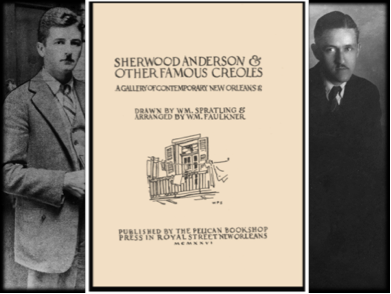
Auction Announcement: William Spratling and William Faulkner, Sherwood Anderson and Other Famous Creoles: A Gallery of Contemporary New Orleans

In American History, Arts & Letters, Books, History, Humanities, Literature, News and Current Events, News Release, Southern History, Southern Literary Review, The South, Writing on April 5, 2013 at 8:45 am

Famous Creoles

William Spratling and William Faulkner, Sherwood Anderson and Other Famous Creoles: A Gallery of Contemporary New Orleans, published by Pelican Bookshop Press, New Orleans, 1926, first edition, first issue, number 217 of 250, bound in green boards, with label on front cover, interior of back cover with a label printed “Rebound in L’ATELIER Le Loup” and dated in ink “1986”.

Provenance: From the collection of Stephanie Durant, by descent from the collection of Ray Samuel.

A special copy of a rare and fragile book described by The Booklover’s Guide to New Orleans as “one of the great literary curiosities in the city’s history.” The book comprises Spratling’s drawings of himself, Faulkner, and 41 of their acquaintances–artists, musicians, academics, preservationists, and socialites, “artful and crafty ones of French Quarter” with some of their uptown friends and patrons. One was novelist Sherwood Anderson, and Faulkner’s introduction parodies Anderson’s style.


The note above is taken from the catalog description of an extraordinary book that will be sold at auction on April 19.  The book has been given by Stephanie Durant of New Orleans to be sold for the benefit of the Ogden Museum of Southern Art, and the sale will be conducted by the New Orleans Auction Galleries, which will donate its commission to the museum as well.

This copy is uniquely valuable because it is signed by 41 of the 43 persons included,

in a few cases with personal notes to its original owner. (See below for a complete list.) That number of autographs is certainly a record: The only other copy I know with more than a dozen or so is one with 31, and it was stolen from a Charlottesville, Virginia, bookshop some time ago.

The catalog description is accurate as far as it goes, but there is a great deal more to be said about this odd little book, written by two young men who went on to become arguably the greatest American novelist and the greatest Mexican silver designer of the twentieth century.  Those depicted include both figures well-known at the time, like writer Grace King and artist Ellsworth Woodward, and some who would become well-known later, like artist Caroline Durieux and writer Hamilton Basso. The title, an obscure joke, refers to a book of caricatures entitled The Prince of Wales and Other Famous Americans, by Vanity Fair cartoonist Miguel Covarrubias (to whom Famous Creoles is dedicated). The “Pelican Bookshop Press” was a fiction: Spratling and Faulkner paid a local printer to produce 250 copies. Spratling (though, note, not Faulkner) signed and hand-tinted some images in 50, mostly for the friends who were included. There was a second printing of 150 copies, somewhat less valuable on the rare book market. The book was not at all sturdy, and it is not unusual to find copies that have been repaired or, like this one, rebound. Many copies have presumably fallen apart and been discarded. Musician Harold Levy’s hand-tinted copy was destroyed by Hurricane Katrina.

The original owner of this particular copy, Stella Lengsfield Lazard, signed her name in ink on inside front. In 1926 Mrs. Lazard was 43. Her husband, Henry Calme Lazard, was a stockbroker related by blood and marriage to several distinguished mercantile and financial families in New Orleans and elsewhere. The couple had one grown son, and lived with her parents uptown on St. Charles Avenue.  (Her father was a successful cotton factor.)

Mrs. Lazard had literary, historical, and musical interests.  In 1925 she wrote a series of feature articles for the Times-Picayune on the mayors of New Orleans, and a few years later she served as narrator for a weekly musical program on WDSU radio, “Sweet Mystery of the Air,” featuring a trio of local musicians: harpist, violinist, and tenor.  To judge by the inscriptions in her copy of Famous Creoles, she was friends with a number of those included.  For instance, one reads, “To Stella, the star, from the stellar Helen Pitkin Schertz”; Flo Field wrote “Love to my old staunch [?] friend”; and William “Cicero” Odiorne, who was in Paris, wrote “When are you coming over?”

Others who did more than simply sign their names include writers Sherwood Anderson and Roark Bradford; artists Conrad Albrizio, Marc Antony, and Virginia Parker Nagel; Tulane cheerleader Marian Draper; and Lillian Friend Marcus, managing editor of the Double Dealer magazine. The presidents of Tulane and of Le Petit Théatre, A. B. Dinwiddie and Mrs. J. O. Nixon, simply added their institutional affiliations.  Natalie Scott just signed the page with her picture on it, but a note in Mrs. Lazard’s hand identifies a building shown in the picture as the Court of Two Sisters (which Miss Scott owned).  One amusing addition: On an almost blank page Arthur Feitel, a 34-year-old bachelor architect, wrote “Me, too” and signed his name.  Feitel, whose picture was not included, was a Tulane graduate who had studied at the Ecole des Beaux Arts; he would later serve as president of both the Art Association of New Orleans and the board of the Delgado Museum.

Only two “Famous Creoles” did not sign Mrs. Lazard’s book. One is easily explained. By the time the book appeared Ronald Hargrave was pretty much incommunicado; he was painting in Majorca, and he never returned to New Orleans. But the other missing signature is that of William Faulkner. It seems to me that Mrs. Lazard went to a great deal of trouble to track down people to sign her book (William Odiorne signed it, and he was in Paris), so it is almost inconceivable that she didn’t ask Faulkner. He must have refused to sign, possibly just out of general cussedness — he was known for being moody and sometimes difficult, and he didn’t sign the 50 copies that Spratling hand-tinted either. In addition, however, Faulkner didn’t care for “artsy” uptown people he thought were dilettantes (unlike Spratling, who enjoyed their company), and he may have viewed Mrs. Lazard as one of them. Whatever the explanation, in some ways Faulkner’s absence may actually be more interesting than a perfunctory autograph would have been.

Mrs. Lazard’s copy was eventually acquired by Stephanie Durant’s father, J. Raymond Samuel, a well-known historian, collector and (in his retirement years) dealer in books and art. On his death the book passed to Mrs. Durant, who has now generously given it to benefit the Ogden Museum.


–John Shelton Reed, University of North Carolina at Chapel Hill,

Author of Dixie Bohemia: A French Quarter Circle in the 1920s


Inquiries about the auction should be directed to :


Jelena James

New Orleans Auction Galleries                                                        <jelena@neworleansauction.com>

801 Magazine Street                                                                          800-501-0277
New Orleans, Louisiana 70130                                                        504-566-1849


“Famous Creoles”

(with ages in 1926)

Signed Lazard copy

Conrad Albrizio, 27

New York-born, serious artist, Spratling’s neighbor, Arts and Crafts Club

stalwart

Sherwood Anderson, 50

“Lion of the Latin Quarter,” eminence gris, generous to respectful younger

writers

Marc Antony and Lucille Godchaux Antony, both 28

Love-match between heiress and lower-middle-class boy, local artists

Hamilton “Ham” Basso, 22

Star-struck recent Tulane grad, aspiring writer, good dancer

Charles “Uncle Charlie” Bein, 35

Director of Arts and Crafts Club’s art school; lived with mother, sister,

and aunt

Frans Blom, 33

Danish archeologist of Maya, Tulane professor, colorful resident of

Quarter

Roark Bradford, 30

Newspaperman, jokester, hit pay dirt with Negro dialect stories

Nathaniel Cortlandt Curtis, 45

Tulane architecture professor, preservationist, recorded old buildings

Albert Bledsoe Dinwiddie, 55

President of Tulane, Presbyterian

Marian Draper, 20

Ziegfeld Follies alum, Tulane cheerleader, prize-winning architecture

student

Caroline “Carrie” Wogan Durieux, 30

Genuine Creole, talented artist living in Cuba and Mexico, painted by Rivera

Flo Field, 50

French Quarter guide, ex-journalist, sometime playwright, single mother

Louis Andrews Fischer, 25

Gender-bending Mardi Gras designer, named for her father

Meigs O. Frost, 44

Reporter’s reporter; lived in Quarter; covered crime, revolutions, and arts

Samuel Louis “Sam” Gilmore, 27

Greenery-yallery poet and playwright, from prominent family

Moise Goldstein, 44

Versatile and successful architect, preservationist, active in Arts and

Crafts Club

Weeks Hall, 32

Master of and slave to Shadows-on-the-Teche plantation, painter, deeply

strange

R. Emmet Kennedy, 49

Working-class Irish boy, collected and performed Negro songs and stories

Grace King, 74

Grande dame of local color literature and no-fault history, salonnière

Alberta Kinsey, 51

Quaker spinster, Quarter pioneer, indefatigable painter of courtyards

Richard R. Kirk, 49

Tulane English professor and poet, loyal Michigan Wolverine alumnus

Oliver La Farge, 25

New England Brahmin, Tulane anthropologist and fiction-writer, liked

a party

Harold Levy, 32

Musician who ran family’s box factory, knew everybody, turned up

everywhere

Lillian Friend Marcus, 35

Young widow from wealthy family, angel and manager of Double Dealer

John “Jack” McClure, 33

Poet, newspaper columnist and reviewer, Double Dealer editor, bookshop

owner

Virginia Parker Nagle, 29

Promising artist, governor’s niece, Arts and Crafts Club teacher

Louise Jonas “Mother” Nixon, 70

A founder of Le Petit Theatre and its president-for-life, well-

connected widow

William C. “Cicero” Odiorne, 45

Louche photographer, Famous Creoles’ Paris contact

Frederick “Freddie” Oechsner, 24

Recent Tulane graduate, ambitious cub reporter, amateur actor

Genevieve “Jenny” Pitot, 25

Old-family Creole, classical pianist living in New York, party girl

Lyle Saxon, 35

Journalist, raconteur, bon vivant, host, preservationist, bachelor

Helen Pitkin Schertz, 56

Clubwoman, civic activist, French Quarter guide, writer, harpist

Natalie Scott, 36

Journalist, equestrian, real-estate investor, Junior Leaguer, social

organizer

William “Bill” Spratling, 25

Famous Creoles illustrator, Tulane teacher, lynchpin of Quarter

social life

Keith Temple, 27

Australian editorial cartoonist, artist, sometimes pretended to be

a bishop

Fanny Craig Ventadour, 29

Painter, Arts and Crafts Club regular, lately married and living in

France

Elizebeth Werlein, 39

Suffragette with colorful past, crusading preservationist,

businessman’s widow

Joseph Woodson “Pops” Whitesell, 50

Photographic jack-of-all-trades, French Quarter eccentric,

inventor

Daniel “Dan” Whitney, 32

Arts and Crafts Club teacher, married (two) students, beauty

pageant judge

Ellsworth Woodward, 65

Artistic elder statesman, old-fashioned founder of Newcomb art

department

Did not sign Lazard copy

William “Bill” Faulkner, 29

Needs no introduction, but wrote the one to Famous Creoles

Ronald Hargrave, 44

Painter from Illinois formerly active in Quarter art scene,

relocated to Majorca


From Dixie Bohemia: A French Quarter Circle in the 1920s,

© 2012, LSU Press.

Joyce Corrington Publishes the Work of Late Husband John William Corrington

In Arts & Letters, Books, Fiction, Humanities, John William Corrington, Joyce Corrington, Literature, Poetry, Southern History, Television Writing, The South, Writing on March 13, 2013 at 8:45 am

Joyce Corrington, pictured above, has made her late husband John William “Bill” Corrington’s book The Upper Hand available on Amazon as a Kindle e-book. Click here to view or purchase this book.

Even more important, she has collected John William Corrington’s poems into a book. Click here to view or purchase this book. This is the first publication of Corrington’s collected poems, and Joyce is delighted to make them available to the public and future scholars.

Joyce Corrington is a writer who, with her late husband John William “Bill” Corrington, wrote several films, including The Omega Man (1970), Box Car Bertha (1971), and The Battle for the Planet of the Apes (1973). Also with Bill Corrington, she co-authored four novels: So Small a Carnival (1986), A Project Named Desire (1987), A Civil Death (1987), and The White Zone (1990). She was head writer for such television series as Search for Tomorrow, Texas, General Hospital and Superior Court, and she has been a co-executive producer for MTV’s The Real World. She holds a Ph.D. from Tulane University. Her latest book, Fear of Dying, is available in both Kindle e-book and paperback format. Formerly a Malibu resident, she now resides in New Orleans.

To read more about John William Corrington, click here to read this profile.

Glory and Indignity

In America, American History, Arts & Letters, Book Reviews, Books, Conservatism, Historicism, History, Humanities, Politics, Southern History, The South on February 20, 2013 at 8:45 am

Allen Mendenhall

The following review first appeared here at The University Bookman.

John Randolph of Roanoke
by David Johnson.
Baton Rouge: Louisiana State University Press, 2012

“I am an aristocrat. I love liberty, I hate equality.” Thus spoke John Randolph of Roanoke (1773–1833), one of the most curious, animated figures ever to grace American soil. That David Johnson’s biography of Randolph is the first of its kind since Russell Kirk published John Randolph of Roanoke in 1951 suggests how deteriorated American memory and education have become. Randolph ought to be studied by all American schoolchildren, if not for his politics then for the vital role he played in shaping the nation’s polity. Dr. Kirk declared that in writing about Randolph, he was summoning him from the shades. If so, Johnson has gone a step farther and brought Randolph into the sunshine to reveal just how spectacular a man he really was.

Kirk’s biography of Randolph was in fact his first book. Kirk dubbed the colorful Virginian a “genius,” “the prophet of Southern nationalism,” and the “architect of Southern conservatism.” In The Conservative Mind, Kirk treats Randolph as a necessary link between George Mason and John C. Calhoun and proclaims that Randolph should be remembered for “the quality of his imagination.” Randolph enabled the proliferation and preservation of the conservative tradition in America. He became an icon for decentralization and localism.

Why would a scandalous, sickly, go-it-alone, riotous rabble-rouser appeal to the mild-mannered Dr. Kirk? The answer, in short, is that Randolph was as conservative a politician as America has ever produced, and he was, despite himself, a gentleman and a scholar. Eccentric though he appeared and often acted, Randolph celebrated and defended tradition, championed small government and agrarianism, sacrificed careerism and opportunism for unwavering standards, professed self-reliance and individualism, took pains to preserve the rights of the states against the federal government, delighted in aristocratic tastes and manners, read voraciously the great works of Western civilization, cultivated the image of a statesman even as he attended to the wants and needs of his yeomen constituents, discoursed on weighty topics with wit and vigor, and adhered to firm principles rather than to partisan pandering. Admired by many, friend to few, he made a prominent display of his wild personality and unconditional love for liberty, and he devoted himself, sometimes at great cost, to the ideals of the American Revolution, which had, he claimed, marked him since childhood.

Remembered chiefly (and, in the minds of some progressives, unfortunately) for his contributions to states’ rights doctrines and to the judicial hermeneutics of strict constructionism, Randolph was responsible for so much more. The son of a wealthy planter who died too young, Randolph became the stepson of St. George Tucker, a prominent lawyer who taught at the College of William and Mary and served as a judge on the Virginia General District Court and, eventually, on the Virginia Court of Appeals, the United States District Court for the District of Virginia, and the United States District Court for the Eastern District of Virginia. A cousin to Thomas Jefferson, Randolph studied under George Wythe and his cousin Edmond Randolph. A boy who was forced to flee his home from the army of Benedict Arnold, Randolph later played hooky from college to watch the orations of Fisher Ames, the stout Federalist from New York, and Madison. He served in the U.S. House of Representatives as well as the U.S. Senate, and was, for a brief time, Minister to Russia. A supporter of Jefferson before he became Jefferson’s tireless adversary, he criticized such individuals as Patrick Henry, Washington, Madison, Monroe, John Adams, Henry Clay, and Daniel Webster. He was sickened by the Yazoo Land Scandal, opposed the War of 1812 in addition to the Missouri Compromise, and promoted nullification.

Many conservatives, Kirk among them, have tended to overlook the more unpalatable aspects of Randolph’s life, whether personal or political. For instance, Randolph was, more than Jefferson, enthralled by the French Revolution and supportive of its cause. He manufactured a French accent, used a French calendar, and called his friends “Citizens.” In his twenties, he referred to himself as a deist “and by consequence an atheist,” and he acquired, in his own words, “a prejudice in favor of Mahomedanism,” going so far as to proclaim that he “rejoiced in all its [Islam’s] triumphs over the cross.” One might excuse these infelicities as symptoms of youthful indiscretion and impetuosity, but they do give one pause.

Not for lack of trying, Randolph could not grow a beard, and although he spoke well, his voice was, by most accounts, awkward, piping, off-putting, and high-pitched. His critics have painted him as a villain of the likes of Shakespeare’s Richard III: resentful, obstinate, loudmouthed, and as deformed in the mind as he was in the body. Yet Randolph cannot be made into a monster. More than others of his station in that time and place, Randolph was sensitive to the problems of slavery, which had only intensified rather than diminished since the Founding. He freed his slaves in his will, granted them landholdings in Ohio, and provided for their heirs. Slavery was incompatible with liberty, and Randolph, despite being a product of his time, appears to have worried much about the paradox of a nation conceived in liberty but protective of institutional bondage. Randolph asserted, in some way or another, over and over again, that his politics were based on a presumption of liberty, which was (and is) the opposite of slavery and governmental tyranny. Read the rest of this entry »