See Disclaimer Below.

Archive for the ‘Writing’ Category

Thoreau, Environmentalism, Economy

In America, American History, Arts & Letters, Books, History, Humanities, Literary Theory & Criticism, Literature, Nineteenth-Century America, Philosophy, Writing on May 22, 2013 at 8:45 am

Allen Mendenhall

This post first appeared here at The Literary Table in 2010.

Turning to the works of Henry David Thoreau might provide a “third way” and go some length toward resolving debates about the Environmentalists’ Dilemma.  I borrow the words “Environmentalists’ Dilemma” from Bryan G. Norton, who uses the phrase to refer to the competing discourses of two environmentalist camps: the economists and the moralists.  These camps would, Norton submits, provide very different answers to the question, “What is the value of biodiversity?”  Economists would emphasize “the actual and potential uses of living species” whereas the moralists “do not believe our obligations to protect nature can be traded off against other obligations” (Norton 29-30).  Economists would state the value of biodiversity in quantifiable, utilitarian, and anthropocentric terms whereas the moralists “insist that we have an obligation to protect all species, an obligation that transcends economic reasoning and trumps our mere interests in using nature for our own welfare” (Norton 30).  The dilemma for the environmentalist is which of the two realms, economic or moral, to heed.  Norton’s argument is that the two realms are not in fact mutually exclusive and that Henry David Thoreau supplies proof of their mutual reinforcement.  That Thoreau titles the opening chapter of Walden with one simple if unsuspecting word, “Economy,” is no coincidence.  The Environmentalists’ Dilemma, for Thoreau, is no dilemma at all: “most commentators have assumed that we should give one answer or the other,” but an absolute, totalizing separation is neither necessary nor accurate (Norton 31, my italics).  I agree with Norton and would like to extend his reasoning in this brief post, which draws its analysis from Thoreau’s Walden.

If economists first measure value “as contributions to human welfare” and then promise “an aggregation of values”—i.e., if they promise a calculation of “the contribution of nature to human welfare” as “commensurable and interchangeable with other human benefits”—then Thoreau was something of an economist (Norton 30).  As implied by the title of his opening chapter, Thoreau uses nature as an occasion to opine about human affairs, often in purely economic terms; he transforms the humble, small, and common scenes of nature into grand meditations about labor and profit.  “When my hoe tinkled against the stones,” he says of a day in the bean field, “that music echoed to the woods and the sky, and was an accompaniment to my labor which yielded an instant and immeasurable crop” (247).  Here, Thoreau’s profit—his “yield”—is not quantifiable in monetary terms but in vague moral insight:  “It was no longer beans that I hoed, nor I that hoed beans; and I remembered with as much pity as pride, if I remembered at all, my acquaintances who had gone to the city to attend the oratorios” (247).  Thoreau appreciates the value of labor (minimal physical input for cost-effective output—free food) while recognizing that such value goes far beyond the fiscal benefit of planting crops rather than purchasing food at a store: the labor becomes valuable for what it teaches about solitude, individualism, and freedom from materialism, and not just for its potential for monetary savings.  In this respect, Thoreau marries economics and morality.  Or, as Norton, looking elsewhere in Walden, puts it, “Thoreau describes the benefits of the transformation to higher values in terms of human maturation and fulfillment of potential, as improvements within human consciousness, not in terms of obligations to nature and extrinsic to human consciousness” (32).  In other words, in his celebration of nature, Thoreau takes pains to privilege human economy over natural aesthetic, although the former is dependent upon the latter for its “proceeds.”  Nature is a vehicle for arriving at virtue, thrift included.  It is good—and a good—but humanity is essentially of higher importance.

The merger, as it were, of economics and morality finds its most obvious expression in Thoreau’s various price listings: the costs of building a house; the profits turned from harvesting corn, potatoes, turnips, and beans; the expenses of food and clothing; and the overhead in maintaining a self-sufficient lifestyle.  Of these, John Updike writes,

The long opening chapter, “Economy,” joyously details just how to build a house […] down to a list of expenses totaling $28.11 1/2.  Briskly marketing to the world his program of austerity and self-reliance, he itemizes the few foodstuffs he paid for and the profits he obtained from his seven miles of bean rows.  (xiv, my italics)

Updike’s choice of the word “marketing” is important, revealing as it does that Thoreau’s economics did not stop at savings and cutbacks, but actively advertised a lifestyle at once economic and environmentalist.  Thoreau sold his routine and persona to a curious public, a few of whom bought—and bought into—the ultimately published and publicized form (the book).

On the one hand, Thoreau’s frugality is a lesson about simplicity and prudence; on the other hand, it offers a more environmentally friendly approach to architecture and construction while simultaneously warning about the destructive effects of what today we might call “the tragedy of commons.”  I have neither the time nor space to fully hash out my ideas about the tragedy of commons.  I will, however, quickly supply Steven C. Hackett’s definition for the term and then offer a short justification for my reference to it.  According to Hackett,

The tragedy of the commons is most likely to occur under the conditions of open-access or other poorly designed and enforced property rights regimes.  The tragedy of the commons outcome results from strategic behavior—behavior that an individual takes based on how other people are expected to behave and respond.  At the heart of the tragedy of commons is the belief that if one were to conserve the CPR, others will take what was conserved, and the CPR will degrade (116).

Thoreau’s worries about the tragedy of commons are evident in a few abrupt asides.  Take, for instance, these lines regarding hunting:

Almost every New England boy among my contemporaries shouldered a fowling piece between the ages of ten and fourteen; and his hunting and fishing grounds were not limited, like the preserves of an English nobleman, but were more boundless even that those of a savage.  No wonder, then, that he did not oftener stay to play on the common.  But already change is taking place, owing, not to an increased humanity, but to an increased scarcity of game, for perhaps the hunter is the greatest friend of the animals hunted, not excepting the Humane Society (329).

It seems abundantly clear that Thoreau refers here to the phenomenon—now known as the tragedy of commons—whereby people acting in their own self-interest use up a limited shared resource, in this case animal prey, despite their knowledge that doing so will be bad for everyone.  [Consider this point in light of another sentence by Thoreau: “By avarice and selfishness, and a groveling habit, from which none of us is free, of regarding the soil as property, or the means of acquiring property chiefly, the landscape is deformed, husbandry is degraded with us, and the farmer leads the meanest of lives” (257-58).]  Perhaps the tragedy of commons motivates Thoreau’s declaration that “if all men were to live as simply as I then did, thieving and robbery would be unknown” (269-70).  After all, thieving and robbery “take place only in communities where some have got more than is sufficient while others have not enough” (270).

Economics and morality also apply—albeit more tenuously—to what Michael Berger calls Thoreau’s “study of ecological dynamics in forests,” a “vigorous program of research” about seed dispersal and its spontaneous generation (381-82).  Although Berger does not explicitly say so, he implies that Thoreau’s scientific forays lend authority to his literary works.  This authority allows Thoreau to promote himself and his philosophical vision.  Berger analyzes Thoreau’s The Dispersion of Seeds, which was not published until 1993.  Nevertheless, Berger’s observations apply almost as aptly to various passages in Walden.  Setting out to show that Thoreau’s somewhat Darwinian ideas were not only sophisticated but also pioneering, Berger posits, “Thoreau’s seed dispersal ecology was […] rich in significance regarding the various kinds of complicated mechanisms, principles, and patterns by which species of plants succeed one another in local ecosystems” (382).  To substantiate this point, Berger quotes the following from The Dispersion of Seeds:

In this haphazard manner Nature surely creates you a forest at last, though as if it were the last thing she were thinking of.  By seemingly feeble and stealthy steps—by a geologic pace—she gets over the greatest distances and accomplishes her greatest results.  It is a vulgar prejudice that such forests are ‘spontaneously generated,’ but science knows that there has not been a sudden new creation in their case but a steady progress according to existing laws, that they came from seeds—that is, are the result of causes still in operation, though we may not be aware that they are operating. (383)

This passage recalls Thoreau’s claim in Walden that “where a forest was cut down last winter another is springing up by its shore as lustily as ever” (302).  Thoreau’s point, at any rate, is, in both cases, that forests (in all their various manifestations—trees, plants, etc.) will spring up as if on their own: independent of the botany or vegetation that preceded them.  In the “big picture,” the economics and morality at issue have to do with Thoreau’s ability to market himself and his ideas.  If he could pit himself as both scientist and writer, his writings would gain both cultural and actual currency as well as popular credibility.  This coupling of scientific sophistication with moral sensitivity produces, in Updike’s words, Thoreau’s thinginess: “the thinginess of Thoreau’s prose […] still excites us, the athleticism with which he springs from detail to detail, image to image, while still toting something of Transcendentalism’s metaphysical burden” (xxii).  Without science, Thoreau is little more than a gushing nature enthusiast; without science or the metaphysical burden, he “comes close to being merely an attentive and eloquent travel writer” (Updike xxii).  Fortunately, Thoreau recognizes the need to economize while moralizing, and to do the former well required a certain scientific literacy.  Norton is more generous than I because he casts Thoreau’s scientific observations about the forest as having nothing to do with self-promotion and everything to do with the Environmentalists’ Dilemma.  Thoreau’s self-promotion notwithstanding, Norton’s praise does tend to demonstrate the manner in which Thoreau yoked science to economics and morality:

Thoreau quite explicitly recognized that the forest, a dynamic system, had a ‘language of its own, and that the transition form the immature state was both literary and scientific. […]  He saw that one learns more important things by relating an organism to its environment than by dissecting an organism into parts.  This indicates that Thoreau was on the right track, seeking the secret of life and its organization in the larger systems in which species live.  Especially, he thought we learn more important things about human behavior, and the evaluation of it, by observing organisms in environments.  He believed that if he could unlock the code of nature’s language, it would provide the key to a new, dynamic and scientific understanding of nature.  The key prerequisite for this change to a more contemplative consciousness was development of a new ‘language’ of human values based on analogies from the ‘language’ of nature. (40)

If Norton is right, as I believe he is, then the Environmentalists’ Dilemma is not so paralyzing as some would suggest.  Indeed, Thoreau’s Walden shows how economy and morality can participate with each other in unique and even scientific ways.

For further reading, see the following:

Berger, Michael.  “Henry David Thoreau’s Science in the Dispersion of Seeds.”  Annals of Science.  Vol. 53 (1996:  381-397).

Hackett, Steven C.  Environmental and Natural Resources Economics:  Theory, Policy, and the Sustainable Society.  M.E. Sharpe, 2001.

Norton, Bryan G.  Searching for Sustainability:  Interdisciplinary Essays in Philosophy and Biology.  Cambridge University Press, 2003.

Thoreau, Henry David.  Walden.  Houghton Mifflin Company, 1893.

Updike, John.  “Introduction.”  Walden.  Princeton University Press, 2004.

Edgar Allan Poe and Mesmeric Possibility

In American History, Arts & Letters, Fiction, History, Humanities, Literary Theory & Criticism, Literature, Nineteenth-Century America, Writing on May 15, 2013 at 8:45 am

Allen Mendenhall

This piece first appeared here at The Literary Table in 2010.

Sidney E. Lind, writing in the 1940s, said of the “mesmeric lexica” of nineteenth-century America:  “It is safe to say that the terminology of mesmerism was bandied about in much the same manner as the language of psychoanalysis was to be eighty years later, and with, in all probability, as little real comprehension on the part of the public.”

Lind’s reference to psychoanalysis—signified, at that moment, by Austrian physicist Sigmund Freud—is particularly telling for 21st century audiences, who have witnessed an avalanche of criticism of psychoanalysis, a pseudoscience, according to the naysayers, the results of which are un-testable at best and bogus at worst.  Lind’s aim is not to destabilize the practices of psychoanalysis but to interrogate three short works by Edgar Allan Poe in which mesmerism features prominently:  “A Tale of the Ragged Mountains,” “Mesmeric Revelation,” and “The Facts in the Case of M. Valdemar.”  “These three stories,” Lind submits, “constitute a series within which the mesmeric experiment becomes more profound, irrespective of plausibility or implausibility, or of whether or not Poe in at least two of the three was hoaxing his readers.”

Lind’s point is well-taken.  In Poe’s day, the subject of mesmerism was “in the air” and therefore “it was logical that Poe, as a journalist sensitive to popular interest, should have exploited it.”  True, these three stories exhibit, often wryly, a profound familiarity with mesmeric techniques and influences.  But more is going on in them than Lind lets on.  Indeed, Lind goes to great lengths to contextualize these stories within scientific (or other) discourses on mesmerism in Poe’s era, but he overemphasizes their “unity,” “theme,” and “intention” (always mimetic) instead of their singular dialogic contribution.  That is to say, Lind treats the stories as “echoes” or “reiterations” of other thinkers rather than as unique theses in their own right.  For Lind, the stories are indebted to other sources because they derive their vocabularies and methods from these sources.  I would suggest that Poe’s stories are in conversation with various dissertations on mesmerism rather than mere signs of cherry-picking or copying.  Although Poe’s modus operandi or preferred genre is fiction, his supposedly plagiarized passages lend substance to the notion that he might actually have been dissertating on mesmerism, animal magnetism, or hypnosis.  The luxury of storytelling is that the storyteller can dismiss unverifiable data as hoaxes or products of imagination; nevertheless, the storyteller can at least hope to hit on something real, novel, or scientific.  Two examples, Jules Verne and H.G. Wells, writing well after Poe, conceived of technological advances—most notably space travel—long before such advances were practical.

Lind’s work, at any rate, is impressively researched, laying the foundation for future analyses of Poe and his infatuations with mesmerism.  But why does Lind downplay Poe’s role in developing pioneering work?  All arguments are indebted to previous arguments; indebtedness does not take away from the originality or force of their articulation or genre.

Unlike Lind, Matthew A. Taylor calls attention to the distinctiveness of Poe’s contributions to “mesmeric theory” (for want of a better phrase) and its progeny.  He locates Poe in contradistinction to Herbert Mayo:  “Unlike Mayo, […] Poe radically deviated from the utopian utilitarian, or benign notions of mesmerism at play in most contemporary discourses on the topic, picturing instead the unsettling implications for human ontology consequent upon the idea that persons are less sovereign entities than manipulatable effects of external powers.”  In short, Poe considered mesmerism a bad thing, or at least a dangerous thing that did not lead down a road to human improvement.  “Poe concluded,” Taylor opines, “that an all-encompassing cosmic energy inevitably troubles human-being by suspending the autonomy and interiority of individual humans; the disorientation of normal, corporeal functioning and the literal loss of self-possession attending mesmeric practice illustrated for Poe the fact that people are little more than occasions for the demonstration of an impersonal power.”  If Taylor is right, then Poe’s take on mesmerism is not only unique but also quite sophisticated; it demonstrates a full understanding of mesmeric theory while simultaneously rejecting that theory.  More to the point, if Taylor is right, then Poe’s take on mesmerism stands on its own and demands critical attention.  Unlike Lind, Taylor seems to acknowledge Poe’s special role in shaping mesmeric theory—or, more precisely, mesmeric counter-theory.  In fact, Taylor seems to think Poe’s ideas about mesmerism reflect an entire cosmology about human nature and the imperfectability of humankind.  This is a tall claim.  For present purposes, it shows that Poe might have been worried about more than entertaining readers with fanciful mind-candy.  He might have been positing a worldview that flew in the face of prevailing physics (that “perverse yet consistent calculus that unites everything in existence under a single, universal law that, by definition, eliminates all difference—including, of course, the human difference”).  Poe, the relativistic Renaissance man, might have been demonstrating his facility as both scientist and philosopher.  To further establish Poe’s uniqueness, I might add to Taylor’s observations the theological dimension of “Mesmeric Revelation,” which accounts for evangelical objections to mesmerism without plainly endorsing or rejecting them.

Besides the three stories that Lind interrogates, there are, Martin Willis claims, “many other tales that exemplify [Poe’s] abiding interest in the contestation between the science and the human, as well as his fascination with the borderlands of scientific achievement, both in terms of their advancement to new states of knowledge and their place within the scientific pantheon.”  Poe’s interest in scientific trends was not a passing one.  Willis points out that Poe spent years studying science in general before turning to mesmerism in particular.  Whether Poe “believed” in mesmerism is unclear.  It seems plausible that his stories about mesmerism were meant, in Willis’s words,  to “consider mesmeric debates in the realm of fiction rather than that of science.”  I would argue that Poe collapses any distinction between science and fiction by teasing out various theses—which, for all he knew, might one day be proven—through the medium of imaginary characters.  In doing so, Poe forges a distance between theories and their authors: if the theories turn out to be “true,” future generations will consider Poe a genius; if they turn out to be bogus, future generations will claim Poe was merely hoaxing.  Thus the dual-advantage of employing fiction to hash out scientific hypotheses.  Regardless of whether Poe is ultimately “right” about any of his dissertations, which he dresses up as fiction, he demonstrates an impressive breadth of knowledge that should not be ignored.

Not all scholars have ignored it.  Antoine Faivre takes pains to explain how Poe appropriated scientific knowledge and then inserted it into fictional narratives.  He suggests that many readers have mistaken or misread Poe’s tales as “factual, non-fictional case studies,” which in turn has led to a “flurry of reactions and debates.”  My point is not to argue that Poe treats his stories as factual case-studies but to suggest that he left open the case-study possibility.  In other words, Poe might have wanted readers to misread his tales as factual, or else to have some later scientist come along and verify the “truth” of his hypotheses, notwithstanding whether they were in fact his, or whether they were intended as reasoned argument at all.

Lind allows that Poe might not have been hoaxing readers in writing about mesmerism.  “Mesmerism as a theme for fiction,” he explains, “was, like metempsychosis and the exploration of the realm of the conscience, so well suited to Poe’s principles of literary composition that it was natural for him to work this new field, to attempt to achieve the sensational without deliberately attempting to mislead.”  More than simply avoiding misleading commentary, Poe might have been dissertating with the hopes that, one day, scientists would look on his fiction as a catalyst for new and innovative practices.  While not aspiring to complete verisimilitude, Poe’s stories about mesmerism are highly sophisticated tracts, informed by trendy scientific theories (and their counter-discourses), and very probably marked with the faint expectation that their subjects, though fictional, might somehow contribute to future systems of knowledge.

See the following for further reading:

Faivre, Antoine.  “Borrowings and Misreading:  Edgar Allan Poe’s ‘Mesmeric’ Tales and the Strange Case of their Reception.”  Aries, Vol. 7, No. 1 (2007: 21-62).

Lind, Sidney E.  “Poe and Mesmerism.”  PMLA, Vol. 62, No. 4 (1947:  1077-1094).

Torrey, E. Fuller.  Freudian Fraud:  The Malignant Effect of Freud’s Theory on American Thought and Culture. Lucas Publishers, 1999.

Taylor, Matthew A.  “Edgar Allan Poe’s (Meta)physics:  A Pre-History of the Post Human.”  Nineteenth-Century Literature, Vol. 62, No. 2 (2007: 193-221).

Willis, Martin.  Mesmerists, Monsters, and Machines:  Science Fiction and the Cultures of Science in the Nineteenth Century. Kent State University Press, 2006.

Sara Blair’s “Local Modernity, Global Modernism”

In Arts & Letters, Britain, British Literature, Fiction, History, Humanities, Literary Theory & Criticism, Literature, Novels, Writing on April 24, 2013 at 8:45 am

Allen Mendenhall

Sara Blair’s “Local Modernity, Global Modernism” describes the colorful landscape of the Bloomsbury district and proposes, among other things, that Bloomsbury the geographical space preceded Bloomsbury the movement; the site of Bloomsbury, reputedly “performative” or “kaleidoscopic,” provided the heterogeneous and cosmopolitan culture and influence necessary for the movement to flourish.

Blair admits that “[t]o insist that the sociality producing such definitive performances is itself located […] is not to resolve the question of the relations between literary modes and their geocultural contexts.” And yet she offers that such insistence “does help us think more imaginatively about how to frame such relations.” One might ask, then, what “imaginative” links could be made between the “modernist” attributes of Bloomsbury the place and, say, Virginia Woolf’s personal literary style.

“With rare exceptions, Woolf writes little about the texture of Bloomsbury […] spaces, institutions, and local histories,” submits Blair, adding that Woolf does in fact “richly register and exploit a larger fact of Bloomsbury already suggested in Black’s and Baedeker’s maps: its function not merely as a marginal space or a site of uneven alterities but simultaneously also as a lived form of […] the non-lieu, or non-place.” If the non-place is represented in Woolf’s work, and if the non-place is “a space of transition, anticipation, and fluid movement,” then we might view her novel Jacob’s Room as a series of transitional, liminal, or unfixed settings—as a sketchy composite of Jacob that is something like an impressionistic painting. This reading would be consistent with Blair’s idea that Bloomsbury functions “to organize psychic and social relations to other more immediately functional spaces.” If one were to read Jacob’s Room as a sequence of kaleidoscopic settings or spaces, organized chronologically but never quite fixed in place and time, then one might see something of the dislocating characteristics of Bloomsbury the place throughout the novel. It is in this context that one can claim Woolf’s style as itself a signifier of “Bloomsbury.” As Blair puts it, “Woolf’s own evocative narratology […] can be read as a response to both the ambient facts of Bloomsbury’s heterogeneity and its status as a non-place alike.”

Can we link the dreamlike fluidity of Jacob’s Room with the distinct fluidity of Bloomsbury culture as described by Blair. Should we even try? Blair seems to believe that we not only can, but should: “While a more systematic reading of the relations between Bloomsbury as a site of social experience and cultural generation and the work of ‘Bloomsbury,’ particularly Woolf’s, is called for, it remains beyond my scope here.” A good challenge for students is to consider how they can expand Blair’s scope and to debate whether they would be “overreading” Jacob’s Room (or any novel by Woolf and the Bloomsbury crowd) by trying to locate it in the larger modernist context of “Bloomsbury” (both the space and the movement).

See Sara Blair, “Local Modernity, Global Modernism.” ELH, Vol. 71, No. 3 (Fall 2004), pp. 813-838.

Allen Mendenhall Interviews Lauren Clark

In Arts & Letters, Fiction, Literature, Southern Literary Review, Writing on April 10, 2013 at 8:45 am

Lauren Clark

This interview originally appeared here at Southern Literary Review.

AM: Lauren, thank you for doing this interview. I’m glad to have the opportunity to ask you about Dancing Naked in Dixie. Before I get to the book, though, I’d like to ask you about your transition from television to writing. How did that transition take place?

LC: I loved working in TV news and it was great when my son was little. I worked for two different CBS stations — first anchoring the weekend news and then the morning news in Dothan, Alabama. The shift was 2 am to 10 am, so after three years, I needed a change and a regular schedule. I then took a job in pharmaceutical sales, but was able to transition into stay-at-home mom and full-time writer soon after. It’s what I’ve always wanted to do as a career.

AM: Okay, on to Dancing Naked in Dixie. The protagonist of the book is Julia Sullivan. Tell us about her. What was the impetus behind this character? Did you develop her in stages, or did you have some preconceived notion of her character that you wanted to realize in the text?

LC: Fortunately, Julia Sullivan came to the pages of Dixie almost fully formed. She is a well-traveled writer, perpetually busy, and married to her job — largely to avoid dealing with her mother’s death, her boyfriend, and a painful estrangement from her father. She’s talented, with personality — but definitely has an ADHD side that gets her into some trouble when she acts before she thinks.

There’s a lot of me in Julia — especially since I made the move from New York to Alabama twelve years ago. Many of her experiences (sweet tea, fire ants) are based on my experiences.

Julia was developed with change in mind. I wanted her out of her comfort zone, in a totally new environment that she’d decided to dislike. Much of Dixie involves Julia discovering secrets about her parents’ relationship and realizing that forgiveness isn’t as frightening as she believes.

AM: Within the last month, I’ve become an Alabamian, and I grew up taking family vacations to Destin, Florida, by way of Eufaula, Alabama, so I’m interested in the role that Eufaula plays in Dancing Naked in Dixie. Why Eufaula? What made you choose this city?

LC: Eufaula is my favorite Alabama city. When I was an anchor at WTVY in Dothan, I loved driving up on the weekends and having a light lunch, stopping at Shorter Mansion, and browsing in the lovely gift shops. Lake Eufaula is nearby, and on my trips to Atlanta, I would often stop at the state park to take in the beautiful, calming scenery.

I’ve attended the Pilgrimage several times, but it was during one of the candlelight tours, with everyone in antebellum costume, that I decided Eufaula provided that bit of magic that would make it the perfect setting for a story.

AM: Julia is, you could say, a cosmopolitan jetsetter who, due to events largely out of her control, finds herself living and working in Alabama. Do you think the South is indispensable to your writing? In other words, could the narrative in Dancing Naked in Dixie have transpired in some other geographical area? If not, why not?

LC: The South is indispensable to Dixie, and all of my books, to some extent, have Southern ties. Julia’s story — her cosmopolitan edge and big city sharpness — had to be balanced out with the warm and loving nature of the Deep South. It became the perfect balance to round out her empty life, the yin to her yang.

I am sure that many talented writers could place the story with a “Julia” character traveling from the majestic Pacific Northwest to the warmth of New Mexico or Arizona, but I prefer to write from experience and draw on the sights and sounds that I know and love. For me, there’s a certain charm about the Deep South that can’t be duplicated.

AM: Where would you direct our readers to learn more about you and your work?

LC: I really appreciate my readers so much and love to hear from anyone who’s read my work. I welcome emails at laurenclarkbooks@gmail.com. I’m also on Goodreads (GoodReads), Facebook (Lauren Facebook) and Twitter (LaurenClark_Bks).

You can also find more information about my latest release Stardust Summer (February 14, 2013), on my website (Lauren Clark Books) and blog (Lauren Clark Blog).

Dixie on Amazon in paperback, ebook, or audiobook: Click here.

Dixie on BN.com: Click here.

AM: Thank you for taking the time, Lauren. I wish you all the best.

LC: Thank you.

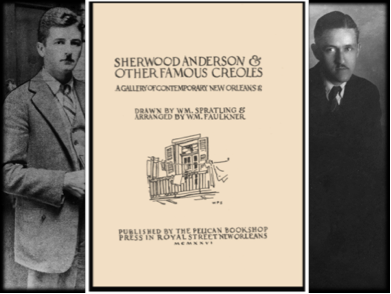
Auction Announcement: William Spratling and William Faulkner, Sherwood Anderson and Other Famous Creoles: A Gallery of Contemporary New Orleans

In American History, Arts & Letters, Books, History, Humanities, Literature, News and Current Events, News Release, Southern History, Southern Literary Review, The South, Writing on April 5, 2013 at 8:45 am

Famous Creoles

William Spratling and William Faulkner, Sherwood Anderson and Other Famous Creoles: A Gallery of Contemporary New Orleans, published by Pelican Bookshop Press, New Orleans, 1926, first edition, first issue, number 217 of 250, bound in green boards, with label on front cover, interior of back cover with a label printed “Rebound in L’ATELIER Le Loup” and dated in ink “1986”.

Provenance: From the collection of Stephanie Durant, by descent from the collection of Ray Samuel.

A special copy of a rare and fragile book described by The Booklover’s Guide to New Orleans as “one of the great literary curiosities in the city’s history.” The book comprises Spratling’s drawings of himself, Faulkner, and 41 of their acquaintances–artists, musicians, academics, preservationists, and socialites, “artful and crafty ones of French Quarter” with some of their uptown friends and patrons. One was novelist Sherwood Anderson, and Faulkner’s introduction parodies Anderson’s style.


The note above is taken from the catalog description of an extraordinary book that will be sold at auction on April 19.  The book has been given by Stephanie Durant of New Orleans to be sold for the benefit of the Ogden Museum of Southern Art, and the sale will be conducted by the New Orleans Auction Galleries, which will donate its commission to the museum as well.

This copy is uniquely valuable because it is signed by 41 of the 43 persons included,

in a few cases with personal notes to its original owner. (See below for a complete list.) That number of autographs is certainly a record: The only other copy I know with more than a dozen or so is one with 31, and it was stolen from a Charlottesville, Virginia, bookshop some time ago.

The catalog description is accurate as far as it goes, but there is a great deal more to be said about this odd little book, written by two young men who went on to become arguably the greatest American novelist and the greatest Mexican silver designer of the twentieth century.  Those depicted include both figures well-known at the time, like writer Grace King and artist Ellsworth Woodward, and some who would become well-known later, like artist Caroline Durieux and writer Hamilton Basso. The title, an obscure joke, refers to a book of caricatures entitled The Prince of Wales and Other Famous Americans, by Vanity Fair cartoonist Miguel Covarrubias (to whom Famous Creoles is dedicated). The “Pelican Bookshop Press” was a fiction: Spratling and Faulkner paid a local printer to produce 250 copies. Spratling (though, note, not Faulkner) signed and hand-tinted some images in 50, mostly for the friends who were included. There was a second printing of 150 copies, somewhat less valuable on the rare book market. The book was not at all sturdy, and it is not unusual to find copies that have been repaired or, like this one, rebound. Many copies have presumably fallen apart and been discarded. Musician Harold Levy’s hand-tinted copy was destroyed by Hurricane Katrina.

The original owner of this particular copy, Stella Lengsfield Lazard, signed her name in ink on inside front. In 1926 Mrs. Lazard was 43. Her husband, Henry Calme Lazard, was a stockbroker related by blood and marriage to several distinguished mercantile and financial families in New Orleans and elsewhere. The couple had one grown son, and lived with her parents uptown on St. Charles Avenue.  (Her father was a successful cotton factor.)

Mrs. Lazard had literary, historical, and musical interests.  In 1925 she wrote a series of feature articles for the Times-Picayune on the mayors of New Orleans, and a few years later she served as narrator for a weekly musical program on WDSU radio, “Sweet Mystery of the Air,” featuring a trio of local musicians: harpist, violinist, and tenor.  To judge by the inscriptions in her copy of Famous Creoles, she was friends with a number of those included.  For instance, one reads, “To Stella, the star, from the stellar Helen Pitkin Schertz”; Flo Field wrote “Love to my old staunch [?] friend”; and William “Cicero” Odiorne, who was in Paris, wrote “When are you coming over?”

Others who did more than simply sign their names include writers Sherwood Anderson and Roark Bradford; artists Conrad Albrizio, Marc Antony, and Virginia Parker Nagel; Tulane cheerleader Marian Draper; and Lillian Friend Marcus, managing editor of the Double Dealer magazine. The presidents of Tulane and of Le Petit Théatre, A. B. Dinwiddie and Mrs. J. O. Nixon, simply added their institutional affiliations.  Natalie Scott just signed the page with her picture on it, but a note in Mrs. Lazard’s hand identifies a building shown in the picture as the Court of Two Sisters (which Miss Scott owned).  One amusing addition: On an almost blank page Arthur Feitel, a 34-year-old bachelor architect, wrote “Me, too” and signed his name.  Feitel, whose picture was not included, was a Tulane graduate who had studied at the Ecole des Beaux Arts; he would later serve as president of both the Art Association of New Orleans and the board of the Delgado Museum.

Only two “Famous Creoles” did not sign Mrs. Lazard’s book. One is easily explained. By the time the book appeared Ronald Hargrave was pretty much incommunicado; he was painting in Majorca, and he never returned to New Orleans. But the other missing signature is that of William Faulkner. It seems to me that Mrs. Lazard went to a great deal of trouble to track down people to sign her book (William Odiorne signed it, and he was in Paris), so it is almost inconceivable that she didn’t ask Faulkner. He must have refused to sign, possibly just out of general cussedness — he was known for being moody and sometimes difficult, and he didn’t sign the 50 copies that Spratling hand-tinted either. In addition, however, Faulkner didn’t care for “artsy” uptown people he thought were dilettantes (unlike Spratling, who enjoyed their company), and he may have viewed Mrs. Lazard as one of them. Whatever the explanation, in some ways Faulkner’s absence may actually be more interesting than a perfunctory autograph would have been.

Mrs. Lazard’s copy was eventually acquired by Stephanie Durant’s father, J. Raymond Samuel, a well-known historian, collector and (in his retirement years) dealer in books and art. On his death the book passed to Mrs. Durant, who has now generously given it to benefit the Ogden Museum.


–John Shelton Reed, University of North Carolina at Chapel Hill,

Author of Dixie Bohemia: A French Quarter Circle in the 1920s


Inquiries about the auction should be directed to :


Jelena James

New Orleans Auction Galleries                                                        <jelena@neworleansauction.com>

801 Magazine Street                                                                          800-501-0277
New Orleans, Louisiana 70130                                                        504-566-1849


“Famous Creoles”

(with ages in 1926)

Signed Lazard copy

Conrad Albrizio, 27

New York-born, serious artist, Spratling’s neighbor, Arts and Crafts Club

stalwart

Sherwood Anderson, 50

“Lion of the Latin Quarter,” eminence gris, generous to respectful younger

writers

Marc Antony and Lucille Godchaux Antony, both 28

Love-match between heiress and lower-middle-class boy, local artists

Hamilton “Ham” Basso, 22

Star-struck recent Tulane grad, aspiring writer, good dancer

Charles “Uncle Charlie” Bein, 35

Director of Arts and Crafts Club’s art school; lived with mother, sister,

and aunt

Frans Blom, 33

Danish archeologist of Maya, Tulane professor, colorful resident of

Quarter

Roark Bradford, 30

Newspaperman, jokester, hit pay dirt with Negro dialect stories

Nathaniel Cortlandt Curtis, 45

Tulane architecture professor, preservationist, recorded old buildings

Albert Bledsoe Dinwiddie, 55

President of Tulane, Presbyterian

Marian Draper, 20

Ziegfeld Follies alum, Tulane cheerleader, prize-winning architecture

student

Caroline “Carrie” Wogan Durieux, 30

Genuine Creole, talented artist living in Cuba and Mexico, painted by Rivera

Flo Field, 50

French Quarter guide, ex-journalist, sometime playwright, single mother

Louis Andrews Fischer, 25

Gender-bending Mardi Gras designer, named for her father

Meigs O. Frost, 44

Reporter’s reporter; lived in Quarter; covered crime, revolutions, and arts

Samuel Louis “Sam” Gilmore, 27

Greenery-yallery poet and playwright, from prominent family

Moise Goldstein, 44

Versatile and successful architect, preservationist, active in Arts and

Crafts Club

Weeks Hall, 32

Master of and slave to Shadows-on-the-Teche plantation, painter, deeply

strange

R. Emmet Kennedy, 49

Working-class Irish boy, collected and performed Negro songs and stories

Grace King, 74

Grande dame of local color literature and no-fault history, salonnière

Alberta Kinsey, 51

Quaker spinster, Quarter pioneer, indefatigable painter of courtyards

Richard R. Kirk, 49

Tulane English professor and poet, loyal Michigan Wolverine alumnus

Oliver La Farge, 25

New England Brahmin, Tulane anthropologist and fiction-writer, liked

a party

Harold Levy, 32

Musician who ran family’s box factory, knew everybody, turned up

everywhere

Lillian Friend Marcus, 35

Young widow from wealthy family, angel and manager of Double Dealer

John “Jack” McClure, 33

Poet, newspaper columnist and reviewer, Double Dealer editor, bookshop

owner

Virginia Parker Nagle, 29

Promising artist, governor’s niece, Arts and Crafts Club teacher

Louise Jonas “Mother” Nixon, 70

A founder of Le Petit Theatre and its president-for-life, well-

connected widow

William C. “Cicero” Odiorne, 45

Louche photographer, Famous Creoles’ Paris contact

Frederick “Freddie” Oechsner, 24

Recent Tulane graduate, ambitious cub reporter, amateur actor

Genevieve “Jenny” Pitot, 25

Old-family Creole, classical pianist living in New York, party girl

Lyle Saxon, 35

Journalist, raconteur, bon vivant, host, preservationist, bachelor

Helen Pitkin Schertz, 56

Clubwoman, civic activist, French Quarter guide, writer, harpist

Natalie Scott, 36

Journalist, equestrian, real-estate investor, Junior Leaguer, social

organizer

William “Bill” Spratling, 25

Famous Creoles illustrator, Tulane teacher, lynchpin of Quarter

social life

Keith Temple, 27

Australian editorial cartoonist, artist, sometimes pretended to be

a bishop

Fanny Craig Ventadour, 29

Painter, Arts and Crafts Club regular, lately married and living in

France

Elizebeth Werlein, 39

Suffragette with colorful past, crusading preservationist,

businessman’s widow

Joseph Woodson “Pops” Whitesell, 50

Photographic jack-of-all-trades, French Quarter eccentric,

inventor

Daniel “Dan” Whitney, 32

Arts and Crafts Club teacher, married (two) students, beauty

pageant judge

Ellsworth Woodward, 65

Artistic elder statesman, old-fashioned founder of Newcomb art

department

Did not sign Lazard copy

William “Bill” Faulkner, 29

Needs no introduction, but wrote the one to Famous Creoles

Ronald Hargrave, 44

Painter from Illinois formerly active in Quarter art scene,

relocated to Majorca


From Dixie Bohemia: A French Quarter Circle in the 1920s,

© 2012, LSU Press.

To Educate in the Permanent Things

In Arts & Letters, Books, Essays, Fiction, History, Humanities, Literary Theory & Criticism, Literature, Politics, Walt Whitman, Western Philosophy, Writing on March 20, 2013 at 8:18 am

Allen Mendenhall

This article originally appeared here in The American Spectator.

In his State of the Union address last month, President Obama proposed changes to preschool, high school, and college education, respectively. His proposals generated praise and condemnation from the predictable cheerleaders and naysayers. Some celebrated his efforts to expand early childhood education; others suggested that he should have focused more on the student loan crisis; still others, not to be outdone, pointed to school funding, teacher salaries, grading, standardized testing, technology, and foreign study as the pressing issues that he neglected to address with sufficient detail.

Everyone, it seems, has an opinion about how to improve American education from the top down. But positive change rarely happens through centralized design; it arises spontaneously through the interaction of human agents operating within and among social groups. The State cannot plan and then promulgate a proper education, and legislative enactments cannot reflect the mores and traditions of local groups with differing standards and expectations. The most prudent and humble proposals for improving education are not couched in statist, Platonic terms about civic education and human perfection; instead, they approach learning modestly, on the individual level. They entail the everyday interactions between teachers and students. They are not stamped with the approval of politicians, unions, think tanks, or interest groups.  They take place in the classroom, not the public square. A teacher anywhere, whatever his station, school, or background, can implement them in his course without disrupting the pace or provoking the ire of the educational establishment. The best of these, because it is so easily executed, is simply to teach what T.S. Eliot, and Russell Kirk after him, called “permanent things.”

The permanent things are the inherited principles, mores, customs, and traditions that sustain humane thinking and preserve civilized existence for future generations; their canonization in literary, philosophical, religious, and historical texts happened and is happening in slow degrees. We can trace the permanent things through curricula that emphasize the ultimate values of prosperous societies. An informed, laborious study of the perennial themes and archetypal patterns in what are variously denominated as the Great Works, the Western Canon, or the Classics can help us to organize and make sense of the permanent things. There are those who would object that this approach seems too hopeful and ideal. But no one has suggested it as a panacea, of which there are none, and anyway, is there a proposal that could be simpler, more straightforward, and more workable than assigning and discussing the Great Works?

As early as 1948, Eliot remarked that “there is no doubt that in our headlong rush to educate everybody, we are lowering our standards, and more and more abandoning the study of those subjects by which the essentials of our culture—of that part of it which is transmittable by education—are transmitted; destroying our ancient edifices to make ready the ground upon which the barbarian nomads of the future will encamp in their mechanized caravans.” It might be asked just who these barbarian nomads are and why we ought not to welcome their cultural practices and assumptions. The barbarian nomads could be, I think, any group lacking in historical perspective and mostly ignorant of the illuminating continuities that have guided our weightiest and most imaginative thinkers. The practices and assumptions of these nomads are not grounded in lived experience but aimed at utopian projects such as ensuring equality, creating fundamental rights, or eliminating poverty, and, to the extent that these practices and assumptions deviate from enduring norms, they cannot be said to have flourished ever.

To study the permanent things, on the other hand, is to consider the prevailing and profound ideas from certain times and schools in relation to other such ideas from various times and schools throughout successive eras. It is to map the course of perennial ideas to examine how they apply to different settings and generations. It is both sequential and diachronic in its approach. Its chief benefit is to put ideas into context, which is to say that it is to make us aware of our own presuppositions and perspectives that necessarily arise from our social, cultural, and historical situation.  Each thinker lives in his own specific era and place and cannot gain knowledge in a vacuum outside of time; our era and place shape the manner in which we think and restrict our ability to imagine conditions beyond our immediate and tangible experience.

This is not to submit that our ideas are determined for us, only that we enter into experience with certain perceptions that we have no control over. They are there because of the conditions present at the time and space in which we exist.  A sustained study of the permanent things will show us that our perceptions are not totally alien from those of our predecessors, although the respective perceptions are different. It also teaches us to compensate for our prejudices and to avoid thinking that our necessarily limited perspectives are unconditionally true and universally acceptable, even if they have verifiable antecedents. It reveals, as well, that schools of thought cannot simply be deemed later versions of earlier schools just because the two are in agreement about certain points. Finally, although we cannot escape those presuppositions that are embedded in our thought and culture, being alert to their probable existence can counteract their possible effect.

A rigorous study of the permanent things provides a lodestar for evaluating particular ideas against that which has been tested and tried before. Ideas that seem new always have traceable antecedents, and individuals equipped with a fundamental knowledge of the permanent things are able to situate purportedly novel ideas alongside their forerunners. These individuals recognize that change is not always progress; sometimes it is decline, deterioration, or decay. Only a sense of the continuities of history and thought can demonstrate the difference. Our political pedants in general and President Obama in particular insist on recognizing and implementing new institutions as if a radical departure from historic standards and established customs is itself the mark of good and lasting policy. Yet the permanent things show that even the most exceptional thinkers, those who represent the spirit of their age, whatever that might have been or might be, are part of a greater tradition.

It may be true that to study a particular thinker’s cultural milieu and biography is requisite to placing his ideas into their proper context and to highlighting the unacceptable premises of his philosophy; nevertheless, cautious interpreters ought to consider whether his thoughts necessarily lead to certain consequences, or whether the events that seem related to his thoughts arose accidentally, apart from his philosophy. Put another way, the cautious interpreter must carefully consider causation: whether theories actually generate particular circumstances, or whether those circumstances would have come to pass regardless of what the thinker spoke or wrote. Mussolini, for instance, praised William James, but it does not follow that anything James said or wrote endorses or enables fascism. He who would suggest otherwise betrays an ignorance of James’s work. The permanent things can help us to distinguish the true forms and implications of an individual’s thought from their appropriations by hostile forces.

By studying the permanent things, moreover, we learn that we cannot achieve the proper education through mere funding; nor does the solution to schooling gridlock and setbacks come from student aid, dress codes, student evaluations, tuition, or whatever. These issues begin to seem fleeting and trivial to one with an historical sense. They are at most temporary struggles, and although they are important, as all struggles are important, we are not to subordinate liberal learning to them. The best way to achieve the liberal learning necessary to make important and meaningful distinctions about our complex world is, as I have suggested and as it bears repeating, through a holistic, painstaking exploration of the permanent things. This means not only reading the Great Works for their content, but analyzing them in light of their place in history.

The beauty of this approach is that anyone can carry it out; the wisdom of it lies in its civilizing effects. Whether one is a homeschooling parent, a public school teacher, the leader of a local book club, or simply a curious-minded autodidact, the permanent things are available to him in texts, waiting to be sifted through and analyzed. It is true that there is disagreement as to what constitutes a Great Work and by what criteria, but it does not take more than research and commonsense empiricism to discern which pre-twentieth century texts have withstood the test of time. Teaching the permanent things does not require a large-scale, bureaucratic, administrative overhaul. It does not demand central planning or the implementation of mass, curricular programs; it can be accomplished through decentralized networks of concerned individuals. If parents would teach their children, friends their friends, colleagues their colleagues, and so on, we would in the aggregate become a more literate, astute, and informed society. And as our politicians lecture us about our duties even as they demand our money, we can take comfort in the proverb that these things too shall pass.

Joyce Corrington Publishes the Work of Late Husband John William Corrington

In Arts & Letters, Books, Fiction, Humanities, John William Corrington, Joyce Corrington, Literature, Poetry, Southern History, Television Writing, The South, Writing on March 13, 2013 at 8:45 am

Joyce Corrington, pictured above, has made her late husband John William “Bill” Corrington’s book The Upper Hand available on Amazon as a Kindle e-book. Click here to view or purchase this book.

Even more important, she has collected John William Corrington’s poems into a book. Click here to view or purchase this book. This is the first publication of Corrington’s collected poems, and Joyce is delighted to make them available to the public and future scholars.

Joyce Corrington is a writer who, with her late husband John William “Bill” Corrington, wrote several films, including The Omega Man (1970), Box Car Bertha (1971), and The Battle for the Planet of the Apes (1973). Also with Bill Corrington, she co-authored four novels: So Small a Carnival (1986), A Project Named Desire (1987), A Civil Death (1987), and The White Zone (1990). She was head writer for such television series as Search for Tomorrow, Texas, General Hospital and Superior Court, and she has been a co-executive producer for MTV’s The Real World. She holds a Ph.D. from Tulane University. Her latest book, Fear of Dying, is available in both Kindle e-book and paperback format. Formerly a Malibu resident, she now resides in New Orleans.

To read more about John William Corrington, click here to read this profile.

My Reading List for 2013

In Arts & Letters, Books, Creativity, Fiction, History, Humanities, Law, Literature, Novels, Philosophy, Politics, Western Civilization, Western Philosophy, Writing on December 12, 2012 at 8:45 am

Allen Mendenhall

Editorial Note (April 15, 2013):  At this point in the year, I have already discovered flaws in this list. For instance, I gave myself two weeks to read Augustine’s Confessions and one week to read Aquinas’s Summa Theologica.  I should have done the reverse.  Summa Theologica may have required more than two weeks to read, since I found myself rushing through it, and it is not a book through which one should rush.  My schedule has forced me to speed read some texts in order to avoid taking shortcuts.  Some of the texts on this list will therefore appear on my list for next year, so that they get the treatment and consideration they deserve.

2013 will be a good year for reading.  I’ve made a list of the books I’m going to undertake, and I hope you’ll consider reading along with me.  As you can see, I’ll be enjoying many canonical works of Western Civilization.  Some I’ve read before; some I haven’t.  My goal is to reacquaint myself with the great works I fell in love with years ago and to read some of the great works that I’ve always wanted to read but haven’t.  I wouldn’t go so far as to say that everybody ought to read these works, but I do think that by reading them, a person will gain a fundamental understanding of the essential questions and problems that have faced humans for generations.

Some works are conspicuous in their absence; the list betrays my preferences.  Notably missing are the works of Shakespeare and the canonical texts that make up the Old and New Testament.  There’s a reason for that.  I’ve developed a morning habit of reading the scriptures as well as Shakespeare before I go to work.  If I’m reading these already, there’s no need to add them to the list, which is designed to establish a healthy routine.  What’s more, the list comes with tight deadlines, and I’m inclined to relish rather than rush through the Bible or Shakespeare.

Lists provide order and clarity; we make them to reduce options or enumerate measurable, targeted goals.  Lists rescue us from what has been called the “tyranny of choice.”  Benjamin Franklin made a list of the 13 virtues he wished to live by.  What motivated him is perhaps what’s motivating me: a sense of purpose and direction and edification.

At first I wanted to assign myself a book a week, but realizing that some works are longer or more challenging than others, that as a matter of obligation I will have other books to read and review, that I have a doctoral dissertation to write, that the legal profession is time consuming, and that unforeseen circumstances could arise, I decided that I might need more time than a week per book depending on the complexity of the particular selection or the busyness of the season.  Although I hope to stick to schedule, I own that I might have to permit myself flexibility.  We’ll see.

For variety—and respite—I have chosen to alternate between a pre-20th century text and a 20th century text.  In other words, one week I might read Milton, the next Heidegger.  For the pre-20th century texts, I will advance more or less chronologically; there is no method or sequence for the 20th century texts, which I listed as they came to mind (“oh, I’ve always wanted to read more Oakeshott—I should add him.  And isn’t my knowledge of Proust severely limited?—I’ll add him as well.”).  It’s too early to say what lasting and significant effects these latter texts will have, so I hesitate to number them among the demonstrably great pre-20th century texts, but a general consensus has, I think, established these 20th century texts as at least among the candidates for canonicity.

I have dated some of the texts in the list below.  Not all dates are known with certainty, by me or anyone else.  Some texts were revised multiple times after their initial publication; others were written in installments.  Therefore, I have noted the time span for those works produced over the course of many years.

One would be justified in wondering why I’ve selected these texts over others.  The answer, I suppose, pertains to something Harold Bloom once said: that there are many books but only one lifetime, so why not read the best and most enduring?  I paraphrase because I can’t remember precisely what he said or where he said it, but the point is clear enough: read the most important books before you run out of time.

Making this list, I learned that one can read only so many great works by picking them off one week at a time.  The initial disheartenment I felt at this realization quickly gave way to motivation: if I want to understand the human condition as the most talented and creative of our predecessors understood it, I will have to make a new list every year, and I will have to squeeze in time for additional texts whenever possible.  I am shocked at the number of books that I wanted to include in this list, but that didn’t make it in.  I ran out of weeks.  What a shame.

Here is my list.  I hope you enjoy. Read the rest of this entry »

Communitas

In Arts & Letters, Creative Writing, Short Story, Writing on November 29, 2012 at 8:45 am

The following short story first appeared here in Full of Crow.

The man awoke to the chirping of a bird.  He lay listening in his bed for some time before rising, stretching, and gaining the window.  He looked outside.  The sun had risen; off-white clouds unrolled like scrolls across the horizon; wet grass and tall pines punctuated the land below.  Sometimes the man looked out and read the words of the world; sometimes he looked out and read nothing because the world seemed unwritten.  “Not for nothing,” he said to himself.  “Not for nothing.”

Sometimes he would see her standing in the yard, working in the garden, pretty as a sunflower.  Sometimes he forgot her.  She was never there in any case.

The woman was, in her youth, symmetric and vaguely beautiful, like a poem: full of marks and scribbles working in concert, taking on meaning.  In recent years she had become, despite herself, an aging monument to womanhood whose rough topography of face showed traces, however faint, of vigor.  She had been gone five years, but he thought about her, and about her cool, liquid eyes, on many mornings, especially on the cool mornings when the steady, westward breezes tussled his hair and smelled, to him, like memory; the pain of her leaving was stronger in the mornings than in the afternoons or nights.  The earth, the soil, the animals: all were alive, shamelessly, recklessly, gloriously alive then.  The stirring of birds and squirrels and the retreat of nighttime critters—raccoons, owls, opossums—inscribed the world with syllables and notes, sang the world to the world, perhaps even to the universe.  Something happened in the mornings, something tremendous: the soul, his soul, like leaking ink, bled into the world, stained the world, and he, the man, became an artist, and joined the growing chorus of life.

But the man was not happy.  He no longer understood happiness because he could not read it.

This morning was different.  He wondered whether it was the music, the tune, the tone.   Standing before the window, he closed his eyes and listened to the world and turned his head toward the source of the sounds and then opened his eyes.

There it was.

A redbird.

He stared at the redbird, a stranger to him.  He knew the daily visitors to his feeders and birdbaths, knew them as one knows the contours of his hand: mostly bluebirds and robins, but occasionally finches and sparrows.  The redbird, though, was new; its music moved him, drew him out of himself.

The redbird perched on a limb on the old maple tree and turned its beak to the sky, its crimson crest and round black mask both brilliant and threatening.  Its little button-eyes were barely visible beneath the mask, but the man thought he saw the redbird looking back at him.  He smiled and waved.  The redbird bobbed in acknowledgment and then flew off.

The man grew sad.

He gazed as far as he could into the distance: at the brooks and streams meandering down the mountain and terminating into the various fishponds that dimpled the Okmulgee valley.  He could just make out the images of trees covering the foothills; yet when he had stood here as a boy, he could see everything, even the neighboring village, south of the mountain.  How strange, he thought, that the body grows old.

The man placed his hand before his face and wiggled his wrinkled fingers.  He smiled knowing that he controlled these appendages even if they weren’t strong or nimble, even if they wouldn’t touch the woman again.  Then he frowned because the fingers, crusty and bent, seemed separate from him—as if they belonged to a force even greater: God maybe.

It was Monday.  The boy would come today.

He was kind, this boy: a hard worker.  He showed up on time every Monday and Wednesday to till the land, chop the wood, feed the cows, water the plants.  He had been at this routine for two years.

When the boy came, the man was happy. Read the rest of this entry »

Of Bees and Boys

In Arts & Letters, Creative Writing, Essays, Writing on November 14, 2012 at 8:45 am

Allen Mendenhall

The following essay appeared here in Front Porch Republic.

My brother Brett and I were polite but rambunctious children who made a game of killing bees and dumping their carcasses into buckets of rainwater.  Having heard that bees, like bulls, stirred at the sight of red, we brandished red plastic shovels, sported red t-shirts, and scribbled our faces in red marker.  They were small, these shovels, not longer than arm’s length.  And light, too.  So light, in fact, that we wielded them with ease: as John Henry wielded a hammer or Paul Bunyan an axe.

The bees had a nest somewhere within the rotting wood of our swing set.  Monkey bars made of metal triangles, much like hand percussion instruments, dangled from the wooden frame above; when struck or rattled with a stick, these replied in sharp, loud tones, infuriating the bees, a feisty frontline of which launched from unseen dugouts.

These deployments, though annoying, were easily outmaneuvered: Brett and I swatted them to the ground with our shovelheads.  Mortally wounded, they twitched and convulsed, moving frantically but going nowhere; all except one bee, valiant as he was pathetic, wriggling toward his nearest companion, his maimed posterior dragging in the dirt.  Not much for voyeurism, I relieved him of his misery.  Then Brett and I whacked the littered lot into tiny bee pancakes.

Meanwhile, the defeated community, convening somewhere in the wood, commissioned its combat medics: fat, steady-flying drones that hovered airborne over the dead and then descended, slow and sinking, like flying saucers.  The medics would, when we let them, carry off their dead to an undisclosed location.  I couldn’t watch this disturbingly human ritual, so instead I annihilated the medics, too.  They were easy targets, defenseless.  And they kept coming in battalions of ten or eleven.  As soon as I’d destroy one battalion, another materialized to attend to the new dead.  Unlike the frontliners, the medics didn’t try to sting.  They just came to collect.  But I wouldn’t let them.  Neither would Brett.  Eventually, they quit coming.  That, or we killed them all.

Bees are funny creatures.  Unlike birds, they have two sets of wings.  Most female bees, unlike most female humans Iknow, grow their leg hairs long and their bellies plump—this in order to carry nectar or pollen.  Bee pollination accounts for one-third of the human food supply.  Without bees, then, we might not have our Big Macs or Whoppers—nor, for that matter, honey or flowers.

When I lived in Japan, I had a friend who fancied himself an entomologist.  When he and I tired of talking politics, books, or women, we spoke of insects: I told him weird insect stories, and he explained away the weirdness.  He informed me, for instance, that the bees living in my swing set were probably solitary bees: a gregarious species that stung only in self-defense.  This, you might imagine, was sobering news for an insect murderer.

I asked about the medics that carried away the dead.  Honey bees, he said, discarded their dead for hygienic reasons—to prevent the spread of infection—and they coated their dead in antibacterial waxes.  As for the behavior of my bees, however, he wasn’t sure: maybe they, like honey bees, discarded remains where germs wouldn’t spread.  Or maybe—and he said this facetiously—they conducted funerals.

It wasn’t long before Jared, the boy next door, got in on our bee brutality.  Pregnant with mischief—more so than me or Brett—he decided one day to show us something; shepherding us through the woods, lifting a disarming smile as if to say, “Trust me,” he paused at last, indicated a hole in the ground, and declared, “Thisis it!”

A steady stream of yellow jackets purred in and out of the hole.  He waved his hand to signify the totality of our surroundings and said, “Ours.  All ours.  None for the bees.”

Or something to that effect.

Brett and I nodded in agreement, awaiting instruction.  If we were confused by Jared’s deranged sense of prerogative, we didn’t show it.  Brett found a heavy rock, which I helped him to carry.  We dropped it at Jared’s feet.

Jared summoned forth a mouthful of mucus and hacked it into the hole.  Unfazed, the yellow jackets buzzed in acknowledgment but otherwise ignored the assault.  “These guys are in for hell,” Jared said of the bees, offended at the ineffectuality of his first strike.  He anchored his feet and bent over the rock, which he heaved to his chest and, leaning backwards, rested on his belly; then he staggered a few steps, stopped, and—his face registering another thought—dropped the rock to the ground.

“Spit on it!” he ordered.

Brett and I, obedient friends that we were, doctored the rock in spit.

Then Jared undertook to finish the job he’d begun:  he bent down, lifted the rock, waddled to the hole, straddled the hole, and dropped the rock.  The ground thumped.  A small swirl of dust spiraled into miniature tornadoes that eventually outgrew themselves and became one with the general order of things.

“That’ll do it,” Jared said, clapping his hands together to dry the spit.  The colony, its passage blocked, was trapped both inside and out.  Those un-entombed bees, rather than attack, simply disappeared.

We rejoiced in our victory.  Jared pantomimed conquest, pretending to hold an immense, invisible world Atlas-like over his shoulders.  Brett danced.  I was so busy watching Jared and Brett that I can’t remember what I did.

We didn’t know that yellow jackets engineered nests, tunneled hidden passages and backup exits; nor did we appreciate what the tiny zealots were capable of.

It started with trifling harassment: a slight, circling buzz—reconnaissance probably.  Then I felt the first sting; looking down, I saw a yellow jacket, curled like a question-mark, bearing into my leg.  I spanked it dead.  It looked angry—something in the way it moved.

I heard Brett scream.  Then Jared.  Then saw the ubiquitous cloud of yellow jackets rising in the air, moving as one unit, enveloping us with fatalistic purpose.  My ears filled with the steady drone of thrumming wings.

Then, as happens in moments like this, moments of panic, moments when one feels he’s lost control, feels some other faculty taking over, I submitted to a greater power, which stiffened the muscles of my neck and arms, sent contractions through my calves and thighs, like spasms moving me forward, making me to run, the house, my house, once far away, a small square, growing larger and larger until at last it became a complete, reachable form, the door, my safety, announcing its presence, telling me to hurry, hurry.  Ahead was a fence.  I’d have to jump it.  I measured my strides for the leap, which, miraculously, I achieved with the slight assistance of my palms upon the fence-top.  I found the doorknob, dove into the kitchen, flung off my clothes.  The drone wouldn’t go away.

But where was Brett?  Not here.  Where was he?  Just then came a voice—“Allen!  What in God’s name?!”—and then mom was beside me, horrified, her eyes growing three-times their normal size; and then she was gone again; somehow I was back at the door, looking outside, at the yard, at mom battling the fleet of yellow jackets, at Brett stuck on the fence top, screaming, his face flushed red—red!—his arms leaking blood.  Was that blood?  Or a sore?  I couldn’t tell.

Mom deposited Brett in the kitchen, stripped him naked, called the doctor.  Tweezers.  I remember tweezers.  Yellow jackets were in his ears and mouth.  They were everywhere.  Outside, they continued ramming their bodies into the window.  I looked out.  One hovered there.  It looked at me.  I looked at it.  Insect and Man.  Sizing each other up.

In light of these memories, I can’t help but sense that, no, on account of their characteristics and functions, bees are not the affirmative, happy creatures of some Wordsworthian lyric; that they are too much like us for armistice or reconciliation; that, in fact, we will never see the last of them, as they will never see the last of us.  They will live on, as will we.

Let the boys at them, and they at the boys.  That’s how it ought to be.  So alike are the two that it’s hard to tell who has the advantage of intelligence.  I learned, those many years ago, before the profundity of it all struck me,that wounds can teach the tragic lessons of ignored similarities.  There’s something to be said for that.

If nothing else, I have come to admire bees for their tenacity and courage in the face of insurmountable power.  Theirs is a world of flux,disorder, and death.  Their body is a weapon, one that, once used, terminates everything.

Boys war with bees.  Bees war with boys.  Just another kind of outdoor game, one on a side, except no one can say “Elves.”  Not in this game.

In this game, there is only one ending.  Even in victory, the bees lose.  It takes a man to understand; it might just take bees, or something like them, to make a man.