See Disclaimer Below.

Archive for the ‘The South’ Category

Unmasking

In Arts & Letters, Creative Writing, Essays, Humanities, The South, Writing on August 14, 2013 at 8:45 am

This essay first appeared here in Kestrel: A Journal of Literature and Art.

Allen Mendenhall

There is no remembrance of former things; neither shall there be any remembrance of things that are to come with those that shall come after.

                                                                                           Qoheleth 1 : 11

Southerners are particular about the way they preserve their loved ones; they encourage embalming, for instance, although at one time they shunned it as unconsented-to tampering with the body.  Eventually someone decided, rather wisely, that the deceased, had they a choice, would like a genteel display of their “shell.”  This meant more than sanitization: it meant dressing the dead like ladies or gentlemen on their way to church.  Which is precisely where they were going—just before they were buried in the ground.  For the most part, Southerners don’t cremate.  (A preacher once told me that the Bible discourages cremation.)

In the South—more than in other regions—funerals are hierarchical affairs: one’s nearness to the deceased signifies one’s importance to the family.  This holds for the church and burial service and is especially true if the departed was popular in life.  Being closest to the deceased, pallbearers shoulder the weightiest burden.

Nowhere is decorum more important than at a funeral procession.  It’s unseemly for one who’s not party to the procession to fail to bow his head and arrange a grave face as the procession passes.  If you’re in a vehicle, you pull over to the curb and, so long as it isn’t dangerous to do so, take up the sidewalk as if on foot.  Quitting the vehicle is, in general, inadvisable if by the time you encounter the procession the hearse is no longer in sight.  Or if, alternatively, the weather doesn’t permit.  If you’re in line, the modus operandi is ecclesiastic—ordered from clergy, to immediate kin, to next-of-kin, to distant family, to friends, to the rest.  Losing your place in line is, accordingly, like losing your intimacy with the family, for whom these rituals are carried out.

I was eight when Great-Granddaddy died.  Mom piloted me before his open-casket and whispered, “That’s not Great-Granddaddy.  That’s just a shell.  Great-Granddaddy’s gone to heaven.”

I looked down at the thing, the shell, the facsimile that seemed uncannily human, and said to myself—perhaps out loud—“That’s not Great-Granddaddy.  That’s something else.”  But the thing appeared real, strange, so nearly alive that it repulsed me.  Its eyes, thank God, were closed, but its mannequin face, vacant and plastic, nauseated me.

Mom prodded me away, hollering at my cousin to take me outside.  My first brush with death, while necessary, had not imparted a healthy understanding of mortality.

My grandmother, Nina, tried to familiarize me with the inescapable while I was still a boy.  Instead of taking me to playgrounds, she took me to cemeteries for what she called “Southern preparations.”  These outings usually occurred on warm spring afternoons, when azaleas bloomed bright white and pink, when yellow Jessamine vines crawled up walls and fences, when dogwoods yawned inflorescent, and when tulips, still un-beheaded, stretched with impeccable posture.  When, in short, nature was doing anything but dying.

Nina shared facts about various grave plots, giving the lowdown on so-and-so’s passing—“he died in Korea,” “he of aids,” “she during pregnancy,” and so forth.  When she finished, we fed the swans.

Which attacked me once.  I was standing on the riverbank, feeding the once-ugly ducklings by hand just as Nina had taught me, when, like Leda, I was enveloped by a feathered glory of beating white wings.  Traumatized, I no longer stood on shore but sat on the roof of the car.  To make me feel less sissy, Nina sat on the hood and pretended that she, too, was afraid.  It wasn’t their size exactly.  Nor the way they tussled with graceful wrath.  Maybe it was the mask about their swan eyes.  I’m sure it was that: the concealment, secret identity, veiled feelings.

Just before I got married, my fiancée, Giuliana, flew in from São Paulo to meet my family.  After supper, Nina insisted that I drive her through the cemetery.  I hadn’t been in years but instantly recognized the rod-iron gates that once seemed so colossal.  There was the river.  The ducks.  The swans.  In the distance, a family, their heads bowed, stood under a high green tent.

Giuliana was not disturbed by this detour.  Quite the contrary:  she felt in some way moved.  It was as if Nina had invited her into a private, intimate space: one that contradicted this modern world of medical science in which everyone tries to postpone or avert death.  In a cemetery one couldn’t help but think of decomposition, permanence, the soul.  One couldn’t help but track the beat of one’s heart, measure the inhales and exhales of one’s breathing.  One couldn’t help, that is, but cherish the fact that one’s alive.

My cell phone buzzed.  An unknown number flashed across the screen.  I answered, “Hello?”

“Mr. Mendenhall?”

“Yes.”

“Are you in the car?”

“No.”

“This is the cancer center at St. Joseph’s Hospital.  We need you to come in.”

I was twenty-four, and about to hear, “You have cancer.”

Nothing—not even a Southern upbringing—can prepare you for those three words.

The odd thing about preachers is that, depending on time and place, their company is either most welcome or most unwelcome.  When I got the call, the cancer call, my uncle, a preacher, was beside me, and I was, to that end, glad.  He made me feel the power of presence, to say nothing of companionship:  I was not alone.

My uncle—Uncle Steve—preaches in the only Southern Baptist church in Chicago.  Unlike most Southern Baptist preachers down South, he eschews the noisy and spectacular, preferring, instead, politesse and restraint.  Bookish and professorial, his voice nasal, his nose suitably sloped to hold up his saucer-sized spectacles, he loves theology and will tell you as much at the drop of a hat.  What with his general softness, he might, with a bit more age, have been mistaken for Truman Capote, with whom, incidentally, his father—my grandfather—had grown up in Monroeville, Alabama.

A man of custom, a student of Latin and Greek, fluent in Russian and French, a former lawyer and journalist, Uncle Steve is uncommonly qualified to carry on the sanctifying traditions of Western Civilization.  He is, in short, a gentleman and a scholar.  And he was in Atlanta that day, standing in the Varsity parking lot, his belly stuffed full of chili dogs, his ketchup-smudged face like an advertisement for this, the world’s largest drive-in restaurant.

I could feel his gaze moving over me and spared him the discomfort of asking what was the matter.

“I have cancer,” I said.

As the words issued from my mouth, my chest felt as though someone were driving a stake into it.  Cancer.  That thing other people got.  Old people.  Not young and healthy people.  Not me.

I tried to act normal, but in doing so betrayed what I really felt—terror.

Uncle Steve put his arm around me.  “Come on.  Let’s get to the hospital.”

Every hour on the hour, the employees of St. Joseph’s Hospital pray together.  These moments, though heavily orchestrated, bring peace to the ill and dying, the sick and suffering.  The nurses and doctors who wander the hallways pause while a disembodied, female voice recites the Lord’s Prayer, first in English, then in Spanish.  “Our Father, who art in heaven…”—the words echo off the cold, linoleum tiles—“hallowed be thy name.

This was happening when I walked into the waiting room.  A nurse, a heavyset black woman with the softest eyes I’d ever seen, was behind the counter, her necklace, weighed down by a tiny crucified Jesus, dangling at her pillow-like breasts.  She whispered, again and again, amen, amen, and then, looking up, took me in with those deep knowing eyes, spoke without speaking.  Sunlight streamed through the cool, trapezoid panes of glass in the ceiling, falling across her face and hair at a low angle.

At last the prayer ended.  She unfolded her hands and smiled formally.  “Good afternoon, how may I help you?”

Responding with “I have cancer” didn’t feel right, so I said, “I’m here to see Dr. Danaker.”

That was all she needed to know.

“Bless your heart, child,” she said.  And, for the first time, I got emotional.  She hugged me, calling me child again; then, right then, I wanted to be a child, wanted her to scoop me into her arms and cradle me, wanted her thick, strong body wrapped around me; but there, too, was Uncle Steve, dignified and collected.  I couldn’t break down in front of him.

The nurse ushered me into a white, windowless room with expansive tile walls and sat me on a tissue-papered chair, which swished and crackled whenever I readjusted my derrière.

There I was.  Conscious.  Being, yet trying to fathom not being.  I imagined myself in a coffin, like that horrid shell, Great-Granddaddy.  Which only made things worse, for I knew that, once in the coffin, I would have no notion of being there.  The problem was thinking itself.  I couldn’t imagine being dead because I couldn’t imagine not imagining.

On Sunday mornings, before church, dad had always made my siblings and me read from the obituaries.  This, he said, would acquaint us with the fragility of life.  He also thought the best way to learn was from experience.  But he’d known only one person who’d experienced death and, almost impossibly, lived to tell about it—Martin, a friend of the family, who’d apparently died three times and, on the operating table, been revived.  Martin loved cigarettes, which he called the backbone of Southern economy and which, he readily admitted, had brought about his three near-fatalities.

Except Martin didn’t put it in those terms.  To him, cigarettes had allowed him to float outside his body for a while, to see what death was like.  For better or worse, Martin didn’t tease a tunnel of light, greet a golden angel, or feel a fluffy cloud:  he simply “left” himself and, in a state of utter weightlessness, peered down on his body as would an outside observer.  Maybe that’s why dad didn’t like us talking to Martin about death: Dad wanted us to hear about St. Peter and heaven and departed relatives.

The trouble with Martin was that one never knew when to believe him.  Heck, we barely knew who he was.  Ephemerally at least, he’d been my aunt’s boyfriend; then, when she dumped him, he’d never gone away: he moved in with my other aunt, a single mother, and helped care for my young cousin.  Martin was present every Thanksgiving and Christmas, but neither got nor gave gifts.  A transplant from North Carolina, he had daughters somewhere—either the Carolinas or Virginia—and had graduated from the University of North Carolina at Chapel Hill, an achievement he was quite proud of.  He didn’t work.  Didn’t own a car.  And didn’t seem to have money.  His singular ability to access death could’ve been, for all we knew, lifted from a sci-fi novel.  Nevertheless, I believed him.

Ten.  That’s how old I was when I saw a dead body I wasn’t supposed to see.  A right turn on I-85, heading north, highway stretching to where sky and land sandwiched together.  I was in my school outfit, backpack in my lap.  Mom was in her tennis getup, checking the rearview mirror.  Traffic was slowing and stopping.  To my left was a vast gray sheet held up by blank-faced men.  Behind it, a woman.  Or what was left of a woman.  Arms and legs bent at impossible angles; head sagging, possibly unattached; a bloodied skirt lifted by the breeze.  Someone’s mom.  Or sister.  Or wife.  Or girlfriend.  Or daughter.  Here one minute, gone the next.  This wasn’t dignity.  This was mean and messy.

Death, they say, is not only universal but also the great leveler: it befalls kings and paupers, rich and poor, wise and foolish.  Solomon, Caesar, Constantine, Charlemagne, Napoleon: all died despite their glory in life.  What I never understood, and, frankly, still don’t, is why folks pretend death doesn’t happen.  The person who ignores death is delusional at best, narcissistic at worst.  Death is our sole commonality, the thing in this world we all await, about which we may commiserate.  It’s what makes us human.  I daresay one can’t fully love a person without knowing that person is temporary.

Francis Bacon once declared, “The contemplation of death, as the wages of sin, and passage to another world, is holy and religious; but the fear of it, as a tribute due unto nature, is weak.”  Weak it may be to the healthy and fit, but to the ill and ailing it seems only natural.  The person who claims he doesn’t fear death is either a liar or an incorrigible maniac—or else a coward, too faint-of-heart to face the facts.  Bacon himself had the good fortune of dying in two to three days, having contracted pneumonia while conducting an experiment in the snow.  Willfully blind to his fate, lying on his deathbed, he penned a letter to his friend, Thomas Howard, expressing relief that he hadn’t suffered the fortune of Caius Plinius, “who lost his life by trying an experiment about the burning of Mount Vesuvius.”

After surgery, I, like Bacon, was bedridden.  Soon a phone call would tell me one of two things: that I was okay, my cancer hadn’t metastasized, or else I wasn’t okay, I needed chemotherapy and my chances of living another two years were below fifteen percent.  A glued-together wound, resembling fat, blue, puckered-up lips, took up the length of my chest.  Visitors asked to see it and then regretted their request when I rolled up my shirt, revealing a moon-shaped, smurfy smile.  When the visitors left, and I was alone again, alone and quiet, I imagined what the malignancy would look like as it spread through my body, which I conceived of as a mini mine field: tunneled with small explosive cancer clusters about to be detonated.  How could this shell—which once ran a mile in under four-and-a-half minutes—expire?

I’m not in my brain but somewhere lower: near the chest, maybe, or the gut.  I couldn’t, for instance, stop a dream even if I wanted to.  Which is odd, because it’s my brain that’s dreaming—not someone else’s.  The brain works independently of me, or, to be precise, of what I perceive to be me: it’s like an unmanned motor boat zipping on the water.  Occasionally one of my siblings, or an old friend, will recall some long-ago event, which I’d otherwise forgotten, and then, suddenly, I’ll remember.  The brain has stored this memory somewhere—somewhere not readily accessible—but I, wherever I am in this shell, never felt compelled to find it.  The thought just exists up there, waiting.

It’s the soul, I suppose, that’s me.  When I lie awake at night and contemplate this interim body, which I inhabit the way a renter inhabits an apartment, I locate my self—that subjective knowing ego—whole and center, as though the brain, convenient as it is, has a mind of its own.  To be sure, I can borrow this organ when I study or otherwise require deep reflection; but when I tire of thinking, when I want a break, when I lean back from my desk, I’m very aware that I, my self, am moving from the head to just above the torso, where I belong.  And when I experience joy, compassion, anguish, despair—when, that is, I feel—it’s never with my head but with something deep within my bosom.  How does one explain this?  Perhaps we’re all antecedent to the body: little floating things confined to this definite, corporate form we didn’t choose, waiting, like thoughts, to be accessed—or released.    

Opossums, more commonly known, in the South, as “possums,” are, I’m told, a delicacy.  Nina’s got a cookbook that says so, though she claims she’s never cooked or eaten one.  I have my doubts, since my dad grew up eating squirrel, which, I think, is more revolting because squirrels are cute and handsome, whereas possums have that eerie look I associate with demons and devils—and masks.

At seven, I persuaded my brother to take a life.  A possum’s life.  It was a horrible affair, really.  One that, even today, is difficult to own up to.  Brett, being the gullible little brother he was—I convinced him once that the shadow-puppet giant who lived on the ceiling would kill him in his sleep—stomped on a squeaking pile of pine-straw while I looked on, presumably to punish him if he disobeyed.  Of course, the squeaking didn’t belong to the pine-straw, but to a tiny nest of baby possums underneath.

For some reason, I was initially proud of what I’d done, and, hours later, said as much to my mom.  Horrified, she made me show her the nest, since I’d “cried-wolf” before.  Sure enough, there, in the pine-straw, lay a bloody baby possum, whimpering, dying.

My first defense was I hadn’t done anything.  Brett had.  I’d simply stood by and watched.  Mom was smarter than that.  I don’t remember what she said—only that, once she said it, I began to cry.  And couldn’t stop.

It was this event, this murder of an innocent, that brought about my general appreciation for original sin, or least for the idea of innate human depravity.  Humans, you might say, are born rotten—so much so that most of us, in our youth, could stomp infant possums to death without understanding the wrongness of our action.  No doubt I regretted this behavior—this actus rea—but not because I felt guilty: it was, in effect, because I feared punishment—some combination of mom’s wrath and her spank-happiness.  A parent’s role is, among other things, to tame a child’s destructive impulses.  That’s what mom did—without succumbing to her own elemental aggressions.

She called the Chattahoochee Nature Center, a local environmental organization, and a worker there explained how to save the baby possum.  This, then, became my task, my agonizing punishment: to keep the possum alive.  Being intimate with death is one thing; being intimate with suffering quite another.  When I scooped the trembling creature up to my palm, it emitted a sad, pitiable squeak.  “Everything’s okay,” I whispered, “I’m not here to hurt you”—a funny assurance coming from the kid who’d just ordered its murder.

If truth be told, I wished I’d just destroyed the thing.  Better dead than in this wretched condition.  Still, the way it looked at me—its beady, searching eyes perusing my face—reminded me of how Ansley, my little sister, then only a year old, looked up at mom when she wanted to be fed.

I placed the creature in a shoe box, which I tucked beneath a shelf in my parents’ closet, the darkest place in the house.  More than anything, the possum needed darkness and silence.  I dug a hole in the backyard, tied two twigs together in the shape of a cross, and arranged a constellation of stones around what would’ve been a grave.  But the thing didn’t die.  It healed so well that, the next morning, it was squirming and scurrying and dad needed a net to contain it.  Even after the possum was free in the backyard, I left the grave untouched, a reminder that all things, even possums, eventually come to an end.

My Southern upbringing was all about learning how to die.  Like the Greek Stoics, Southerners believe in cultivating virtue, improving life, and, above all, accepting mortality.  Liberated from urban distractions, tied to land and home, they regard humans as custodians of the past; they keep gardens, preserve antiques, record lineage, mark battlefields, and salvage the efforts of planters, carpenters, raconteurs, and architects; they ensure, in short, the availability of history.  This can lead to nostalgia for times they never knew, bad times, ugly times, which is to say that this can cause Southerners to overlook—or, worse yet, revise—the inconveniences of history: slavery, for instance, or civil rights.  All the same, the Southern tradition, burdened as it is by various conflicts, retains virtues worth sustaining: community, family, religion, husbandry, stewardship.  These customs, however vulnerable, hardly need guardians.  They will, I suspect, persist, in some form or another, as long as humanity itself; for they are practical, permanent ideals—tested by generations—which people fall back on during disorienting times.  In a region haunted by racial brutality, these principles are, and have been, a unifying reference point, a contact zone where cultures—black, white, and Hispanic—share something spiritual despite their differences.

Living history, not just studying it, but consciously living it, is neither wicked nor wrong; the chronic, urgent awareness that everything you know and love will come undone, is not, I think, misguided, but utterly essential.  There’s something beautiful about facing the insurmountable.  When the world’s fleeting, death becomes a liberating, albeit terrifying, reality.  It throbs and pulsates and beats beneath the skin, inside of which we’re all raw skeleton.

For all this, however, I wasn’t ready.  Didn’t want to die.  Couldn’t even conceive of it.  The twenty-something years my family had been teaching me about death amounted to, not nothing, but not much, either.  Death, I suppose, is a hard thing to accept, and an even harder thing to fight, since fighting seems so pointless: deep down, you know you can’t win.  You might prevail once.  Maybe even twice.  But ultimately it’ll beat you.  It almost did me.

Friends ask how it feels to “beat” cancer.  I never can answer—not satisfactorily—for the experience is more like submission than competition: it’s a manifold process of coming to terms with the body, a thing doomed to decay.  When the doctor—Dr. Danaker—called to say the lymph nodes were benign, that the cancer hadn’t spread, I shocked him with a tired reply:  “Oh, good.”

“This is great news,” he assured me, as if I needed reminding, as if I hadn’t appreciated—indeed, hadn’t understood—how lucky I was.

“I know,” I said.

At this, the good doctor seemed annoyed.  “Ungrateful kid,” his tone implied.  But I wasn’t ungrateful.  Nor ecstatic.  I was, simply put, unbound—by life, by people, by things.  His take was that I had another chance, a fresh start, that I could put this nonsense behind me and move on.  My take was that, having embraced impermanence, I was done protecting myself from suffering, done seeking security through delusion, done dislocating from fate, destiny, providence, what have you.

Done: this, it is true, is weary resignation.  Yet it’s more than that: it’s a sweet but unhappy release, a deliverance, an unmasking.  Almost paradoxically, it’s freedom within—and despite—limitation.

What’s more exhilarating than that one should die?  What’s more mysterious, more horribly electrifying?  As one writer, Paul Theroux, has put it, “Death is an endless night so awful to contemplate that it can make us love life and value it with such passion that it may be the ultimate cause of all joy and all art.”  That is how you cope with this chilling, daunting, stupefying phenomenon: you do it every day until it’s serviceable and aesthetic, until at last you won’t know, can’t know, when it happens, until it’s pleasurable, a masterpiece, sublime in its regularity.  You keep it close, so close it becomes part of you, so close it’s at your disposal, so close that without it, you’re nothing, nothing if not boringly, thoughtlessly, mechanically alive, which is just another way of being dead.  You train and train and then it comes.
Bartram’s Travels and the Erotica of Nature

In America, American History, Arts & Letters, History, Humanities, Literary Theory & Criticism, Literature, Philosophy, Southern History, The South, Writing on May 29, 2013 at 8:45 am

Allen Mendenhall

This post first appeared here at the Literary Table in 2010.

I’ll limit my discussion of Bartram’s cognitive originality to some finer points made by Michael Gaudio, whose article, “Swallowing the Evidence,” is a mostly on-the-mark interrogation of Bartram’s persistent use of metaphor.

Gaudio writes that Bartram’s Travels, with its imagery of swallowing, mouths, and voids, calls into question Enlightenment aesthetics while signaling glaring absences in the putatively public sphere. Although Gaudio argues convincingly that Bartram’s imagery signifies an “Enlightenment view of the cosmos in which the natural and the social operate according to the same rational principles,” he privileges a political over an erotic reading, thereby reducing the text to a series of subversive patterns of visual perception. In fact, Bartram’s text is less about movement politics than it is about scientific or social politics.

Travels describes a journey lasting from 1773 to 1777, arguably the most intense moment in American political history, yet Bartram makes no mention of the Revolution, the Continental Congress, the Declaration of Independence, or any other political signifier. As the war between Britain and America raged, Bartram rummaged through woods recording data and collecting specimens. He might have been interested in undermining Enlightenment ideals, as Gaudio suggests, but he probably was not keen on likening sink holes to doubts about the democratic project. A better reading would treat Bartram’s concave, hollow, and gaping imagery as vaginal and his nature aesthetics as sexual. Such a reading not only sheds light on Bartram’s aesthetic facility but also gives rise to a better reading of Bartram’s politics as understood through depictions of Natives, black men, or property-owning colonials. Gaudio is right to argue that, for Bartram, “the work of the naturalist is the recording of not only the visibility of nature’s surfaces but also the struggle that leads to that visibility,” but he is wrong to ignore the language of penetration and other pseudo-sexual insinuations. Attending to this sexual language might have allowed Gaudio to enlist Bartram in the “anti-Enlightenment” project in other, more interesting ways—for instance, by contrasting Bartram’s observations of Indian tribes with the unwarranted assumptions of Enlightenment thinkers who dismissed Natives as mere barbarians or worse.

Gaudio submits that because Bartram’s aim was to “exhibit the self-evidence of nature” and to “set the full presence of its surfaces before the viewer,” Bartram’s appeals were necessarily visual. That much, I think, we can grant. But Gaudio goes too far when he contrasts Bartram with Bacon by claiming that the latter employed “rhetoric of penetration” to peer beneath nature’s surfaces whereas Bartram looked precisely to nature’s surfaces because he preferred architectural forms to dissected taxonomies. Gaudio suggests, in other words, that Bartram seeks out rational forms, which share a visual logic, to show nature’s uniform and universal manifestations. Nevertheless, Bartram’s rhetoric (like Bacon’s) is rich in references to penetration. Gaudio’s formative analogy therefore does not stand up to close examination.

“Having some repairs to make in the tackle of my vessel, I paid my first attention to them,” Bartram says of a particularly cheerful morning, adding, “my curiosity prompted me to penetrate the grove and view the illuminated plains.” Similarly, Bartram speaks of “penetrating the groves,” “penetrating the Canes,” “penetrating the forests,” penetrating the “first line” of alligators, “penetrating a thick grove of oaks,” and penetrating “the projecting promontories.” All of this penetration flies in the face of Gaudio’s argument that Bartram’s “voids” signal the limits of Enlightenment thought. Rather than avoiding vocabulary of penetration, Bartram embraces it. Bartram may be interested in surfaces, but he is also interested in—one might say seduced by—what lies beneath. He even employs sexual innuendo and other erotic lexica to portray what lies beneath.

The sexual language in Travels serves to eroticize nature, which seduces with its enchanting if virginal charms. In a brilliant essay, Thomas Hallock speaks of botanic men (including William Bartram’s father, John) who turned “genteel ladies into fascinated subjects.” For these men, plants “served as a shorthand for intimate relationships that were transacted across vast space.” According to this logic, it follows that any “individual who interacts with the natural world takes on an ‘ecopersona,’ an identity or costume of manners that locates consumption of the natural within a given cultural code.” By ignoring the eros pouring forth from Bartram’s nature writings, Gaudio overlooks a very telling association between Native women, whom Bartram eroticizes, and nature, itself a sensual “organism.” More to the point, he misses Bartram’s odd constructions of eco-personae for Native women. Indeed, Bartram forges an association between nature and Native women in his “sylvan scene of primitive innocence,” which was “enchanting” and “perhaps too enticing for hearty young men long to continue idle spectators.”

In what Bartram calls a “joyous scene of action,” nature (read: passion) prevails over reason and European men are drawn helplessly—as if by Sirens—to the Native “nymphs” guarded by “vigilant” and “envious” matrons. The Native women are sensual and seductive because they seem in tune with Nature and the “Elysian fields.” In light of this analogy, Bartram speaks of Natives as “amorous topers,” “amorous and bacchanalian” dancers, amorous singers, and amorous and intriguing wives, just as he speaks of the “sweet enchanting melody of the feathered songsters” in their “varied wanton amorous chaces,” or of the “soothing love lays of the amorous cuckoo.” That is to say, Bartram effectively ties Native women to the carnal cravings of animal lust. For this reason, the desire to penetrate takes on a much stronger meaning than the one Gaudio describes vis-à-vis Bacon—it becomes not just about examinations of exterior surfaces but about the physical need and urge to thrust right through surfaces.

The land on and adjacent to a particular river “appears naturally fertile,” Bartram declares, “notwithstanding its arenaceous surface.” Surfaces can be deceiving, so Bartram digs deeper, so to speak, and identifies their sexual and reproductive possibilities. Similarly, he likens “many acres of surface” to a “delusive green wavy plain of the Nymphae Nelumbo,” a plant that represents sexual purity or virginity. In these and other instances, Bartram renders nature as a playground of erotic spaces for male pleasure. Simply put, Bartram’s nature is fertile and stimulates sexual arousal.

If, for Bartram, Native women were in harmony with nature and so were fertile and seductive—if they were hypersexualized—then Gaudio could have done far more with the vaginal motifs in Travels. Like countless others, he could have called into question the tropes, male gazing, and sexual power plays at work in the book and thereby achieved a “political” reading actually supported by the text. Gaudio is at his best when bringing to light metaphors that would seem easy to overlook, but his analysis fails for disregarding the obvious sexual and vaginal connotations evoked by these metaphors. At worst, his analysis fails for pivoting on a major assumption—that Bartram limited his analysis to surfaces and exteriors without regard to “the insides.” If anything, Bartram seems even more interested in “the insides” given his sexual renderings of a nature that invites penetration and carnal exploration.

See the following articles for more reading:

Abrams, Ann Uhry. The Pilgrims and Pocahontas: Rival Myths of American Origin. Boulder: Westview, 1999.

Fischer, Kirsten. “The Imperial Gaze: Native American, African American, and Colonial Women in European Eyes,” in A Companion to American Women’s History. Blackwell Publishing, 2002.

Fleming, E. McClung. “The American Image as Indian Princess.” Winterthur Portfolio. Vol. 2 (1965: 65-81).

Gaudio, Michael. “Swallowing the Evidence: William Bartram and the Limits of Enlightenment.” Winterthur Portfolio. Vol. 36, No. 1 (2001: 1-17).

Hallock, Thomas. “Male Pleasure and the Genders of Eighteenth-Century Botanic Exchange: A Garden Tour.” The William and Mary Quarterly 62.4 (2005): 32 pars. 13 Oct. 2009 .

The Travels of William Bartram. Ed. Mark Van Doren. New York: Dover Publications, 1928.

Schoelwer, Susan Prendergast. “The Absent Other,” in Discovered Lands, Inventing Pasts. Yale University Press, 1992.

Auction Announcement: William Spratling and William Faulkner, Sherwood Anderson and Other Famous Creoles: A Gallery of Contemporary New Orleans

In American History, Arts & Letters, Books, History, Humanities, Literature, News and Current Events, News Release, Southern History, Southern Literary Review, The South, Writing on April 5, 2013 at 8:45 am

Famous Creoles

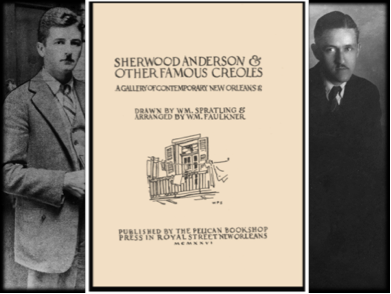
William Spratling and William Faulkner, Sherwood Anderson and Other Famous Creoles: A Gallery of Contemporary New Orleans, published by Pelican Bookshop Press, New Orleans, 1926, first edition, first issue, number 217 of 250, bound in green boards, with label on front cover, interior of back cover with a label printed “Rebound in L’ATELIER Le Loup” and dated in ink “1986”.

Provenance: From the collection of Stephanie Durant, by descent from the collection of Ray Samuel.

A special copy of a rare and fragile book described by The Booklover’s Guide to New Orleans as “one of the great literary curiosities in the city’s history.” The book comprises Spratling’s drawings of himself, Faulkner, and 41 of their acquaintances–artists, musicians, academics, preservationists, and socialites, “artful and crafty ones of French Quarter” with some of their uptown friends and patrons. One was novelist Sherwood Anderson, and Faulkner’s introduction parodies Anderson’s style.


The note above is taken from the catalog description of an extraordinary book that will be sold at auction on April 19.  The book has been given by Stephanie Durant of New Orleans to be sold for the benefit of the Ogden Museum of Southern Art, and the sale will be conducted by the New Orleans Auction Galleries, which will donate its commission to the museum as well.

This copy is uniquely valuable because it is signed by 41 of the 43 persons included,

in a few cases with personal notes to its original owner. (See below for a complete list.) That number of autographs is certainly a record: The only other copy I know with more than a dozen or so is one with 31, and it was stolen from a Charlottesville, Virginia, bookshop some time ago.

The catalog description is accurate as far as it goes, but there is a great deal more to be said about this odd little book, written by two young men who went on to become arguably the greatest American novelist and the greatest Mexican silver designer of the twentieth century.  Those depicted include both figures well-known at the time, like writer Grace King and artist Ellsworth Woodward, and some who would become well-known later, like artist Caroline Durieux and writer Hamilton Basso. The title, an obscure joke, refers to a book of caricatures entitled The Prince of Wales and Other Famous Americans, by Vanity Fair cartoonist Miguel Covarrubias (to whom Famous Creoles is dedicated). The “Pelican Bookshop Press” was a fiction: Spratling and Faulkner paid a local printer to produce 250 copies. Spratling (though, note, not Faulkner) signed and hand-tinted some images in 50, mostly for the friends who were included. There was a second printing of 150 copies, somewhat less valuable on the rare book market. The book was not at all sturdy, and it is not unusual to find copies that have been repaired or, like this one, rebound. Many copies have presumably fallen apart and been discarded. Musician Harold Levy’s hand-tinted copy was destroyed by Hurricane Katrina.

The original owner of this particular copy, Stella Lengsfield Lazard, signed her name in ink on inside front. In 1926 Mrs. Lazard was 43. Her husband, Henry Calme Lazard, was a stockbroker related by blood and marriage to several distinguished mercantile and financial families in New Orleans and elsewhere. The couple had one grown son, and lived with her parents uptown on St. Charles Avenue.  (Her father was a successful cotton factor.)

Mrs. Lazard had literary, historical, and musical interests.  In 1925 she wrote a series of feature articles for the Times-Picayune on the mayors of New Orleans, and a few years later she served as narrator for a weekly musical program on WDSU radio, “Sweet Mystery of the Air,” featuring a trio of local musicians: harpist, violinist, and tenor.  To judge by the inscriptions in her copy of Famous Creoles, she was friends with a number of those included.  For instance, one reads, “To Stella, the star, from the stellar Helen Pitkin Schertz”; Flo Field wrote “Love to my old staunch [?] friend”; and William “Cicero” Odiorne, who was in Paris, wrote “When are you coming over?”

Others who did more than simply sign their names include writers Sherwood Anderson and Roark Bradford; artists Conrad Albrizio, Marc Antony, and Virginia Parker Nagel; Tulane cheerleader Marian Draper; and Lillian Friend Marcus, managing editor of the Double Dealer magazine. The presidents of Tulane and of Le Petit Théatre, A. B. Dinwiddie and Mrs. J. O. Nixon, simply added their institutional affiliations.  Natalie Scott just signed the page with her picture on it, but a note in Mrs. Lazard’s hand identifies a building shown in the picture as the Court of Two Sisters (which Miss Scott owned).  One amusing addition: On an almost blank page Arthur Feitel, a 34-year-old bachelor architect, wrote “Me, too” and signed his name.  Feitel, whose picture was not included, was a Tulane graduate who had studied at the Ecole des Beaux Arts; he would later serve as president of both the Art Association of New Orleans and the board of the Delgado Museum.

Only two “Famous Creoles” did not sign Mrs. Lazard’s book. One is easily explained. By the time the book appeared Ronald Hargrave was pretty much incommunicado; he was painting in Majorca, and he never returned to New Orleans. But the other missing signature is that of William Faulkner. It seems to me that Mrs. Lazard went to a great deal of trouble to track down people to sign her book (William Odiorne signed it, and he was in Paris), so it is almost inconceivable that she didn’t ask Faulkner. He must have refused to sign, possibly just out of general cussedness — he was known for being moody and sometimes difficult, and he didn’t sign the 50 copies that Spratling hand-tinted either. In addition, however, Faulkner didn’t care for “artsy” uptown people he thought were dilettantes (unlike Spratling, who enjoyed their company), and he may have viewed Mrs. Lazard as one of them. Whatever the explanation, in some ways Faulkner’s absence may actually be more interesting than a perfunctory autograph would have been.

Mrs. Lazard’s copy was eventually acquired by Stephanie Durant’s father, J. Raymond Samuel, a well-known historian, collector and (in his retirement years) dealer in books and art. On his death the book passed to Mrs. Durant, who has now generously given it to benefit the Ogden Museum.


–John Shelton Reed, University of North Carolina at Chapel Hill,

Author of Dixie Bohemia: A French Quarter Circle in the 1920s


Inquiries about the auction should be directed to :


Jelena James

New Orleans Auction Galleries                                                        <jelena@neworleansauction.com>

801 Magazine Street                                                                          800-501-0277
New Orleans, Louisiana 70130                                                        504-566-1849


“Famous Creoles”

(with ages in 1926)

Signed Lazard copy

Conrad Albrizio, 27

New York-born, serious artist, Spratling’s neighbor, Arts and Crafts Club

stalwart

Sherwood Anderson, 50

“Lion of the Latin Quarter,” eminence gris, generous to respectful younger

writers

Marc Antony and Lucille Godchaux Antony, both 28

Love-match between heiress and lower-middle-class boy, local artists

Hamilton “Ham” Basso, 22

Star-struck recent Tulane grad, aspiring writer, good dancer

Charles “Uncle Charlie” Bein, 35

Director of Arts and Crafts Club’s art school; lived with mother, sister,

and aunt

Frans Blom, 33

Danish archeologist of Maya, Tulane professor, colorful resident of

Quarter

Roark Bradford, 30

Newspaperman, jokester, hit pay dirt with Negro dialect stories

Nathaniel Cortlandt Curtis, 45

Tulane architecture professor, preservationist, recorded old buildings

Albert Bledsoe Dinwiddie, 55

President of Tulane, Presbyterian

Marian Draper, 20

Ziegfeld Follies alum, Tulane cheerleader, prize-winning architecture

student

Caroline “Carrie” Wogan Durieux, 30

Genuine Creole, talented artist living in Cuba and Mexico, painted by Rivera

Flo Field, 50

French Quarter guide, ex-journalist, sometime playwright, single mother

Louis Andrews Fischer, 25

Gender-bending Mardi Gras designer, named for her father

Meigs O. Frost, 44

Reporter’s reporter; lived in Quarter; covered crime, revolutions, and arts

Samuel Louis “Sam” Gilmore, 27

Greenery-yallery poet and playwright, from prominent family

Moise Goldstein, 44

Versatile and successful architect, preservationist, active in Arts and

Crafts Club

Weeks Hall, 32

Master of and slave to Shadows-on-the-Teche plantation, painter, deeply

strange

R. Emmet Kennedy, 49

Working-class Irish boy, collected and performed Negro songs and stories

Grace King, 74

Grande dame of local color literature and no-fault history, salonnière

Alberta Kinsey, 51

Quaker spinster, Quarter pioneer, indefatigable painter of courtyards

Richard R. Kirk, 49

Tulane English professor and poet, loyal Michigan Wolverine alumnus

Oliver La Farge, 25

New England Brahmin, Tulane anthropologist and fiction-writer, liked

a party

Harold Levy, 32

Musician who ran family’s box factory, knew everybody, turned up

everywhere

Lillian Friend Marcus, 35

Young widow from wealthy family, angel and manager of Double Dealer

John “Jack” McClure, 33

Poet, newspaper columnist and reviewer, Double Dealer editor, bookshop

owner

Virginia Parker Nagle, 29

Promising artist, governor’s niece, Arts and Crafts Club teacher

Louise Jonas “Mother” Nixon, 70

A founder of Le Petit Theatre and its president-for-life, well-

connected widow

William C. “Cicero” Odiorne, 45

Louche photographer, Famous Creoles’ Paris contact

Frederick “Freddie” Oechsner, 24

Recent Tulane graduate, ambitious cub reporter, amateur actor

Genevieve “Jenny” Pitot, 25

Old-family Creole, classical pianist living in New York, party girl

Lyle Saxon, 35

Journalist, raconteur, bon vivant, host, preservationist, bachelor

Helen Pitkin Schertz, 56

Clubwoman, civic activist, French Quarter guide, writer, harpist

Natalie Scott, 36

Journalist, equestrian, real-estate investor, Junior Leaguer, social

organizer

William “Bill” Spratling, 25

Famous Creoles illustrator, Tulane teacher, lynchpin of Quarter

social life

Keith Temple, 27

Australian editorial cartoonist, artist, sometimes pretended to be

a bishop

Fanny Craig Ventadour, 29

Painter, Arts and Crafts Club regular, lately married and living in

France

Elizebeth Werlein, 39

Suffragette with colorful past, crusading preservationist,

businessman’s widow

Joseph Woodson “Pops” Whitesell, 50

Photographic jack-of-all-trades, French Quarter eccentric,

inventor

Daniel “Dan” Whitney, 32

Arts and Crafts Club teacher, married (two) students, beauty

pageant judge

Ellsworth Woodward, 65

Artistic elder statesman, old-fashioned founder of Newcomb art

department

Did not sign Lazard copy

William “Bill” Faulkner, 29

Needs no introduction, but wrote the one to Famous Creoles

Ronald Hargrave, 44

Painter from Illinois formerly active in Quarter art scene,

relocated to Majorca


From Dixie Bohemia: A French Quarter Circle in the 1920s,

© 2012, LSU Press.

Joyce Corrington Publishes the Work of Late Husband John William Corrington

In Arts & Letters, Books, Fiction, Humanities, John William Corrington, Joyce Corrington, Literature, Poetry, Southern History, Television Writing, The South, Writing on March 13, 2013 at 8:45 am

Joyce Corrington, pictured above, has made her late husband John William “Bill” Corrington’s book The Upper Hand available on Amazon as a Kindle e-book. Click here to view or purchase this book.

Even more important, she has collected John William Corrington’s poems into a book. Click here to view or purchase this book. This is the first publication of Corrington’s collected poems, and Joyce is delighted to make them available to the public and future scholars.

Joyce Corrington is a writer who, with her late husband John William “Bill” Corrington, wrote several films, including The Omega Man (1970), Box Car Bertha (1971), and The Battle for the Planet of the Apes (1973). Also with Bill Corrington, she co-authored four novels: So Small a Carnival (1986), A Project Named Desire (1987), A Civil Death (1987), and The White Zone (1990). She was head writer for such television series as Search for Tomorrow, Texas, General Hospital and Superior Court, and she has been a co-executive producer for MTV’s The Real World. She holds a Ph.D. from Tulane University. Her latest book, Fear of Dying, is available in both Kindle e-book and paperback format. Formerly a Malibu resident, she now resides in New Orleans.

To read more about John William Corrington, click here to read this profile.

Glory and Indignity

In America, American History, Arts & Letters, Book Reviews, Books, Conservatism, Historicism, History, Humanities, Politics, Southern History, The South on February 20, 2013 at 8:45 am

Allen Mendenhall

The following review first appeared here at The University Bookman.

John Randolph of Roanoke
by David Johnson.
Baton Rouge: Louisiana State University Press, 2012

“I am an aristocrat. I love liberty, I hate equality.” Thus spoke John Randolph of Roanoke (1773–1833), one of the most curious, animated figures ever to grace American soil. That David Johnson’s biography of Randolph is the first of its kind since Russell Kirk published John Randolph of Roanoke in 1951 suggests how deteriorated American memory and education have become. Randolph ought to be studied by all American schoolchildren, if not for his politics then for the vital role he played in shaping the nation’s polity. Dr. Kirk declared that in writing about Randolph, he was summoning him from the shades. If so, Johnson has gone a step farther and brought Randolph into the sunshine to reveal just how spectacular a man he really was.

Kirk’s biography of Randolph was in fact his first book. Kirk dubbed the colorful Virginian a “genius,” “the prophet of Southern nationalism,” and the “architect of Southern conservatism.” In The Conservative Mind, Kirk treats Randolph as a necessary link between George Mason and John C. Calhoun and proclaims that Randolph should be remembered for “the quality of his imagination.” Randolph enabled the proliferation and preservation of the conservative tradition in America. He became an icon for decentralization and localism.

Why would a scandalous, sickly, go-it-alone, riotous rabble-rouser appeal to the mild-mannered Dr. Kirk? The answer, in short, is that Randolph was as conservative a politician as America has ever produced, and he was, despite himself, a gentleman and a scholar. Eccentric though he appeared and often acted, Randolph celebrated and defended tradition, championed small government and agrarianism, sacrificed careerism and opportunism for unwavering standards, professed self-reliance and individualism, took pains to preserve the rights of the states against the federal government, delighted in aristocratic tastes and manners, read voraciously the great works of Western civilization, cultivated the image of a statesman even as he attended to the wants and needs of his yeomen constituents, discoursed on weighty topics with wit and vigor, and adhered to firm principles rather than to partisan pandering. Admired by many, friend to few, he made a prominent display of his wild personality and unconditional love for liberty, and he devoted himself, sometimes at great cost, to the ideals of the American Revolution, which had, he claimed, marked him since childhood.

Remembered chiefly (and, in the minds of some progressives, unfortunately) for his contributions to states’ rights doctrines and to the judicial hermeneutics of strict constructionism, Randolph was responsible for so much more. The son of a wealthy planter who died too young, Randolph became the stepson of St. George Tucker, a prominent lawyer who taught at the College of William and Mary and served as a judge on the Virginia General District Court and, eventually, on the Virginia Court of Appeals, the United States District Court for the District of Virginia, and the United States District Court for the Eastern District of Virginia. A cousin to Thomas Jefferson, Randolph studied under George Wythe and his cousin Edmond Randolph. A boy who was forced to flee his home from the army of Benedict Arnold, Randolph later played hooky from college to watch the orations of Fisher Ames, the stout Federalist from New York, and Madison. He served in the U.S. House of Representatives as well as the U.S. Senate, and was, for a brief time, Minister to Russia. A supporter of Jefferson before he became Jefferson’s tireless adversary, he criticized such individuals as Patrick Henry, Washington, Madison, Monroe, John Adams, Henry Clay, and Daniel Webster. He was sickened by the Yazoo Land Scandal, opposed the War of 1812 in addition to the Missouri Compromise, and promoted nullification.

Many conservatives, Kirk among them, have tended to overlook the more unpalatable aspects of Randolph’s life, whether personal or political. For instance, Randolph was, more than Jefferson, enthralled by the French Revolution and supportive of its cause. He manufactured a French accent, used a French calendar, and called his friends “Citizens.” In his twenties, he referred to himself as a deist “and by consequence an atheist,” and he acquired, in his own words, “a prejudice in favor of Mahomedanism,” going so far as to proclaim that he “rejoiced in all its [Islam’s] triumphs over the cross.” One might excuse these infelicities as symptoms of youthful indiscretion and impetuosity, but they do give one pause.

Not for lack of trying, Randolph could not grow a beard, and although he spoke well, his voice was, by most accounts, awkward, piping, off-putting, and high-pitched. His critics have painted him as a villain of the likes of Shakespeare’s Richard III: resentful, obstinate, loudmouthed, and as deformed in the mind as he was in the body. Yet Randolph cannot be made into a monster. More than others of his station in that time and place, Randolph was sensitive to the problems of slavery, which had only intensified rather than diminished since the Founding. He freed his slaves in his will, granted them landholdings in Ohio, and provided for their heirs. Slavery was incompatible with liberty, and Randolph, despite being a product of his time, appears to have worried much about the paradox of a nation conceived in liberty but protective of institutional bondage. Randolph asserted, in some way or another, over and over again, that his politics were based on a presumption of liberty, which was (and is) the opposite of slavery and governmental tyranny. Read the rest of this entry »

Review of John Shelton Reed’s Dixie Bohemia

In American History, Arts & Letters, Book Reviews, History, Humanities, Literary Theory & Criticism, Literature, Southern History, Southern Literary Review, The South, Writing on October 31, 2012 at 8:45 am

Allen Mendenhall

The following review first appeared here in Southern Literary Review.

John Shelton Reed’s Dixie Bohemia is difficult to classify. It’s easier to say what it isn’t than to say what it is.

It isn’t biography.  It isn’t documentary.  It isn’t quite history, although it does organize and present information about a distinct class of past individuals interacting and sometimes living together in a unique, definable space.

It isn’t quite sociology either, although Reed is, by training and profession, a sociologist, and sociology does, every now and then, sneak its way into the pages.

Maybe it’s best to suggest that the book is a bit of all of these, but it’s also an annotated edition of Sherwood Anderson and Other Famous Creoles: A Gallery of Contemporary New Orleans.

Written and compiled by William Spratling and William Faulkner, whom Reed affectionately dubs the “Two Bills,” Sherwood Anderson and Other Famous Creoles, first published in 1926,was something of a joke: its oft-rambunctious subjects weren’t really creoles, but simply friends of the authors, and most weren’t, by most measurable standards, famous.

Reed’s stated goal, one of them at least, is to provide an “introduction to a Bohemian crowd of artists, writers, journalists, musicians, poseurs, and hangers-on found in the French Quarter in the mid-1920s.”  This eclectic and creative crowd comprises what Reed calls a social circle, or, in more academic parlance, a “loose network of relationships linked by friends in common,” “by association with the same institutions,” and “by common interests.”

Reed explains that social circles, by nature, “have no formal leaders, but they may have their notables,” and they have their cores, too.  The leader of the so-called “famous Creoles” is Sherwood Anderson, and the core, as you might have guessed, is the French Quarter.

Tulane University, with all of its energy, entertainers, and eccentrics, enabled and sustained the circle that produced the local arts, literature, and culture.  The area and its residents gained a national, indeed international, reputation.  As Meigs Frost, a reporter who made the cut as a famous creole, put it, “So many of us here are internationally famous locally.”

Reed’s subtly sociological introductory chapters place his subjects, which were also the two Bills’ subjects, into their historical context—and what a wild, exotic, and at times erotic context it is.  His comprehensive research is delivered with such wit and enthusiasm that one can forget this work is scholarship written by a former professor and published by a university press.

His occasional use of the first person and confessional, qualifying asides—“as far as I know,” “Some may find it easier than I do,” “to my mind artists should not be judged on what prejudiced observers see in their work,” “It is difficult to discuss this,” “I have mentioned,” “I know of someone,” “it’s fair to say,” “It’s hard to imagine”—will let you know, or let you guess at, where he stands on an issue or acknowledges an assumption on his part.  Such delicate humility—or is it just honest colloquialism?—is rare for a person who made his career in the university, and it would be a shame if readers neglected to notice it.

Peopled with absinthe-drinking, music-loving debauchers, 1920s New Orleans was a place where madams and brothels were as common as jambalaya and gumbo; where music poured into the streets, which smelled of spices, sex, and booze; where bootleggers (this was the Prohibition Era, remember) set up shop next to cops (who were customers of the brothels and the bootleggers); where the only limit on free love, it seemed, was the stultifying effect of alcohol; where parties—especially costume balls—were considered failures if nobody got naked; and where vivacious theater, daily newspapers, and edgy literary periodicals flourished.

If this milieu seemed excessive, radical, intemperate, even libertine, it was also in a way conservative: there was among its dwellers a ubiquitous impulse to preserve and maintain.  History, both that being made and that made already, was important to the artists and writers.  The districts, the streets, the homes, the buildings, the sidewalks—all of them required and received care and protection, and all of them underwent systematic revitalization.  The literati, as conservationists, were afraid that the world they had inherited, and to some extent made, was endangered.

Fans of Reed have come to expect certain things: the informal idioms and plain speech he uses while dissecting, with surgeon-like precision, complex people and institutions; the surprising clarity he brings to understudied topics; and the delightful, conversational prose with which he arrests your attention, transports you into another world, and then releases you back into your own world.

In this, his latest, he does not disappoint.  As always, he delivers—and in so doing provides telling insights into a minor renaissance in American literary history.  His discussions of race and sexuality will inspire (or provoke) future study, but more importantly he has addressed some of the least known phases of some of the most known American litterateurs.

Reed doesn’t need my endorsement.  But he’s got it.

“Gone,” Edited with Photography by Nell Dickerson

In Arts & Letters, Book Reviews, History, Humanities, Nineteenth-Century America, Southern History, Southern Literary Review, The South, Writing on May 9, 2012 at 7:45 am

Allen Mendenhall

The following review originally appeared here in the Southern Literary Review.

I’ve always maintained a spectator’s curiosity in the rituals and practices of photography.  I can’t take a good picture, no matter which side of the camera I’m on, but I appreciate the idea of reducing the world to a more manageable form, something I can look at and admire without getting overwhelmed by the sheer magnitude and kinetics of it all.

I used to have a friend who was a photographer, and I would watch her take pictures.  She tried, once or twice, to teach me the nuances and particulars of photography, but I’m too proud to fail at new activities, so I strive never to undertake them.

Photographs are, folks say, moments stuck in time.  That makes them especially melancholy if their subjects, as it were, are decaying, rotting, or dying.  That’s what I realized when I leafed through the pages of Gone, a brilliant, conversation-starting, coffee-table book bearing the subtitle “A Heartbreaking Story of the Civil War,” and the sub-sub-title “A Photographic Plea for Preservation.”

Gone makes history even as it documents history.  Its images of antebellum Southern churches, plantations, and homes—some dilapidated, some just barely restored—ought to remind Southerners of the need for preserving the finest monuments of, and to, our complicated history.

That the photographer is Nell Dickerson, cousin to the late, great historian and novelist Shelby Foote, who needs no introduction to readers of this publication—although we editors have given him one—only adds a sense of authenticity to this project.  It’s as if in image and word and authorial kin, the book is tied to a past that struggles, and fails, to remain present; and it’s in that failing that the book achieves its most meaningful and poignant expression.

We Southerners place a premium on the fixed, the immutable, the known, perhaps because we understand that the things we value—family, hearth, home, community, place, religion—are bound to change.  We mourn change as we mourn loss, because all change entails loss, and it’s our tendency to mourn that gives us a unique, constructive identity.

We define ourselves as a people who have lost, or have lost something.  It’s a position that doesn’t survive interrogation, but there it is, a tragic ethos (and, for that matter, pathos) that we hope will stay the same when all else is, if not different, then almost unfamiliar.  Almost. Read the rest of this entry »

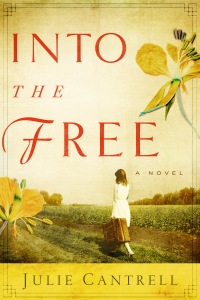
Allen Mendenhall Interviews Julie Cantrell

In Arts & Letters, Book Reviews, Creative Writing, Fiction, Humanities, Literature, News and Current Events, Novels, Southern Literary Review, The South, Writing on February 29, 2012 at 6:10 am

Julie Cantrell was editor-in-chief of the Southern Literary Review.  She teaches English as a second language to elementary school students and is a freelance writer who has published two children’s books. Julie and her family run Valley House Farm in Mississippi.  Her first novel, Into the Free, was released by David C. Cook in 2012.


Julie, so glad to be doing this interview.  First of all, congratulations on the publication of Into the Free, which, at the moment, is number 23 on the Amazon Kindle bestseller list.  What does it feel like to have completed your first novel?

It’s amazing! The entire journey has been joyful for me, but to see it reach readers across the world is incredible. Having it become a bestseller is simply surreal. I admit I’m a bit numb watching it climb the charts, and I keep thinking it will end in a few minutes – a strange little bubble of joy that is about to pop. For that reason, I’ve been doing the happy dance nonstop and am just going to enjoy the fun while it lasts.

The main character of the book is Millie Reynolds.  How did you come up with Millie?  Did you know what she would be like—her personality, her attitudes, her struggles—before you started writing, or did she sort of come to you as you worked?

Well, to be honest, I never intended to write from a child’s point of view. I originally set out to write about the “Gypsy Queen,” but it just wasn’t the voice I heard. Then I saw a scene of a poor, depressed woman standing on a porch watching the Travelers leave town. She wanted to leave with them, but she was too afraid to take the first step. So I sat down to write her story, but it wasn’t her voice I heard either. Instead, Millie sat in her tree and told me her story. I know it sounds kooky, but I guess I just have a very vivid imagination. I’m happy to introduce Millie to readers, and I hope they love her as much as I do.

You once told me that you had two kids, four cows, three goats (two of which were then due with babies that you’d have to bottle feed), two dogs, two cats (one stray that arrived pregnant), a horse that likes a lot of attention, a flock of hens, a newly arrived carton of chicks, a husband, and a full-time job as a speech therapist.  How did you ever manage to finish writing Into the Free

It sounds crazy, doesn’t it? In fact, we’ve grown bigger since then! I still work in an elementary school, but now I teach English as a Second Language, so I was able to reduce my hours to part-time this year. With a full-time farm, a teaching job (which is never really part-time, as any teacher will tell you), two kids, a wonderful hubby, freelance gigs, and an active community life, we stay very busy. I usually write between the hours of 3 am and 5 am, when the rest of the world is sleeping. I just love it more than sleep.

Tell us a little about your choice of setting for the novel?

I am a southern girl, through and through. I spent my childhood in Louisiana before leaving the south after graduate school. I loved living in various states across the country, but our family relocated to Mississippi seven years ago, returning to our southern roots. I find this state incredibly rich with everything needed to whip up a story. I never considered setting it anywhere other than Mississippi. However, I like to mix things up a bit, so let’s see where the sequel takes us.

Any advice for aspiring novelists who might come across this interview?

Yes. I say, Go for it! If writing is what you love, be willing to make sacrifices to keep that in your life. Only you know what you were born to do, and only you know how to live the life that makes you happy. Life is short. Choose wisely.

Thank you, Julie.  This has been a great interview.  I’m thrilled to see the success of Into the Free, and I would encourage readers of this site to purchase a copy right away. 

Thank you, Allen. I am honored to be interviewed here on a site I have always loved. You’ve done a fabulous job with Southern Literary Review, and I know your readers all agree. Kudos!

Review of Lions of the West by Robert Morgan

In America, American History, Arts & Letters, Book Reviews, Historicism, History, Humanities, Nineteenth-Century America, Politics, Southern History, The South, Writing on January 31, 2012 at 6:46 am

Allen Mendenhall

This review originally appeared here at the Southern Literary Review.

Good histories don’t just tell stories; they make arguments.  Robert Morgan’s arguments in Lions of the West, subtle though they are, run as follows: historians and storytellers cannot help but view dramatic shifts of history as products of the actions of famous individuals; nevertheless, what happens in the course of history is attributable to numerous common folk acting independently and with disparate motivations.  Even the most comprehensive history cannot tell the stories of all these individuals, each of whom, in the narrative of the American West, could be numbered among the great “lions.” 

“While it is understandable,” Morgan explains, “that we see history mostly in terms of the deeds of a few, our grasp of what actually happened will be flawed and limited if we do not consider the story of the almost invisible many who made the notable deeds possible, even inevitable.”  Despite this claim, Morgan seems taken by the Great Man theory of history, and one of the epigrams to his book, which gets repeated in the Prologue, is Emerson’s remark that there is “properly no history; only biography.”

Morgan’s stated purpose is to “create a living sense of the westward expansion of the United States through brief biographies of some of the men involved.”  In realizing this goal, he offers a nod to other popular historians and storytellers such as Joseph J. Ellis, Gordon S. Wood, and David McCullough.  Each of these men writes histories free of the monotony and tendentious urgency of academic historians, yet each is also committed to facts and small details as indicia of greater narrative patterns. 

Morgan admits, as he must, that Lions of the West is, at best, “only a partial story.”  That’s not a shortcoming peculiar to Morgan’s narrative but a reality of human experience: all histories, like all memories, are partial.  Morgan himself submits that “written history is distortion through selection,” and that by its nature “narrative can represent only by implication, explicit about some parts, suggesting the many.”  No history could recount all the constituent parts that make up the whole; no history, in other words, could recreate the past.  For that reason, an author’s values and priorities are reflected in the subjects he or she chooses to undertake. 

Morgan’s values and priorities can be gleaned from his decision to profile ten individuals whose lives and toils characterize the American West in all its outlandishness and glory: Thomas Jefferson, Andrew Jackson, John Chapman (“Johnny Appleseed”), David (“Davy”) Crockett, Sam Houston, James K. Polk, Winfield Scott, Kit Carson, Nicholas Trist, and John Quincy Adams.  Of these, all but Chapman and Adams maintained significant ties to the South or would have considered themselves, or by others would have been considered, Southerners. Read the rest of this entry »

Additional Thoughts on Gary W. Gallagher’s The Union War

In American History, Arts & Letters, Book Reviews, Historicism, History, Nineteenth-Century America, Slavery, Southern History, The South, Western Civilization on December 23, 2011 at 10:50 am

Allen Mendenhall

Recently I reviewed Gary W. Gallagher’s The Union War (Harvard University Press, 2011) for The University Bookman.  The review (“Why the Union Soldiers Fought”) is available here.  I have not said all I mean to say about Gallagher’s book, so this post records some additional thoughts.

I began my review with the tale of the “Lost Women and Children of Roswell.”  It was difficult as a child, knowing this story and others like it, to view the Union Army as completely righteous and pure, or to justify the eradication of certain evils like slavery with other widespread and destructive evils like war.  Despite being a Southerner with ancestors who fought for the Confederacy, I’m ambivalent about the War because of the various and totalizing perspectives that were thrust upon me when I was young, and because of my general opposition to war and nationalism, to say nothing of the complex figuring of race that played a defining role in bringing about the conflict.

As I went from middle school to high school, and then college to graduate school, the less likely I was to reduce the causes of the War to one or two factors, and the more likely I was to believe that anyone’s view of the War is already tainted by biases and assumptions.  Over time, I learned never to rule out alternate ways of viewing the War or the Confederacy.  I decided that no one would ever discover the intellectual trump card that would prevail over other viewpoints about the War that killed more men than all other wars in American history, combined.

There’s always more than one way of looking at a conflict, be it this War or some other one.  And our imperfect understanding of conflicts—of anything, really—always consists of generalizations based on the confines of personal experience.  We can read about the events encompassing the War, and we can guess at the logic and beliefs that explain those events.  But we can never relive the War or experience it in real time; and if we are honest, we must say that we can never read all there is to read about the period, never fully know the way a nineteenth-century mind thought, never entirely understand the quotidian realities of the men and women of all races at those times and in those places.  Being human, moreover, we make mistakes and assumptions.  Most of us revise our errors when we notice them.  But some don’t.  Some try to rationalize the logic of the unrealities to which they cling.  Read the rest of this entry »