See Disclaimer Below.

Archive for the ‘History’ Category

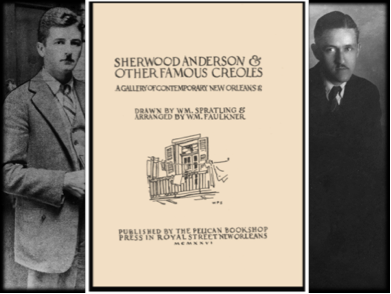
Auction Announcement: William Spratling and William Faulkner, Sherwood Anderson and Other Famous Creoles: A Gallery of Contemporary New Orleans

In American History, Arts & Letters, Books, History, Humanities, Literature, News and Current Events, News Release, Southern History, Southern Literary Review, The South, Writing on April 5, 2013 at 8:45 am

Famous Creoles

William Spratling and William Faulkner, Sherwood Anderson and Other Famous Creoles: A Gallery of Contemporary New Orleans, published by Pelican Bookshop Press, New Orleans, 1926, first edition, first issue, number 217 of 250, bound in green boards, with label on front cover, interior of back cover with a label printed “Rebound in L’ATELIER Le Loup” and dated in ink “1986”.

Provenance: From the collection of Stephanie Durant, by descent from the collection of Ray Samuel.

A special copy of a rare and fragile book described by The Booklover’s Guide to New Orleans as “one of the great literary curiosities in the city’s history.” The book comprises Spratling’s drawings of himself, Faulkner, and 41 of their acquaintances–artists, musicians, academics, preservationists, and socialites, “artful and crafty ones of French Quarter” with some of their uptown friends and patrons. One was novelist Sherwood Anderson, and Faulkner’s introduction parodies Anderson’s style.


The note above is taken from the catalog description of an extraordinary book that will be sold at auction on April 19.  The book has been given by Stephanie Durant of New Orleans to be sold for the benefit of the Ogden Museum of Southern Art, and the sale will be conducted by the New Orleans Auction Galleries, which will donate its commission to the museum as well.

This copy is uniquely valuable because it is signed by 41 of the 43 persons included,

in a few cases with personal notes to its original owner. (See below for a complete list.) That number of autographs is certainly a record: The only other copy I know with more than a dozen or so is one with 31, and it was stolen from a Charlottesville, Virginia, bookshop some time ago.

The catalog description is accurate as far as it goes, but there is a great deal more to be said about this odd little book, written by two young men who went on to become arguably the greatest American novelist and the greatest Mexican silver designer of the twentieth century.  Those depicted include both figures well-known at the time, like writer Grace King and artist Ellsworth Woodward, and some who would become well-known later, like artist Caroline Durieux and writer Hamilton Basso. The title, an obscure joke, refers to a book of caricatures entitled The Prince of Wales and Other Famous Americans, by Vanity Fair cartoonist Miguel Covarrubias (to whom Famous Creoles is dedicated). The “Pelican Bookshop Press” was a fiction: Spratling and Faulkner paid a local printer to produce 250 copies. Spratling (though, note, not Faulkner) signed and hand-tinted some images in 50, mostly for the friends who were included. There was a second printing of 150 copies, somewhat less valuable on the rare book market. The book was not at all sturdy, and it is not unusual to find copies that have been repaired or, like this one, rebound. Many copies have presumably fallen apart and been discarded. Musician Harold Levy’s hand-tinted copy was destroyed by Hurricane Katrina.

The original owner of this particular copy, Stella Lengsfield Lazard, signed her name in ink on inside front. In 1926 Mrs. Lazard was 43. Her husband, Henry Calme Lazard, was a stockbroker related by blood and marriage to several distinguished mercantile and financial families in New Orleans and elsewhere. The couple had one grown son, and lived with her parents uptown on St. Charles Avenue.  (Her father was a successful cotton factor.)

Mrs. Lazard had literary, historical, and musical interests.  In 1925 she wrote a series of feature articles for the Times-Picayune on the mayors of New Orleans, and a few years later she served as narrator for a weekly musical program on WDSU radio, “Sweet Mystery of the Air,” featuring a trio of local musicians: harpist, violinist, and tenor.  To judge by the inscriptions in her copy of Famous Creoles, she was friends with a number of those included.  For instance, one reads, “To Stella, the star, from the stellar Helen Pitkin Schertz”; Flo Field wrote “Love to my old staunch [?] friend”; and William “Cicero” Odiorne, who was in Paris, wrote “When are you coming over?”

Others who did more than simply sign their names include writers Sherwood Anderson and Roark Bradford; artists Conrad Albrizio, Marc Antony, and Virginia Parker Nagel; Tulane cheerleader Marian Draper; and Lillian Friend Marcus, managing editor of the Double Dealer magazine. The presidents of Tulane and of Le Petit Théatre, A. B. Dinwiddie and Mrs. J. O. Nixon, simply added their institutional affiliations.  Natalie Scott just signed the page with her picture on it, but a note in Mrs. Lazard’s hand identifies a building shown in the picture as the Court of Two Sisters (which Miss Scott owned).  One amusing addition: On an almost blank page Arthur Feitel, a 34-year-old bachelor architect, wrote “Me, too” and signed his name.  Feitel, whose picture was not included, was a Tulane graduate who had studied at the Ecole des Beaux Arts; he would later serve as president of both the Art Association of New Orleans and the board of the Delgado Museum.

Only two “Famous Creoles” did not sign Mrs. Lazard’s book. One is easily explained. By the time the book appeared Ronald Hargrave was pretty much incommunicado; he was painting in Majorca, and he never returned to New Orleans. But the other missing signature is that of William Faulkner. It seems to me that Mrs. Lazard went to a great deal of trouble to track down people to sign her book (William Odiorne signed it, and he was in Paris), so it is almost inconceivable that she didn’t ask Faulkner. He must have refused to sign, possibly just out of general cussedness — he was known for being moody and sometimes difficult, and he didn’t sign the 50 copies that Spratling hand-tinted either. In addition, however, Faulkner didn’t care for “artsy” uptown people he thought were dilettantes (unlike Spratling, who enjoyed their company), and he may have viewed Mrs. Lazard as one of them. Whatever the explanation, in some ways Faulkner’s absence may actually be more interesting than a perfunctory autograph would have been.

Mrs. Lazard’s copy was eventually acquired by Stephanie Durant’s father, J. Raymond Samuel, a well-known historian, collector and (in his retirement years) dealer in books and art. On his death the book passed to Mrs. Durant, who has now generously given it to benefit the Ogden Museum.


–John Shelton Reed, University of North Carolina at Chapel Hill,

Author of Dixie Bohemia: A French Quarter Circle in the 1920s


Inquiries about the auction should be directed to :


Jelena James

New Orleans Auction Galleries                                                        <jelena@neworleansauction.com>

801 Magazine Street                                                                          800-501-0277
New Orleans, Louisiana 70130                                                        504-566-1849


“Famous Creoles”

(with ages in 1926)

Signed Lazard copy

Conrad Albrizio, 27

New York-born, serious artist, Spratling’s neighbor, Arts and Crafts Club

stalwart

Sherwood Anderson, 50

“Lion of the Latin Quarter,” eminence gris, generous to respectful younger

writers

Marc Antony and Lucille Godchaux Antony, both 28

Love-match between heiress and lower-middle-class boy, local artists

Hamilton “Ham” Basso, 22

Star-struck recent Tulane grad, aspiring writer, good dancer

Charles “Uncle Charlie” Bein, 35

Director of Arts and Crafts Club’s art school; lived with mother, sister,

and aunt

Frans Blom, 33

Danish archeologist of Maya, Tulane professor, colorful resident of

Quarter

Roark Bradford, 30

Newspaperman, jokester, hit pay dirt with Negro dialect stories

Nathaniel Cortlandt Curtis, 45

Tulane architecture professor, preservationist, recorded old buildings

Albert Bledsoe Dinwiddie, 55

President of Tulane, Presbyterian

Marian Draper, 20

Ziegfeld Follies alum, Tulane cheerleader, prize-winning architecture

student

Caroline “Carrie” Wogan Durieux, 30

Genuine Creole, talented artist living in Cuba and Mexico, painted by Rivera

Flo Field, 50

French Quarter guide, ex-journalist, sometime playwright, single mother

Louis Andrews Fischer, 25

Gender-bending Mardi Gras designer, named for her father

Meigs O. Frost, 44

Reporter’s reporter; lived in Quarter; covered crime, revolutions, and arts

Samuel Louis “Sam” Gilmore, 27

Greenery-yallery poet and playwright, from prominent family

Moise Goldstein, 44

Versatile and successful architect, preservationist, active in Arts and

Crafts Club

Weeks Hall, 32

Master of and slave to Shadows-on-the-Teche plantation, painter, deeply

strange

R. Emmet Kennedy, 49

Working-class Irish boy, collected and performed Negro songs and stories

Grace King, 74

Grande dame of local color literature and no-fault history, salonnière

Alberta Kinsey, 51

Quaker spinster, Quarter pioneer, indefatigable painter of courtyards

Richard R. Kirk, 49

Tulane English professor and poet, loyal Michigan Wolverine alumnus

Oliver La Farge, 25

New England Brahmin, Tulane anthropologist and fiction-writer, liked

a party

Harold Levy, 32

Musician who ran family’s box factory, knew everybody, turned up

everywhere

Lillian Friend Marcus, 35

Young widow from wealthy family, angel and manager of Double Dealer

John “Jack” McClure, 33

Poet, newspaper columnist and reviewer, Double Dealer editor, bookshop

owner

Virginia Parker Nagle, 29

Promising artist, governor’s niece, Arts and Crafts Club teacher

Louise Jonas “Mother” Nixon, 70

A founder of Le Petit Theatre and its president-for-life, well-

connected widow

William C. “Cicero” Odiorne, 45

Louche photographer, Famous Creoles’ Paris contact

Frederick “Freddie” Oechsner, 24

Recent Tulane graduate, ambitious cub reporter, amateur actor

Genevieve “Jenny” Pitot, 25

Old-family Creole, classical pianist living in New York, party girl

Lyle Saxon, 35

Journalist, raconteur, bon vivant, host, preservationist, bachelor

Helen Pitkin Schertz, 56

Clubwoman, civic activist, French Quarter guide, writer, harpist

Natalie Scott, 36

Journalist, equestrian, real-estate investor, Junior Leaguer, social

organizer

William “Bill” Spratling, 25

Famous Creoles illustrator, Tulane teacher, lynchpin of Quarter

social life

Keith Temple, 27

Australian editorial cartoonist, artist, sometimes pretended to be

a bishop

Fanny Craig Ventadour, 29

Painter, Arts and Crafts Club regular, lately married and living in

France

Elizebeth Werlein, 39

Suffragette with colorful past, crusading preservationist,

businessman’s widow

Joseph Woodson “Pops” Whitesell, 50

Photographic jack-of-all-trades, French Quarter eccentric,

inventor

Daniel “Dan” Whitney, 32

Arts and Crafts Club teacher, married (two) students, beauty

pageant judge

Ellsworth Woodward, 65

Artistic elder statesman, old-fashioned founder of Newcomb art

department

Did not sign Lazard copy

William “Bill” Faulkner, 29

Needs no introduction, but wrote the one to Famous Creoles

Ronald Hargrave, 44

Painter from Illinois formerly active in Quarter art scene,

relocated to Majorca


From Dixie Bohemia: A French Quarter Circle in the 1920s,

© 2012, LSU Press.

To Educate in the Permanent Things

In Arts & Letters, Books, Essays, Fiction, History, Humanities, Literary Theory & Criticism, Literature, Politics, Walt Whitman, Western Philosophy, Writing on March 20, 2013 at 8:18 am

Allen Mendenhall

This article originally appeared here in The American Spectator.

In his State of the Union address last month, President Obama proposed changes to preschool, high school, and college education, respectively. His proposals generated praise and condemnation from the predictable cheerleaders and naysayers. Some celebrated his efforts to expand early childhood education; others suggested that he should have focused more on the student loan crisis; still others, not to be outdone, pointed to school funding, teacher salaries, grading, standardized testing, technology, and foreign study as the pressing issues that he neglected to address with sufficient detail.

Everyone, it seems, has an opinion about how to improve American education from the top down. But positive change rarely happens through centralized design; it arises spontaneously through the interaction of human agents operating within and among social groups. The State cannot plan and then promulgate a proper education, and legislative enactments cannot reflect the mores and traditions of local groups with differing standards and expectations. The most prudent and humble proposals for improving education are not couched in statist, Platonic terms about civic education and human perfection; instead, they approach learning modestly, on the individual level. They entail the everyday interactions between teachers and students. They are not stamped with the approval of politicians, unions, think tanks, or interest groups.  They take place in the classroom, not the public square. A teacher anywhere, whatever his station, school, or background, can implement them in his course without disrupting the pace or provoking the ire of the educational establishment. The best of these, because it is so easily executed, is simply to teach what T.S. Eliot, and Russell Kirk after him, called “permanent things.”

The permanent things are the inherited principles, mores, customs, and traditions that sustain humane thinking and preserve civilized existence for future generations; their canonization in literary, philosophical, religious, and historical texts happened and is happening in slow degrees. We can trace the permanent things through curricula that emphasize the ultimate values of prosperous societies. An informed, laborious study of the perennial themes and archetypal patterns in what are variously denominated as the Great Works, the Western Canon, or the Classics can help us to organize and make sense of the permanent things. There are those who would object that this approach seems too hopeful and ideal. But no one has suggested it as a panacea, of which there are none, and anyway, is there a proposal that could be simpler, more straightforward, and more workable than assigning and discussing the Great Works?

As early as 1948, Eliot remarked that “there is no doubt that in our headlong rush to educate everybody, we are lowering our standards, and more and more abandoning the study of those subjects by which the essentials of our culture—of that part of it which is transmittable by education—are transmitted; destroying our ancient edifices to make ready the ground upon which the barbarian nomads of the future will encamp in their mechanized caravans.” It might be asked just who these barbarian nomads are and why we ought not to welcome their cultural practices and assumptions. The barbarian nomads could be, I think, any group lacking in historical perspective and mostly ignorant of the illuminating continuities that have guided our weightiest and most imaginative thinkers. The practices and assumptions of these nomads are not grounded in lived experience but aimed at utopian projects such as ensuring equality, creating fundamental rights, or eliminating poverty, and, to the extent that these practices and assumptions deviate from enduring norms, they cannot be said to have flourished ever.

To study the permanent things, on the other hand, is to consider the prevailing and profound ideas from certain times and schools in relation to other such ideas from various times and schools throughout successive eras. It is to map the course of perennial ideas to examine how they apply to different settings and generations. It is both sequential and diachronic in its approach. Its chief benefit is to put ideas into context, which is to say that it is to make us aware of our own presuppositions and perspectives that necessarily arise from our social, cultural, and historical situation.  Each thinker lives in his own specific era and place and cannot gain knowledge in a vacuum outside of time; our era and place shape the manner in which we think and restrict our ability to imagine conditions beyond our immediate and tangible experience.

This is not to submit that our ideas are determined for us, only that we enter into experience with certain perceptions that we have no control over. They are there because of the conditions present at the time and space in which we exist.  A sustained study of the permanent things will show us that our perceptions are not totally alien from those of our predecessors, although the respective perceptions are different. It also teaches us to compensate for our prejudices and to avoid thinking that our necessarily limited perspectives are unconditionally true and universally acceptable, even if they have verifiable antecedents. It reveals, as well, that schools of thought cannot simply be deemed later versions of earlier schools just because the two are in agreement about certain points. Finally, although we cannot escape those presuppositions that are embedded in our thought and culture, being alert to their probable existence can counteract their possible effect.

A rigorous study of the permanent things provides a lodestar for evaluating particular ideas against that which has been tested and tried before. Ideas that seem new always have traceable antecedents, and individuals equipped with a fundamental knowledge of the permanent things are able to situate purportedly novel ideas alongside their forerunners. These individuals recognize that change is not always progress; sometimes it is decline, deterioration, or decay. Only a sense of the continuities of history and thought can demonstrate the difference. Our political pedants in general and President Obama in particular insist on recognizing and implementing new institutions as if a radical departure from historic standards and established customs is itself the mark of good and lasting policy. Yet the permanent things show that even the most exceptional thinkers, those who represent the spirit of their age, whatever that might have been or might be, are part of a greater tradition.

It may be true that to study a particular thinker’s cultural milieu and biography is requisite to placing his ideas into their proper context and to highlighting the unacceptable premises of his philosophy; nevertheless, cautious interpreters ought to consider whether his thoughts necessarily lead to certain consequences, or whether the events that seem related to his thoughts arose accidentally, apart from his philosophy. Put another way, the cautious interpreter must carefully consider causation: whether theories actually generate particular circumstances, or whether those circumstances would have come to pass regardless of what the thinker spoke or wrote. Mussolini, for instance, praised William James, but it does not follow that anything James said or wrote endorses or enables fascism. He who would suggest otherwise betrays an ignorance of James’s work. The permanent things can help us to distinguish the true forms and implications of an individual’s thought from their appropriations by hostile forces.

By studying the permanent things, moreover, we learn that we cannot achieve the proper education through mere funding; nor does the solution to schooling gridlock and setbacks come from student aid, dress codes, student evaluations, tuition, or whatever. These issues begin to seem fleeting and trivial to one with an historical sense. They are at most temporary struggles, and although they are important, as all struggles are important, we are not to subordinate liberal learning to them. The best way to achieve the liberal learning necessary to make important and meaningful distinctions about our complex world is, as I have suggested and as it bears repeating, through a holistic, painstaking exploration of the permanent things. This means not only reading the Great Works for their content, but analyzing them in light of their place in history.

The beauty of this approach is that anyone can carry it out; the wisdom of it lies in its civilizing effects. Whether one is a homeschooling parent, a public school teacher, the leader of a local book club, or simply a curious-minded autodidact, the permanent things are available to him in texts, waiting to be sifted through and analyzed. It is true that there is disagreement as to what constitutes a Great Work and by what criteria, but it does not take more than research and commonsense empiricism to discern which pre-twentieth century texts have withstood the test of time. Teaching the permanent things does not require a large-scale, bureaucratic, administrative overhaul. It does not demand central planning or the implementation of mass, curricular programs; it can be accomplished through decentralized networks of concerned individuals. If parents would teach their children, friends their friends, colleagues their colleagues, and so on, we would in the aggregate become a more literate, astute, and informed society. And as our politicians lecture us about our duties even as they demand our money, we can take comfort in the proverb that these things too shall pass.

Cornel West’s Genealogical Approach

In Arts & Letters, History, Humanities, Literary Theory & Criticism, Philosophy, Politics, Western Philosophy on February 27, 2013 at 8:45 am

Allen Mendenhall

“My genealogical approach subscribes to a conception of power that is neither simply based on individual subjects—e.g., heroes or great personages as in traditional historiography—nor on collective subjects—e.g., groups, elites, or classes as in revisionist and vulgar Marxist historiography.  Therefore, I do not believe that the emergence of the idea of white supremacy in the modern West can be fully accounted for in terms of the psychological needs of white individuals and groups or the political and economic interests of a ruling class.” 

                             —Cornel West, “A Genealogy of Modern Racism”

Cornel West expressly borrows from Nietzsche and Foucault when he employs the methodology of genealogy.  Genealogy documents or tracks the development of ideas and their relation to human organization.  Genealogy traces knowledge to its systemic formations across networks of discourse.  Genealogy does not recover origins because origins are not recoverable.  Instead of recovering origins, or attempting to recover origins, genealogy describes the emergence and development of social structures and attitudes based on certain conditions for knowledge construction.  Genealogy is not about using history to legislate to the present or to validate contemporary attitudes and viewpoints.  It is about analyzing ways that attitudes and viewpoints arise and function.  It is about how systems of belief inscribe and imprint themselves on the human body, and how discourse bears a direct relation to individuals and their regulation by society.  Genealogy is not prescriptive; it is descriptive.  Rejecting a telos, it seeks to understand the function and not the merits of discourse formation.

West’s genealogy focuses on the emergence of white supremacy in Western discourse.  Because genealogy is not teleological, West rejects Marxism and its variants as starting-points for explaining “the complex configuration of metaphors, notions, categories, and norms which produces and promotes [objects] of discourse.”  The tendency of Marxism toward essentialism, class dualism, human reductionism, and grand narratives simply will not do for West, who indicts “[t]raditional, revisionist, and vulgar Marxist types of historiography” for focusing “primarily on powers within nondiscursive structures” (such as powers of “kings, presidents, elites, or classes”) and for reducing the “powers within discursive structures to mere means for achieving the intentions, aims, needs, interests, and objectives of subjects in nondiscursive structures.”  In short, West indicts Marxism and its variants for simplifying social and cultural phenomena that are highly complex.

To some extent, moreover, Marxism diminishes the importance of language and rhetoric to the actions of individuals, whose motivations are contingent upon the time or circumstance in which they were produced.  Although humans are acting agents with the capacity to follow their will, they are also limited by the vocabularies and knowledge available to them.  This conception of limitation on human agency does not correspond with the Marxist conception of limitation on human agency.  The Marxist conception of limitation on human agency has to do with the reduction of individual action to some collectivist cause or linear narrative determined by class.  Rather than coming into being because groups of people desired power and suppressed or marginalized their class competition, the discourse of white supremacy emerged because of several historical and discursive accidents.  Even those eighteenth and nineteenth century writers who were antislavery unwittingly contributed to and perpetuated the discourse of white supremacy by classifying human bodies in keeping with scientific schema.  For these reasons, among others, West suggests that Marxism and its variants wrongly deny “the relative autonomy of the powers in discursive structures” and hence reduce “the complexity of cultural phenomena.”

Glory and Indignity

In America, American History, Arts & Letters, Book Reviews, Books, Conservatism, Historicism, History, Humanities, Politics, Southern History, The South on February 20, 2013 at 8:45 am

Allen Mendenhall

The following review first appeared here at The University Bookman.

John Randolph of Roanoke
by David Johnson.
Baton Rouge: Louisiana State University Press, 2012

“I am an aristocrat. I love liberty, I hate equality.” Thus spoke John Randolph of Roanoke (1773–1833), one of the most curious, animated figures ever to grace American soil. That David Johnson’s biography of Randolph is the first of its kind since Russell Kirk published John Randolph of Roanoke in 1951 suggests how deteriorated American memory and education have become. Randolph ought to be studied by all American schoolchildren, if not for his politics then for the vital role he played in shaping the nation’s polity. Dr. Kirk declared that in writing about Randolph, he was summoning him from the shades. If so, Johnson has gone a step farther and brought Randolph into the sunshine to reveal just how spectacular a man he really was.

Kirk’s biography of Randolph was in fact his first book. Kirk dubbed the colorful Virginian a “genius,” “the prophet of Southern nationalism,” and the “architect of Southern conservatism.” In The Conservative Mind, Kirk treats Randolph as a necessary link between George Mason and John C. Calhoun and proclaims that Randolph should be remembered for “the quality of his imagination.” Randolph enabled the proliferation and preservation of the conservative tradition in America. He became an icon for decentralization and localism.

Why would a scandalous, sickly, go-it-alone, riotous rabble-rouser appeal to the mild-mannered Dr. Kirk? The answer, in short, is that Randolph was as conservative a politician as America has ever produced, and he was, despite himself, a gentleman and a scholar. Eccentric though he appeared and often acted, Randolph celebrated and defended tradition, championed small government and agrarianism, sacrificed careerism and opportunism for unwavering standards, professed self-reliance and individualism, took pains to preserve the rights of the states against the federal government, delighted in aristocratic tastes and manners, read voraciously the great works of Western civilization, cultivated the image of a statesman even as he attended to the wants and needs of his yeomen constituents, discoursed on weighty topics with wit and vigor, and adhered to firm principles rather than to partisan pandering. Admired by many, friend to few, he made a prominent display of his wild personality and unconditional love for liberty, and he devoted himself, sometimes at great cost, to the ideals of the American Revolution, which had, he claimed, marked him since childhood.

Remembered chiefly (and, in the minds of some progressives, unfortunately) for his contributions to states’ rights doctrines and to the judicial hermeneutics of strict constructionism, Randolph was responsible for so much more. The son of a wealthy planter who died too young, Randolph became the stepson of St. George Tucker, a prominent lawyer who taught at the College of William and Mary and served as a judge on the Virginia General District Court and, eventually, on the Virginia Court of Appeals, the United States District Court for the District of Virginia, and the United States District Court for the Eastern District of Virginia. A cousin to Thomas Jefferson, Randolph studied under George Wythe and his cousin Edmond Randolph. A boy who was forced to flee his home from the army of Benedict Arnold, Randolph later played hooky from college to watch the orations of Fisher Ames, the stout Federalist from New York, and Madison. He served in the U.S. House of Representatives as well as the U.S. Senate, and was, for a brief time, Minister to Russia. A supporter of Jefferson before he became Jefferson’s tireless adversary, he criticized such individuals as Patrick Henry, Washington, Madison, Monroe, John Adams, Henry Clay, and Daniel Webster. He was sickened by the Yazoo Land Scandal, opposed the War of 1812 in addition to the Missouri Compromise, and promoted nullification.

Many conservatives, Kirk among them, have tended to overlook the more unpalatable aspects of Randolph’s life, whether personal or political. For instance, Randolph was, more than Jefferson, enthralled by the French Revolution and supportive of its cause. He manufactured a French accent, used a French calendar, and called his friends “Citizens.” In his twenties, he referred to himself as a deist “and by consequence an atheist,” and he acquired, in his own words, “a prejudice in favor of Mahomedanism,” going so far as to proclaim that he “rejoiced in all its [Islam’s] triumphs over the cross.” One might excuse these infelicities as symptoms of youthful indiscretion and impetuosity, but they do give one pause.

Not for lack of trying, Randolph could not grow a beard, and although he spoke well, his voice was, by most accounts, awkward, piping, off-putting, and high-pitched. His critics have painted him as a villain of the likes of Shakespeare’s Richard III: resentful, obstinate, loudmouthed, and as deformed in the mind as he was in the body. Yet Randolph cannot be made into a monster. More than others of his station in that time and place, Randolph was sensitive to the problems of slavery, which had only intensified rather than diminished since the Founding. He freed his slaves in his will, granted them landholdings in Ohio, and provided for their heirs. Slavery was incompatible with liberty, and Randolph, despite being a product of his time, appears to have worried much about the paradox of a nation conceived in liberty but protective of institutional bondage. Randolph asserted, in some way or another, over and over again, that his politics were based on a presumption of liberty, which was (and is) the opposite of slavery and governmental tyranny. Read the rest of this entry »

Fredric Jameson and Why Postmodernism is an Enemy of Marxism

In Arts & Letters, Conservatism, Economics, History, Humanities, Literary Theory & Criticism, Modernism, Philosophy, Postmodernism, Western Philosophy on January 23, 2013 at 8:45 am

Allen Mendenhall

“[C]ontemporary theory […] has, among other things, been committed to the mission of criticizing and discrediting this very hermeneutic model of the inside and the outside and of stigmatizing such models as ideological and metaphysical.  But what is today called contemporary theory—or better still, theoretical discourse—is also, I want to argue, itself very precisely a postmodernist phenomenon.  It would therefore be inconsistent to defend the truth of its theoretical insights in a situation in which the very concept of ‘truth’ itself is part of the metaphysical baggage which postructuralism seeks to abandon.  What we can at least suggest is that the poststructuralist critique of the hermeneutic, of what I will shortly call the depth model, is useful for us as a very significant symptom of the very postmodernist culture which is our subject here.”

—Fredric Jameson, from Postmodernism, or, the Cultural Logic of Late Capitalism

Fredric Jameson’s Postmodernism, or, the Cultural Logic of Late Capitalism is a defining work about definition—specifically, about what “postmodernism” is.  Rather than reducing postmodernism to one quality or characteristic, Jameson lays out several qualities or characteristics as manifest in works of literature, architecture, painting, and so forth.  To say that postmodernism is a single thing is to ignore various flows, assemblages, networks, contradictions, tensions, and trajectories summoned forth by this slippery signifier.  It is, in short, to be non-postmodern.

Jameson dislikes postmodernism and does not set out to be postmodern, even if he is, or cannot help but be, postmodern; he seeks to describe postmodernism in order to generate a working, demarcating explanation.  Criticizing the “camp-following celebration” of the postmodern aesthetic, the “current fantasies about the salvational nature of high technology,” and the “vulgar apologias for postmodernism,” Jameson views the postmodern as penetrated and constituted by late capitalism.  For Jameson, the postmodern is less a political program than a moment in time with certain defining characteristics; the postmodern is not an ideological agenda, but something we are in, whether we like it or not.

The trouble with describing the postmodern, as Jameson suggests in the passage above, is that it can refer to various phenomena, from artistic and cultural developments to social and political organization.  One thing seems clear from the prefix “post”: postmodernism replaces (or displaces) the modern.  It comes after.  Therefore, postmodernism must be marked by a break from its predecessor.  What this break is, and how it materializes among social forces, determines what postmodernism means, or at least what it looks like.

“Contemporary theory” or “theoretical discourse,” which has arisen alongside mass mechanical reproductions in the arts as well as commodity culture in every realm of human experience, and which, moreover, is neither unified nor uniform, is a product of postmodernism.  This “Theory” (with a capital T) is splintered into numerous methodologies and logics, but generally holds that meaning is fluid, fragmented, and indeterminate.  That statement does not do justice to the nuance and complexity of the subject.

At any rate, one has, as Jameson points out, trouble defending the “truth” of postmodernism’s “theoretical insights” because “the very concept of ‘truth’ itself is part of the metaphysical baggage which poststructuralism seeks to abandon.”  Jameson rejects a wholesale and unquestioning commitment to poststructuralism, which he tends to conflate with postmodernism.  Perhaps it is more accurate to say that Jameson sees in the postmodern the propensity toward domination, a decidedly essentialized (and essentializing) category of discourse.  Too much reliance on the postmodern, according to Jameson, leads to relativism or nihilism.  Jameson does not use those terms, but he does say that if “we do not achieve some general sense of a cultural dominant, then we fall back into a view of present history as sheer heterogeneity, random difference, a coexistence of a host of distinct forces whose effectivity is undecidable.”

Representing an arguably conservative shift away from other theorists—conservative with regard to ontology or metaphysics, not social politics—Jameson seeks to recover concepts like “dominance,” which are central to Marxist criticism, by arguing that critical theory such as poststructuralism is symptomatic of capitalism itself.  Accordingly, we ought to study postmodernism as a result of capitalism’s rise to maturity.  In this respect, Jameson revives Marxist criticism, which in many ways stands in contradistinction to postmodernism.  Marxist criticism, after all, seems to subsume and encompass other theories, especially those that purport to explode all meanings; it is overarching and paradigmatic.  It cultivates ideas about fixed categories—like dominance—that signify definite and resolved concepts.

Although what or who dominates is always changing, the idea of domination remains relatively stable.  Marxism is therefore incompatible with postmodern theories that would do away with any and all “historicity”—to say nothing of essentializing concepts such as the bourgeois or even the self.  For Jameson, Marxist theory remains useful and instructive.  It is not just the constant play of simulacra or the mere trace of signification.  Rather, it offers a viable and effective method for critiquing globalized consumer culture and ideology, both of which are evident in the frantic insistences on the superiority of the postmodern condition.

Hyperspecialization and the “Permanent Things”

In Arts & Letters, Conservatism, Historicism, History, Humanities, The Academy, Western Philosophy on January 11, 2013 at 8:45 am

Allen Mendenhall

Hyperspecialization in the academy is an enemy of the permanent things.  It has caused scholars to become bogged down in particular eras and woefully constrained in their knowledge of people, events, and ideas from periods outside of their specialization.  The result is that scholars tend to see the world through the lens of their narrow academic focus.  A historian of 19th century American slavery will try to find the residue of slavery in all features of the present era.  He may not realize how distorted his interpretation of the present is in light of his immersion in his scholarly field.  Moreover, his data are atomized; therefore, he cannot have a comprehensive sense of the trajectory of history.

A related problem is over-infatuation with present ideas.  There was a time when philosophies prevailed for centuries, but lately new philosophies seem to spring up every decade.  For thinkers to commit unreservedly to a present philosophical fad is to guarantee their intellectual obsolescence.  Close association with fleeting fancies will blind thinkers to the different manifestations of traditional theories, and it is an awareness of the varying manifestations of similar theories that characterizes the great thinker.

There are benefits to specialization to the extent that it generates efficiency in the way that, in economic terms, division of labor generates efficiency: one scholar works on details that supplement the details provided by another scholar and so on until all of the details in the aggregate enable us to draw general conclusions.  But this process occurs to the detriment of the individual scholar, who becomes alienated from the general conclusions because his profession diverts his activities to the details and minutiae.  We need more scholars who are aware of the general conclusions and can identify and illuminate the permanent things.

A rigorous study of the permanent things provides the lodestar for evaluating particular ideas against that which has been tested and tried already.  Ideas that seem new have traceable historical antecedents, and individuals equipped with a fundamental knowledge of the permanent things are able to put seemingly novel ideas into their proper context.  Such individuals recognize that change is not always evolution; sometimes it is deterioration.  They also acknowledge the value of intellectual flexibility: to spot and utilize ideas with which one disagrees enables the integration of information that, in turn, enables a more thorough understanding.

Bloom, Poirier, Holmes: What’s the Link?

In American History, Arts & Letters, Creativity, Emerson, History, Humanities, Literary Theory & Criticism, Literature, Oliver Wendell Holmes Jr., Pragmatism, Western Philosophy on December 26, 2012 at 8:45 am

Allen Mendenhall

Harold Bloom’s Anxiety of Influence is of a piece with pragmatism as it is manifested in Richard Poirier’s account of poetic influence whereby a poet or writer struggles to overcome the powerful precedent of his or her forerunners.  Poirier goes to great lengths to demonstrate how Emerson’s “superfluity” has to do with Emerson’s anxiety about articulating the phenomenal world in ways that are new.  Like Emerson, Holmes distorts and recasts precedents.  Holmes uses the common law canon much as Emerson uses the literary canon, and vice versa.

Bloom and Poirier are Darwinians, as were most of the classical pragmatists, on the issue of revision and adaptation of forms to fit new social and cultural environments.  Bloom seems to suggest that there are perennial themes and tropes in the work of great poets over time, but that it is the new and creative ways in which these existing categories are expressed that make them great.  The anxiety is in finding new articulation for previously established content and methods.  The poet, then, is like the judge according Holmes: someone who must rely on precedent even as he carves out new spaces for critical inquiry.

Emerson is a milestone figure for Poirier because Emerson struggles with “linguistic skepticism.”  Emerson’s anxiety about expressing new ideas in old forms led him to embrace rhetorical superfluity as a means of compensating for the limitations of his own mind and historical moment.  Emerson was skeptical about the ability of the word or language to summon forth the meanings in his head or the sensations that he felt.  For Poirier, Emerson established what Joan Richardson calls an “aesthetic outpost” against which later writers like Robert Frost or Wallace Stevens wrote.  Emerson facilitated continuity with the past while generating his own tropes on which later American writers would themselves trope.  All of this revision and adaptation had to do with a distinctly American tradition of writing that attempted to break free of the confines of European traditions and express the attitudes and possibilities created by the New World.  Holmes himself turned away from European jurisprudence and embraced philosophical pragmatism, which led to such interpretive tendencies as judicial restraint, deference to state legislatures, rejection of abstractions, and analysis of actual experiences tested and tried in both the economic marketplace and the marketplace of ideas.

What links Bloom, Poirier, and Holmes is Emerson.

The Enduring Importance of Justice Holmes: A Brief Note

In America, American History, Arts & Letters, Conservatism, History, Humanities, Jurisprudence, Law, Liberalism, Oliver Wendell Holmes Jr., Philosophy, Politics, Pragmatism on December 19, 2012 at 9:00 am

Allen Mendenhall

There is an argument to be made that Oliver Wendell Holmes Jr. matters more today than he did in his own lifetime, even if he is, with a few exceptions, less understood.  He continues to be the most cited Supreme Court justice in United States history, and his pithy phrases, hard-hitting prose, and axiomatic opinions and dissents continue to obtain as law; even when they do not obtain as law, they almost always remain valid candidates for becoming law.

Holmes wrote his ambitious tome The Common Law to outline the history of the development of Anglo-American jurisprudence as it played out in the complex interactions among people down through the centuries.  In so doing, he showed that law is a meliorative process of applying and organizing—with mixed purposes and results—general principles in different ages.  Holmes’s attention to precedent as both a corrective heuristic and a systematic hermeneutic grounded in case patterns and practices demonstrates how common law systems work.  In recent Supreme Court cases, justices on both the putative “left” and “right” wing of the court have cited Holmes to authorize certain viewpoints, and Holmes’s writings are recycled so often by judges that they appear to have been central to ensuring the validity and viability of the very organism—the common law—that they sought to improve and describe.

Holmes was, and is, known for his deference to local legislatures; he did not think that unelected judges should be able to impose their viewpoints upon distinct, regional cultures and communities.  He resisted sprawling interpretations of words and principles, even if his hermeneutics brought about consequences he did not like.  He was open about his willingness to decide cases against his own interests.  As he wrote to his cousin John T. Morse, “It has given me great pleasure to sustain the Constitutionality of laws that I believe to be as bad as possible, because I thereby helped to mark the difference between what I would forbid and what the Constitution permits.”

Louis Menand, in The Metaphysical Club, asserts that “one thing that can be said with certainty about Holmes as a judge is that he almost never cared, in the cases he decided, about outcomes,” because he was “utterly, sometimes fantastically, indifferent to the real-world effects of his decisions.”  In other words, Holmes did not reach his decisions because they would produce results that he could applaud; he reached them because he thought they were conclusions he had to arrive at in light of facts, circumstances, precedents, and rules.  A common mistake is to take Holmes’s deference to the mores and traditions of states and localities as evidence of his shared belief in those mores and traditions.  For instance, David Bernstein’s Rehabilitating Lochner (University of Chicago Press, 2011) tickets Holmes’s dissent in Lochner v. New York as a denunciation of business interests, but that was not the case.  Holmes did not have to agree with states and localities to say that federal judges and Supreme Court justices should not inject their worldview (economic or otherwise) into the life of a community with an opposing worldview.  As Frankfurter said of Holmes, “He has ever been keenly conscious of the delicacy involved in reviewing other men’s judgment not as to its wisdom but as to their right to entertain the reasonableness of its wisdom.”

In this respect, Holmes is a pragmatic pluralist in the manner of William James, and his judicial outlook seems to enact a more political version of James’s religious masterpiece “Varieties of Religious Experience.”  Holmes’s jurisprudence might even be dubbed “Varieties of Political Experience.”  Holmes’s position on judging is analogous to James’s suggestion in “Varieties of Religious Experience” that a person is entitled to believe what he wants so long as the practice of his religious belief is verifiable in experience and does not infringe upon the opportunity of others to exercise their own legitimate religious practices.  James put forth the idea of a “pluralistic universe,” which he envisioned to be, in his words, “more like a federal republic than an empire or a kingdom.”  Holmes likewise contemplated the notion of a federal republic in his opinions and dissents, especially in his deference to the states and their legislatures.  Although countless biographers and historians have noted the relationship between Holmes and James, I have yet to see an article-length treatment of this federalist aspect of their commonalities.

Holmes is often harnessed in the service of some conservative or liberal position—the most polemical on this score is Albert W. Alschuler’s Law Without Values: The Life, Work, and Legacy of Justice Holmes (University of Chicago Press, 2001)—but it is a mistake to treat his writings as an endorsement of the politics they enabled.  The most recent article published on Holmes, “The House that Built Holmes” by Brad Snyder (Vol. 30 of the Law & History Review, 2012), argues that Holmes’s reputation is largely a product of the iconic status to which young progressives elevated him, even though, ironically, Holmes disagreed with their politics.  In fact, Holmes did not support many of the projects that his decisions made possible; nor did he consider his own views unconditionally right; he therefore refused to insert his ideas into places where a faraway, federal judge’s opinion did not belong.  Menand seems to suggest that Holmes’s experiences as a soldier in the 20th Massachusetts, during the Civil War, shaped Holmes’s views about law, particularly with regard to regional particularities and idiosyncrasies.  His entire life, Holmes would couch his catchy rhetoric in the vocabularies of war, and he insisted that certitude, such as it was, could lead only to violence.

Absolute, uncompromising certitude is precisely what Holmes had against natural law jurisprudence.  Holmes saw natural law as an excuse for those who thought their worldview was correct to impose their politics onto others with different ideas.  Holmes defined truth as the system of his own limitations and as whatever it was that he could not help but believe.  Truth, for him, was no grounds for policy; it was simply what one does with what one knows.

In “The Path of the Law,” Holmes put forth the bad man theory or prediction theory of law, which holds that we should not view the law as an abstract statement about morals, but as those consequences which a bad man predicts will obtain if he chooses one course of action instead of another.  The law is, accordingly, a prediction about what will happen if one performs certain acts.  Such informed, calculated guessing—a habit acquired and refined by experience—is the way most of us decide to do one thing or another.  Most of us do not, when we stop at a traffic light, for example, consider the morality of the action we are performing, but instead consider the ramifications of our potential act should we actually carry it out.

That Holmes continues to be such a hotly contested figure, that his writings continue to be cited by judges at all levels, state and federal, suggests that his legacy remains important and that his ideas, however misunderstood, continue to figure the direction of American law and government.

My Reading List for 2013

In Arts & Letters, Books, Creativity, Fiction, History, Humanities, Law, Literature, Novels, Philosophy, Politics, Western Civilization, Western Philosophy, Writing on December 12, 2012 at 8:45 am

Allen Mendenhall

Editorial Note (April 15, 2013):  At this point in the year, I have already discovered flaws in this list. For instance, I gave myself two weeks to read Augustine’s Confessions and one week to read Aquinas’s Summa Theologica.  I should have done the reverse.  Summa Theologica may have required more than two weeks to read, since I found myself rushing through it, and it is not a book through which one should rush.  My schedule has forced me to speed read some texts in order to avoid taking shortcuts.  Some of the texts on this list will therefore appear on my list for next year, so that they get the treatment and consideration they deserve.

2013 will be a good year for reading.  I’ve made a list of the books I’m going to undertake, and I hope you’ll consider reading along with me.  As you can see, I’ll be enjoying many canonical works of Western Civilization.  Some I’ve read before; some I haven’t.  My goal is to reacquaint myself with the great works I fell in love with years ago and to read some of the great works that I’ve always wanted to read but haven’t.  I wouldn’t go so far as to say that everybody ought to read these works, but I do think that by reading them, a person will gain a fundamental understanding of the essential questions and problems that have faced humans for generations.

Some works are conspicuous in their absence; the list betrays my preferences.  Notably missing are the works of Shakespeare and the canonical texts that make up the Old and New Testament.  There’s a reason for that.  I’ve developed a morning habit of reading the scriptures as well as Shakespeare before I go to work.  If I’m reading these already, there’s no need to add them to the list, which is designed to establish a healthy routine.  What’s more, the list comes with tight deadlines, and I’m inclined to relish rather than rush through the Bible or Shakespeare.

Lists provide order and clarity; we make them to reduce options or enumerate measurable, targeted goals.  Lists rescue us from what has been called the “tyranny of choice.”  Benjamin Franklin made a list of the 13 virtues he wished to live by.  What motivated him is perhaps what’s motivating me: a sense of purpose and direction and edification.

At first I wanted to assign myself a book a week, but realizing that some works are longer or more challenging than others, that as a matter of obligation I will have other books to read and review, that I have a doctoral dissertation to write, that the legal profession is time consuming, and that unforeseen circumstances could arise, I decided that I might need more time than a week per book depending on the complexity of the particular selection or the busyness of the season.  Although I hope to stick to schedule, I own that I might have to permit myself flexibility.  We’ll see.

For variety—and respite—I have chosen to alternate between a pre-20th century text and a 20th century text.  In other words, one week I might read Milton, the next Heidegger.  For the pre-20th century texts, I will advance more or less chronologically; there is no method or sequence for the 20th century texts, which I listed as they came to mind (“oh, I’ve always wanted to read more Oakeshott—I should add him.  And isn’t my knowledge of Proust severely limited?—I’ll add him as well.”).  It’s too early to say what lasting and significant effects these latter texts will have, so I hesitate to number them among the demonstrably great pre-20th century texts, but a general consensus has, I think, established these 20th century texts as at least among the candidates for canonicity.

I have dated some of the texts in the list below.  Not all dates are known with certainty, by me or anyone else.  Some texts were revised multiple times after their initial publication; others were written in installments.  Therefore, I have noted the time span for those works produced over the course of many years.

One would be justified in wondering why I’ve selected these texts over others.  The answer, I suppose, pertains to something Harold Bloom once said: that there are many books but only one lifetime, so why not read the best and most enduring?  I paraphrase because I can’t remember precisely what he said or where he said it, but the point is clear enough: read the most important books before you run out of time.

Making this list, I learned that one can read only so many great works by picking them off one week at a time.  The initial disheartenment I felt at this realization quickly gave way to motivation: if I want to understand the human condition as the most talented and creative of our predecessors understood it, I will have to make a new list every year, and I will have to squeeze in time for additional texts whenever possible.  I am shocked at the number of books that I wanted to include in this list, but that didn’t make it in.  I ran out of weeks.  What a shame.

Here is my list.  I hope you enjoy. Read the rest of this entry »

Selected Bibliography for Scholarship on Oliver Wendell Holmes, Jr.

In America, American History, Arts & Letters, Historicism, History, Humanities, Jurisprudence, Law, Oliver Wendell Holmes Jr., Pragmatism on November 8, 2012 at 8:20 am

Allen Mendenhall

The following bibliography is far from exhaustive; it consists of the works that I’ve found most helpful in my own research.  This list was created in November 0f 2012.

Books:

Aichele, Gary J.  Oliver Wendell Holmes Jr.: Soldier, Scholar, Judge (Boston: Twayne, 1989).

Alschuler, Albert W. Law Without Values: The Life, Work, and Legacy of Justice Holmes (Chicago, Illinois: University of Chicago Press, 2001).

Baker, Liva.  The Justice from Beacon Hill: The Life and Times of Oliver Wendell Holmes (New York: HarperCollins, 1991).

Bent, Silas.  Justice Oliver Wendell Holmes (New York: Vanguard Press, 1932).

Biddle, Francis.  Mr. Justice Holmes (New York: Scribner, 1942).

Bowen, Catherine Drinker.  Yankee from Olympus: Justice Holmes and His Family (Boston: Little, Brown & Co., 1944).

Burton, David H.  Taft, Holmes, and the 1920s Court: An Appraisal (Madison, New Jersey: Fairleigh Dickinson University Press, 1998).

______________.  Political Ideas of Justice Holmes.  Madison, New Jersey: Fairleigh Dickinson University Press, 1992). 

______________.  Oliver Wendell Holmes Jr. (Boston: Twayne Publishers, 1980).

Cohen, Jeremy.  Congress Shall Make No Law: Oliver Wendell Holmes, the First Amendment, and Judicial Decision Making (Ames: Iowa State University Press, 1989).

Collins, Ronald K. L. and David M. Skover.  On Dissent: Its Meaning in America (New York: Cambridge University Press, forthcoming 2013).

Gibian, Peter.  Oliver Wendell Holmes and the Culture of Conversation (New York: Cambridge University Press, 2001).  [This book focuses on Oliver Wendell Holmes Sr. but reveals much about the environment in which Holmes Jr. grew up.  It also uses Harold Bloom to make sense of Emersonian communication and rhetoric.]

Hoffheimer, Michael H.  Justice Holmes and the Natural Law (New York: Taylor & Francis, 1992).

Howe, Mark DeWolfe.  Justice Oliver Wendell Holmes, Vol. One: The Shaping Years, 1841-1870 (Belknap Press of Harvard University, 1957).

______________.  Justice Oliver Wendell Holmes, Vol. Two: The Proving Years, 1870-1882 (Belknap Press of Harvard University, 1963). 

Kellogg, Frederic R. Oliver Wendell Holmes, Jr.: Legal Theory and Judicial Restraint (New York: Cambridge University Press, 2007).

Menand, Louis.  The Metaphysical Club (New York: Farrar, Straus and Giroux, 2001).  [This book situates Holmes alongside other classical pragmatists such as C.S. Peirce, William James, and John Dewey.]

Novick, Sheldon M.  Honorable Justice: The Life of Oliver Wendell Holmes (New York: Little, Brown & Co., 1989).

Pohlman, H. L.  Justice Oliver Wendell Holmes and Utilitarian Jurisprudence (Harvard University Press, 1984).

______________.  Free Speech and the Living Constitution (New York: New York University Press, 1991).

Rosenberg, David.  The Hidden Holmes: His Theory of Torts in History (Harvard University Press, 1995).

White, G. Edward.  Justice Oliver Wendell Holmes: Law & the Inner Self (New York: Oxford University Press, 1993).

Editions of Holmes’s Writings and Letters:

Burton, David H., Editor.  Progressive Masks: Letters of Oliver Wendell Holmes, Jr., and Franklin Ford (Newark: University of Delaware Press, 1982).

______________.  Holmes-Sheehan Correspondence (New York: Fordham University Press, 1993).

Gordon, Robert W., Editor.  The Legacy of Oliver Wendell Holmes, Jr. (Stanford University Press, 1992).

Howe, Mark Dewolfe, Editor.  Holmes-Pollock Letters: The Correspondence of Mr. Justice Holmes and Sir Frederick Pollock, 1874-1932, Vol. 1 and 2 (Cambridge, Massachusetts: Belknap Press of Harvard University, 1941).

______________.  Holmes-Laski Letters: The Correspondence of Mr. Justice Holmes and Harold J. Laski, 1916-1935 (Harvard University Press, 1953).

Lerner, Max, Editor.  The Mind and Faith of Justice Holmes: His Speeches, Essays, Letters & Judicial Opinions (Boston: Little, Brown & Co., 1943).

Mennel, Robert M. and Christine L. Compston, Editors.  Holmes & Frankfurter: Their Correspondence, 1912-1934 (Hanover, New Hampshire: University Press of New England, 1996).

Peabody, James Bishop, Editor.  The Holmes-Einstein Letters: Correspondence of Mr. Justice Holmes and Lewis Einstein, 1903-1935 (New York: St. Martin’s Press, 1964).

Posner, Richard.  The Essential Holmes: Selections from the Letters, Speeches, Judicial Opinions, and Other Writings (Chicago: University of Chicago Press, 1992).

Articles:

Alschuler, Albert W.  “The Descending Trail: Holmes’ Path of the Law One Hundred Years Later.”  Florida Law Review, Vol. 49 (1997).

Bernstein, Irving.  “The Conservative Mr. Justice Holmes.”  New England Quarterly, Vol. 23 (1950).

Blasi, Vincent.  “Reading Holmes Through the Lens of Schauer: The Abrams Dissent.”  Notre Dame Law Review, Vol. 72 (1997).

Bogen, David S.  “The Free Speech Metamorphosis of Mr. Justice Holmes.”  Hofstra Law Review, Vol. 11 (1982).

Caplan, Gerald.  “Searching for Holmes Among the Biographers.”  George Washington Law Review.  Vol. 70 (2002).

Cate, Irene M. Ten.  “Speech, Truth, and Freedom: An Examination of John Stuart Mill’s and Justice Oliver Wendell Holmes’s Free Speech Defenses.”  Yale Journal of Law and the Humanities, Vol. 22 (2010).

Feldman, Stephen M.  “Free Speech, World War I, and Republican Democracy: The Internal and External Holmes.”  First Amendment Law Review, Vol. 6 (2008).

Ferguson, Robert A.  “Holmes and the Judicial Figure.”  Chicago Law Review, Vol. 55 (1988).

Frankfurter, Felix.  “The Constitutional Opinions of Justice Holmes.”  Harvard Law Review.  Vol. 29 (1916).

Grey, Thomas C.  “Plotting the Path of the Law.”  Brooklyn Law Review, Vol. 63 (1997).

Haack, Susan.  “On Legal Pragmatism: Where Does ‘The Path of the Law’ Lead Us?”  American Journal Jurisprudence, Vol. 50 (2005).

Leonard, Gerald.  “Holmes on the Lochner Court.”  Boston University Law Review, Vol. 85 (2001).

Luban, David.  “Justice Holmes and the Metaphysics of Judicial Restraint.”  Duke Law Journal, Vol. 44 (1994).

Mendenhall, Allen.  “Holmes and Dissent.”  The Journal Jurisprudence, Vol.12 (2011).

______________.  “Dissent as a Site of Aesthetic Adaptation in the Work of Oliver Wendell Holmes Jr.”  British Journal of American Legal Studies, Vol. 1 (2012).

Ragan, Fred D.  “Justice Oliver Wendell Holmes, Jr., Zechariah Chafee, Jr., and The Clear and Present Danger Test for Free Speech: The First Year, 1919.”  Journal of American History, Vol. 58 (1971).

Rosenblatt, Rand.  “Holmes, Peirce, and Legal Pragmatism.”  Yale Law Journal, Vol. 84 (1975).

Shea, Thomas F.  “Great Dissenters: Parallel Currents In Holmes and Scalia.”  Mississippi Law Journal, Vol. 67 (1997).

Snyder, Brad.  “The House that Built Holmes.”  Law & History Review.  Vol. 30, No. 3 (2012).

Wells, Catherine Peirce.  “Old-Fashioned Postmodernism and the Legal Theories of Oliver Wendell Holmes, Jr.”  Brooklyn Law Review, Vol. 63 (1997).

______________ [published under the name Catherine Wells Hantzis].  “Legal Innovation Within the Wider Intellectual Tradition: The Pragmatism of Oliver Wendell Holmes, Jr.” Northwestern University Law Review, Vol. 82 (1988).