See Disclaimer Below.

Archive for the ‘Teaching’ Category

Teaching Audience

In Arts & Letters, Communication, Pedagogy, Rhetoric, Rhetoric & Communication, Teaching, Writing on October 21, 2011 at 12:04 pm

Allen Mendenhall

The following post comes from a journal entry I wrote to myself in the fall of 2010.  The post addresses the importance of audience to writing, and more specifically to the teaching of writing.  Other posts on this site have addressed this topic: see here, here, here, here, and here

I’m sitting here at a small wooden desk in my hotel in Destin, Florida, beneath a window that overlooks crowded parking lots, ivy-lined tennis courts, swaying palm trees, and beyond all these, white sand and an emerald-blue ocean.  I haven’t shaved all weekend.  I’m slightly sunburned.  I feel refreshed, except that Giuliana keeps insisting I get a haircut before I head back to Auburn and she to Atlanta.  Instead of walking the beach with her, I’m reading The History of the Kings of Britain and considering what I’ll teach my college freshmen this week. 

I’ve skimmed my syllabus and revisited each underlined phrase and barely legible marginalia from my teaching notes, and now I’m considering a line by Douglas B. Park.  It says, “Locating and discussing the audience for a given piece of prose can be frustrating.” 

Indeed it can.  Just this week I gave my students an assignment that I hoped would teach a thing or two about audience.  I handed out two pieces of paper on which I had copied and pasted three articles about Cancun, Mexico.

I had drawn the first article from the website of a tourist agency, the second from a newspaper, and the third from a literary journal.  I asked my students the same question that Park posed to his students: “Who or what. . . is the audience for this piece?”   

My students replied that tourists—surprise, surprise!—were the targeted audience for article one (perhaps “brochure” is a better term than “article”).  But they couldn’t name the audience for the second and third articles.  They responded with things like “the general public” or “the average reader,” categories so broad as to lack any clear referent.  So I tried, without really knowing what I was doing, asking something like Park’s next question: “How does audience manifest itself to writers writing?”   

I think I put the question more simply: “What’s the point of each piece?”

Perhaps stuck on the first brochure, my students answered, “To persuade you to go to Cancun.” 

I was making progress, but not enough. 

“How,” I asked, “does the article accomplish that?”

One student said, “By bolding words like ‘vacation,’ ‘beach,’ and ‘fun.’”

“What could make this article more effective?” I said.

One student, in so many words, said, “More adjectives.  Some pictures.  Maybe a story or two.” 

The students seemed to “get” article one.  But articles two and three were harder to pin down.  When I repeated my question—“Who is the audience for this piece?”—the students said something like “smart people.” 

Not until this weekend did I realize why my exercise failed.  The failure had something to do with Park’s claim that in the “case of unstructured situations where we would call the audience ‘general,’ where no simple, concrete identifications of audience are possible, the whole concept [of audience] becomes much more elusive.”

Articles two and three were elusive.  Or maybe my exercise for articles two and three was elusive because it created an unstructured situation. 

What documents could I have used to show how different kinds of writings signal different audiences? 

One problem with my activity was that even I couldn’t determine the intended audience for articles two and three.  Presumably there were several audiences.  The point of advertising, after all, is to appeal to as many audiences as possible.     

To satisfy my students, I lumped together articles two and three and said something like, “Now you see how a persuasive piece is different from leisure reading or newspaper reading.” 

That was that.  My activity failed.  I learned, however, about what Park calls the “elusiveness of audience in written discourse.”  I learned that I needed a better exercise to show my students how to anticipate their audiences.  Read the rest of this entry »
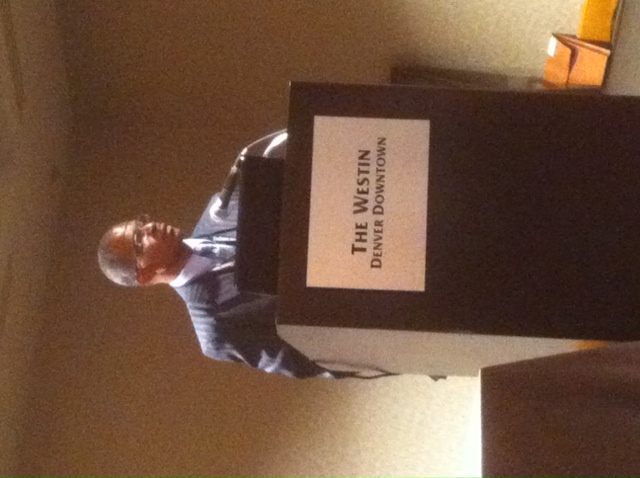
Allen Mendenhall Interviews Richard Miles

In Advocacy, Arts & Letters, Communication, Ethics, Law, News and Current Events, Politics, Prison, Rhetoric, Rhetoric & Communication, Teaching, Writing on September 14, 2011 at 9:23 am

Richard Miles spent years in prison after being wrongly convicted and sentenced to 80 years.  He lives in Texas and speaks about false imprisonment.

Richard, thanks for doing this interview.  You and I have gotten to know each other through email correspondence.  I believe you first contacted me after reading my review of Dorothy and Peyton Budd’s Tested: How Twelve Wrongly Imprisoned Men Held Onto Hope (Dallas, TX: Brown Books Publishing Group, 2010).  You are one of those twelve men.  Tell us how you became part of the book.  What do you think of the book, now that you’ve seen the final product?

The first time anyone heard of or read anything about Richard Ray Miles was in The Dallas Morning NewsI remember that morning as if it was yesterday.  To be arrested for murder and attempted murder, at the age of 19, was a horrific experience, but to wake up Monday morning and read that I was the shooter, in a murder I didn’t commit, tore out my insides.  Mr. Mendenhall, my fight for innocence was not just for me—I knew I was innocent—but for my mom and dad.  I didn’t want the story to be the last thing that my father—a minister in the neighborhood who had to hear accusations about his son—to read.  So, when the book Tested was completed, it was like a dream come true: now Dallas residents could read about MY INNOCENCE. 

You’ve been through a lot.  Would you mind telling us your story?  Start wherever you want to start.

I was born in Dallas to Thelma Malone and Richard Miles.  My parents split when I was young, but not long after my mom met William Lloyd and married him.  I was probably about five when that happened, so to say I was without a father is false.  My dad, William, became a minister when I was still young, so I grew up in a very strict, religious household.  Going to church every day was not out of the ordinary.  For the most part, my older sister, two younger brothers and I had a very good upbringing.

As far as schooling goes, I was very smart and interested in learning.  I went to an academy for middle school and then to Skyline High School, which was one of the most prestigious schools at the time.  When I made it to Skyline, I began to feel something different.  I felt that my parents were way too strict on me.  As young children do, I began to rebel—nothing too extreme, but rebellious nevertheless.  I was kicked out of Skyline at the end of 11th grade and was transferred to Kimball.  Kimball and Skyline were two totally different places to learn.  To be more precise, Kimball was a Hood School; its reputation preceded itself.

By the time I got into Kimball and got ready to take my senior exams, I got a reputation for coming to school drunk.  Mind you, I was not a drinker, so any little thing was not good.  The long and short is that I made it all the way to the 12th grade, but did not graduate.  I left home a little after that, never to be in the streets or in a gang because I was working at McDonalds, and I actually liked the idea of having a job.  All that changed when my friend came to pick me up from my parents’ house.  He asked me about selling drugs.  I had never been introduced to that, and by mere peer pressure, my entire life was turned around.

I struggled on the streets for probably one year, but that was enough to experience a life I will never return to.  On May 15th, I was walking home, not knowing there was a shooting miles away, and I got picked up for a murder and an attempted murder.  I have never shot a gun in my life, nor ever thought about stealing or tried to steal someone’s things by force.  So, I knew I would be going home soon. The whole interrogation lasted probably five or six hours.  Because my friend had driven me home and wasn’t with me when I was walking and got picked up, I gave the detective phone numbers of people who could identify my whereabouts.  My friend had gone to his girlfriend’s place.  That’s why I was walking by myself.  All in all, I gave the detective four phone numbers of people who could verify my whereabouts and confirm that I was not the shooter. The detective left and came back about an hour later.  He said, “Your story checked out, but you killed that man, and you’re going to prison.”  I was lost at that point.

I stayed in the county jail for 17 months before I went to trial.  I was given a court-appointed lawyer. In August 1995, I had a jury trial.  

There were ten witnesses, nine of whom said I was not the shooter.  No weapon was ever found, and the fingerprints that were retrieved were neither mine nor the victims’. One person who was shot testified that I did not look like the shooter, and my alibis came as well.  Nevertheless, I was found guilty of murder and attempted murder and sentenced to 80 years in prison. 

After I had sent out numerous letters and spent 14 years in prison, I was contacted by an organization out of Princeton, New Jersey, that picked up my case and found in the police record an anonymous phone record received before I went to trial.  This record mentioned the real shooter as well as other confidential information.  This stuff had never been turned in.  Based on that and other exculpatory evidence, I was released in October 2009; I was the first non-DNA release under District Attorney Craig Watkins

Now I’m awaiting full exoneration, even though the DA and my judge pronounced me innocent. Read the rest of this entry »

What is a Research Paper, and How Does It Implicate Disciplinarity?

In Arts & Letters, Communication, Law, Legal Education & Pedagogy, Legal Research & Writing, Pedagogy, Rhetoric, Rhetoric & Communication, Teaching, Writing on September 8, 2011 at 10:51 pm

Allen Mendenhall

Richard L. Larson interrogates the “research paper” signifier. He claims that this signifier lacks settled meaning because it “has no conceptual or substantive identity” (218). He calls the term “generic” and “cross-disciplinary” and claims that it “has virtually no value as an identification of a kind of substance in a paper” (218). Despite its empty or fluid meaning, the term “research paper” persists inside and outside English Departments, among faculty and students, at both university and secondary school levels. The problem for Larson is that by perpetuating the use of this slippery signifier, writing instructors mislead students as to what constitutes research and thereby enable bad research.

The term research paper “implicitly equates ‘research’ with looking up books in the library and taking down information from those books” (218); therefore, students learning to write so-called research papers inadvertently narrow their research possibilities by relying on a narrow conception of research as library visitation, note-taking, or whatever, without recognizing other forms of research that may be more discipline-appropriate: interviews, field observations, and the like (218). Using the term “research paper” to describe a particular type of activity implies not only that other, suitable practices are not in fact “research,” but also that students may dispense with elements of logic and citation if their instructors didn’t call the assignment a “research paper.” Really, though, research papers teach skills that apply to all papers, regardless of whether instructors designate a paper as “research.” In a way, all papers are research papers if they draw from sustained observation or studied experience.

Having argued that the term research paper is a vacant signifier—vacant of identity if not of meaning (not that the two are mutually exclusive)—Larson argues that the “provincialism” (220) of writing instructors (by which he means writing instructors’ presumption that they can and should speak across disciplines despite their lack of formal training in other disciplines) leads to a problem of territoriality. Some information belongs in the province of other disciplines, Larson seems to suggest, and writing instructors should not assume that they know enough about other disciplines to communicate in a discipline-appropriate setting. Some knowledge, in other words, lies outside the writing instructor’s jurisdiction. I’m ambivalent on this score. Read the rest of this entry »

Power Made Perfect in Weakness

In Art, Arts & Letters, Communication, Creative Writing, Emerson, Essays, Humanities, Law, Literature, Poetry, Shakespeare, Teaching on August 28, 2011 at 1:30 pm

Allen Mendenhall

I wrote the following piece about three weeks ago, while I was vacationing in Destin, Florida, with my family.

If we expect others to rely on our fairness and justice we must show that we rely on their fairness and justice.

Calvin Coolidge

My wife and I are on vacation in Florida.  Yesterday morning, over a cup of coffee and a doughnut, sitting on the balcony and reading the newspaper amid sounds of seagulls and the grating roll of morning waves, I noted that one Michael Stone—a blind man, XTERRA champion, and 10-time Ironman triathlete who recently published a book, Eye Envy—will speak at the University of North Florida on August 13.  I haven’t read Stone’s book, but it’s apparently a resource not only for those suffering from vision-loss any degenerative disease.

Stone began to lose his sight in 2004.  His blindness is a result of a rare disease called cone-rod dystrophy.  Despite his handicap, he has accomplished amazing things, but not without the help of others.  During races, he relies on guides, who shout directions and warnings to him.

I’ll never understand why God makes some people handicapped and others not, why some must rely on others, and some must be relied on.  Someday and for a time, everyone relies on someone or something and is relied on by someone or something.      Read the rest of this entry »

Note from a Reader: An Article about Leaders in Legal Education

In Law, Legal Education & Pedagogy, Legal Research & Writing, Pedagogy, Teaching on August 2, 2011 at 11:46 am

Allen Mendenhall

A loyal reader of this site has suggested that I post a link to this article about 10 leaders in legal education.  I’m happy to do so.  I’m curious what other readers think of the list. 

Although I’ve posted the list below, I encourage readers to click on the link above to see why these leaders were chosen.

1.  Massachusetts School of Law, Andover

2.  Richard Matasar

3.  Elizabeth Mertz

4.  Association of American Law Schools

5.  Barbara Boxer

6.  David Lat

7.  George Leef

8.  Susan Sturm and Lani Guinier

9.  Bryan Garner

10.  Stephen R. Marsh

The Problem with Legal Education; or, Another Piece About the Aimlessness, Pointlessness, and Groundlessness of Law School

In Arts & Letters, Humanities, Law, Legal Education & Pedagogy, Pedagogy, Teaching, Writing on July 27, 2011 at 2:23 pm

Allen Mendenhall

The latest issue of Academic Questions (Summer 2011: Vol. 24, No. 2) devotes most of its content to legal education.  Published by the National Association of Scholars, Academic Questions often features theme issues and invites scholars from across the disciplines to comment on particular concerns about the professoriate.  (Full disclosure: I am a member of the NAS.)  Carol Iannone, editor at large, titles her introduction to the issue “Law School and Other Tyrannies,” and writes that “[w]hat is happening in the law schools has everything to do with the damage and depredation that we see in the legal system at large.”  She adds that the contributors to this issue “may not agree on all particulars, but they tell us that all is not well, that law school education is outrageously expensive, heavily politicized, and utterly saturated with ‘diversity’ mania.”  What’s more, Iannone submits, law school “fails to provide any grounding in sound legal doctrine, or any moral or ethical basis from which to understand principles of law in debate today.”  These are strong words.  But are they accurate?  I would say yes and no.

Law school education is too expensive, but its costs seem to have risen alongside the costs of university education in general.  Whether any university or postgraduate education should cost what it costs today is another matter altogether.

There is little doubt that law schools are “heavily politicized,” as even a cursory glance at the articles in “specialized” law journals would suggest.  These journals address anything from gender and race to transnational law and human rights.

But how can law be taught without politicizing?  Unlike literature, which does not always immediately implicate politics, law bears a direct relation to politics, or at least to political choices.  The problem is not the political topics of legal scholarship and pedagogy so much as it is the lack of sophistication with which these topics are addressed.  The problem is that many law professors lack a broad historical perspective and are unable to contextualize their interests within the wider university curriculum or against the subtle trends of intellectual history.

In law journals devoted to gender and feminism, or law journals considered left-wing, you will rarely find articles written by individuals with the intelligence or learning of Judith Butler, Camille Paglia, or Eve Sedgwick.  Say what you will about them, these figures are well-read and historically informed.  Their writings and theories go far beyond infantile movement politics and everyday partisan advocacy.    Read the rest of this entry »

What Glynda Hull and Mike Rose Learned from Researching Remedial Writing Programs

In Arts & Letters, Communication, Humanities, Information Design, Legal Research & Writing, Pedagogy, Rhetoric, Rhetoric & Communication, Teaching, Writing on July 20, 2011 at 1:28 pm

Allen Mendenhall

Based on their research of remedial writing programs, Glynda Hull and Mike Rose conclude in “This Wooden Shack Place” that students of writing often offer arguments that at first seem wacky or wrong, but that are actually logical and coherent. These students give unique and insightful interpretations that teachers, fixed in their privileged and heavily conditioned interpretive communities, cannot always realize or appreciate. Hull and Rose treat this student-teacher disjuncture as revealing as much about the teacher as it does about the student. Finally, Hull and Rose conclude that student readings that seem “off the mark” may be “on the mark” depending on where the interpreter—the teacher or student—is coming from or aiming. 

Along these lines, Hull and Rose describe “moments of mismatch between what a teacher expects and what students do.” These moments demonstrate that teachers and students come to writing with different values and assumptions shaped by various experiences. Hull and Rose focus on one student, whom they call “Robert,” to substantiate their claims that students respond to literature based on cultural history and background.

Robert and his peers read a poem that Hull and Rose have reproduced in their essay: “And Your Soul Shall Dance for Wakako Yamauchi.” Working together, the student-readers agreed on certain interpretive generalizations but failed to reach consensus about particular lines and meanings. Some students “offered observations that seemed to be a little off the mark, unusual, as though the students weren’t reading the lines carefully.” Robert, a polite boy with a Caribbean background and Los Angeles upbringing, was one of these students. He commented about the poem in a way that troubled Rose—until, that is, Rose pressed Robert about the poem during a student-teacher conference, which Rose recorded. Robert challenged and surprised Rose at this conference by offering a plausible reading, which Rose had not considered. Read the rest of this entry »

Teaching Bioethics From a Legal Perspective

In Advocacy, Arts & Letters, Bioethics, Communication, Creative Writing, Creativity, Humanities, Jurisprudence, Law, Law-and-Literature, Legal Education & Pedagogy, News and Current Events, Pedagogy, Politics, Rhetoric, Rhetoric & Communication, Teaching, Writing on July 6, 2011 at 8:33 pm

Allen Mendenhall

Last fall, I was assigned to teach a course called “Health & Medicine.”  Because I know little about health or medicine, I was concerned.  The subject of the course was writing, so I decided to craft a syllabus to facilitate classroom discussion and textual argument.  Here is the course description as stated on my syllabus:

Forensic discourse is one of three forms of classical rhetoric as defined by Aristotle.  It focuses on the relationship between language and law.  This semester we will explore forensic discourse in the context of health and medicine and consider the relationship of law to such issues as physician assisted suicide, surrogacy, cloning, informed consent, malpractice, and organ transplants.  Readings on ethics and philosophy will inform the way you think about these issues.

Your grade will not depend on how much you learn about law, but on how you use language to argue about and with law.  Because the facts of any case are rarely clear-cut, you will need to understand both sides of every argument.  Your writing assignments will require you to argue on behalf of both plaintiffs and defendants (or prosecutors and defendants) and to rebut the arguments of opposing counsel.  You will develop different tactics for persuading your audience (judges, attorneys, etc.), and you will become skilled in the art of influence.

During the semester, your class will interview one attorney, one judge, and one justice sitting on the Supreme Court of Alabama.

My students came from mostly nursing and pre-medical backgrounds.  A few were science majors of some kind, and at least two were engineering majors.

The students were also at varying stages in their academic progress: some were freshmen, some were sophomores, two were juniors, and at least one was a senior.  Throughout the semester, I was impressed by students’ ability to extract important issues from dense legal readings and articulate complicated reasoning in nuanced and intelligent ways.

I thought about this “Health & Medicine” class this week when I came across this article published by the Brookings Institution.  The title of the article is “The Problems and Possibilities of Modern Genetics: A Paradigm for Social, Ethical, and Political Analysis.”  The authors are Eric Cohen and Robert P. George.   Cohen is editor of The New Atlantis and an adjunct fellow at the Ethics and Public Policy Center.  George is McCormick Professor of Jurisprudence at Princeton University, the director of the James Madison Program in American Ideals & Institutions, and a fellow at the Hoover InstitutionRead the rest of this entry »

Adam’s Rib and the “Two-Worlds” Problem

In Arts & Letters, Communication, Film, Humanities, Information Design, Law, Legal Education & Pedagogy, Pedagogy, Rhetoric, Shakespeare, Teaching on June 29, 2011 at 1:28 pm

Allen Mendenhall

Directed by George Cukor, the film Adam’s Rib tells the story of Adam (Spencer Tracy) and Amanda Bonner (Katharine Hepburn), New York attorneys whose marriage smacks of “tough love.”  The couple square off when Adam is assigned to prosecute a woman (Judy Holliday) who has attempted to murder her philandering husband—a bumbling dweeb—in the apartment of his mistress.  Amanda, who approves of the woman’s act, which she views as resistance to patriarchal society, takes up the case as defense counsel.

Genesis tells us that God fashioned Adam from dust, Eve from Adam’s rib.  Adam’s Rib tells a different story.

If anything, Amanda, or “Eve,” is the starting-point—a source of controversy, inspiration, and curiosity.  Adam’s Rib isn’t the first production to render gender contests in comedic tones—it’s part of a tradition dating back at least to Shakespeare’s Taming of the Shrew or Fletcher’s Tamer Tamed, and probably much further—but it is one of the more remarkable of all twentieth-century productions, especially in light of Amanda’s advocacy for a doctrine that, in American family law, came to be known as “formal equality.”

What, exactly, does Adam’s Rib offer law students?  What does it teach law students, and why should law professors bother with it?

A film that’s in no way after verisimilitude is unlikely to teach law students how to file motions, write briefs, analyze statutes, or bill clients—tasks that we assume are requisite to becoming “good” lawyers.  So what’s the point?

In his cunning way, James Elkins, during his Lawyers & Film course that I took in law school, responded to questions of this variety by drawing two boxes on the blackboard: one representing law, the other film.

“We’ve gotta get from this box to this box,” he explained, retracing the diagram with the tip of his chalk.  “One place to start,” he suggested, “is with the movie scenes depicting lawyers or the courtroom.”  Read the rest of this entry »

Screening Legal Education

In Arts & Letters, Creativity, Film, Humanities, Law, Legal Education & Pedagogy, Pedagogy, Rhetoric, Teaching, Writing on June 15, 2011 at 10:59 pm

Allen Mendenhall

We go to the movies to enter a new, fascinating world, to inhabit vicariously another human being who at first seems so unlike us and yet at heart is like us, to live in a fictional reality that illuminates our daily reality.  We do not wish to escape life but to find life, to use our minds in fresh, experimental ways, to flex our emotions, to enjoy, to learn, to add depth to our days.

 —Robert McKee, from Story

Law school is, in a way, about performing.  From the minute you walk into the building as a 1L, you search for and construct a new identity—one that conforms to your assumptions of what a lawyer is and does.

The first time a professor called on me—Mr. Mendenhall, can you tell us how the judge in this case distinguishes restitutionary from reliance damages?—I panicked.  I knew the answer.  More or less.  But I had no chance to rehearse.  Here I was, before a large audience, a packed house, all alone, all eyes on me.

“Um, yes,” I stammered, apparently suffering from stage fright.

I don’t remember how I answered—not precisely—but I remember taking a deep breath, feigning confidence, and pretending to know what the professor expected me to know.  I must’ve sounded silly talking about things I hardly understood; but I must’ve performed satisfactorily because the professor let me alone and interrogated another student.

My first audition.  Read the rest of this entry »