See Disclaimer Below.

Archive for 2013|Yearly archive page

Edgar Allan Poe and Mesmeric Possibility

In American History, Arts & Letters, Fiction, History, Humanities, Literary Theory & Criticism, Literature, Nineteenth-Century America, Writing on May 15, 2013 at 8:45 am

Allen Mendenhall

This piece first appeared here at The Literary Table in 2010.

Sidney E. Lind, writing in the 1940s, said of the “mesmeric lexica” of nineteenth-century America:  “It is safe to say that the terminology of mesmerism was bandied about in much the same manner as the language of psychoanalysis was to be eighty years later, and with, in all probability, as little real comprehension on the part of the public.”

Lind’s reference to psychoanalysis—signified, at that moment, by Austrian physicist Sigmund Freud—is particularly telling for 21st century audiences, who have witnessed an avalanche of criticism of psychoanalysis, a pseudoscience, according to the naysayers, the results of which are un-testable at best and bogus at worst.  Lind’s aim is not to destabilize the practices of psychoanalysis but to interrogate three short works by Edgar Allan Poe in which mesmerism features prominently:  “A Tale of the Ragged Mountains,” “Mesmeric Revelation,” and “The Facts in the Case of M. Valdemar.”  “These three stories,” Lind submits, “constitute a series within which the mesmeric experiment becomes more profound, irrespective of plausibility or implausibility, or of whether or not Poe in at least two of the three was hoaxing his readers.”

Lind’s point is well-taken.  In Poe’s day, the subject of mesmerism was “in the air” and therefore “it was logical that Poe, as a journalist sensitive to popular interest, should have exploited it.”  True, these three stories exhibit, often wryly, a profound familiarity with mesmeric techniques and influences.  But more is going on in them than Lind lets on.  Indeed, Lind goes to great lengths to contextualize these stories within scientific (or other) discourses on mesmerism in Poe’s era, but he overemphasizes their “unity,” “theme,” and “intention” (always mimetic) instead of their singular dialogic contribution.  That is to say, Lind treats the stories as “echoes” or “reiterations” of other thinkers rather than as unique theses in their own right.  For Lind, the stories are indebted to other sources because they derive their vocabularies and methods from these sources.  I would suggest that Poe’s stories are in conversation with various dissertations on mesmerism rather than mere signs of cherry-picking or copying.  Although Poe’s modus operandi or preferred genre is fiction, his supposedly plagiarized passages lend substance to the notion that he might actually have been dissertating on mesmerism, animal magnetism, or hypnosis.  The luxury of storytelling is that the storyteller can dismiss unverifiable data as hoaxes or products of imagination; nevertheless, the storyteller can at least hope to hit on something real, novel, or scientific.  Two examples, Jules Verne and H.G. Wells, writing well after Poe, conceived of technological advances—most notably space travel—long before such advances were practical.

Lind’s work, at any rate, is impressively researched, laying the foundation for future analyses of Poe and his infatuations with mesmerism.  But why does Lind downplay Poe’s role in developing pioneering work?  All arguments are indebted to previous arguments; indebtedness does not take away from the originality or force of their articulation or genre.

Unlike Lind, Matthew A. Taylor calls attention to the distinctiveness of Poe’s contributions to “mesmeric theory” (for want of a better phrase) and its progeny.  He locates Poe in contradistinction to Herbert Mayo:  “Unlike Mayo, […] Poe radically deviated from the utopian utilitarian, or benign notions of mesmerism at play in most contemporary discourses on the topic, picturing instead the unsettling implications for human ontology consequent upon the idea that persons are less sovereign entities than manipulatable effects of external powers.”  In short, Poe considered mesmerism a bad thing, or at least a dangerous thing that did not lead down a road to human improvement.  “Poe concluded,” Taylor opines, “that an all-encompassing cosmic energy inevitably troubles human-being by suspending the autonomy and interiority of individual humans; the disorientation of normal, corporeal functioning and the literal loss of self-possession attending mesmeric practice illustrated for Poe the fact that people are little more than occasions for the demonstration of an impersonal power.”  If Taylor is right, then Poe’s take on mesmerism is not only unique but also quite sophisticated; it demonstrates a full understanding of mesmeric theory while simultaneously rejecting that theory.  More to the point, if Taylor is right, then Poe’s take on mesmerism stands on its own and demands critical attention.  Unlike Lind, Taylor seems to acknowledge Poe’s special role in shaping mesmeric theory—or, more precisely, mesmeric counter-theory.  In fact, Taylor seems to think Poe’s ideas about mesmerism reflect an entire cosmology about human nature and the imperfectability of humankind.  This is a tall claim.  For present purposes, it shows that Poe might have been worried about more than entertaining readers with fanciful mind-candy.  He might have been positing a worldview that flew in the face of prevailing physics (that “perverse yet consistent calculus that unites everything in existence under a single, universal law that, by definition, eliminates all difference—including, of course, the human difference”).  Poe, the relativistic Renaissance man, might have been demonstrating his facility as both scientist and philosopher.  To further establish Poe’s uniqueness, I might add to Taylor’s observations the theological dimension of “Mesmeric Revelation,” which accounts for evangelical objections to mesmerism without plainly endorsing or rejecting them.

Besides the three stories that Lind interrogates, there are, Martin Willis claims, “many other tales that exemplify [Poe’s] abiding interest in the contestation between the science and the human, as well as his fascination with the borderlands of scientific achievement, both in terms of their advancement to new states of knowledge and their place within the scientific pantheon.”  Poe’s interest in scientific trends was not a passing one.  Willis points out that Poe spent years studying science in general before turning to mesmerism in particular.  Whether Poe “believed” in mesmerism is unclear.  It seems plausible that his stories about mesmerism were meant, in Willis’s words,  to “consider mesmeric debates in the realm of fiction rather than that of science.”  I would argue that Poe collapses any distinction between science and fiction by teasing out various theses—which, for all he knew, might one day be proven—through the medium of imaginary characters.  In doing so, Poe forges a distance between theories and their authors: if the theories turn out to be “true,” future generations will consider Poe a genius; if they turn out to be bogus, future generations will claim Poe was merely hoaxing.  Thus the dual-advantage of employing fiction to hash out scientific hypotheses.  Regardless of whether Poe is ultimately “right” about any of his dissertations, which he dresses up as fiction, he demonstrates an impressive breadth of knowledge that should not be ignored.

Not all scholars have ignored it.  Antoine Faivre takes pains to explain how Poe appropriated scientific knowledge and then inserted it into fictional narratives.  He suggests that many readers have mistaken or misread Poe’s tales as “factual, non-fictional case studies,” which in turn has led to a “flurry of reactions and debates.”  My point is not to argue that Poe treats his stories as factual case-studies but to suggest that he left open the case-study possibility.  In other words, Poe might have wanted readers to misread his tales as factual, or else to have some later scientist come along and verify the “truth” of his hypotheses, notwithstanding whether they were in fact his, or whether they were intended as reasoned argument at all.

Lind allows that Poe might not have been hoaxing readers in writing about mesmerism.  “Mesmerism as a theme for fiction,” he explains, “was, like metempsychosis and the exploration of the realm of the conscience, so well suited to Poe’s principles of literary composition that it was natural for him to work this new field, to attempt to achieve the sensational without deliberately attempting to mislead.”  More than simply avoiding misleading commentary, Poe might have been dissertating with the hopes that, one day, scientists would look on his fiction as a catalyst for new and innovative practices.  While not aspiring to complete verisimilitude, Poe’s stories about mesmerism are highly sophisticated tracts, informed by trendy scientific theories (and their counter-discourses), and very probably marked with the faint expectation that their subjects, though fictional, might somehow contribute to future systems of knowledge.

See the following for further reading:

Faivre, Antoine.  “Borrowings and Misreading:  Edgar Allan Poe’s ‘Mesmeric’ Tales and the Strange Case of their Reception.”  Aries, Vol. 7, No. 1 (2007: 21-62).

Lind, Sidney E.  “Poe and Mesmerism.”  PMLA, Vol. 62, No. 4 (1947:  1077-1094).

Torrey, E. Fuller.  Freudian Fraud:  The Malignant Effect of Freud’s Theory on American Thought and Culture. Lucas Publishers, 1999.

Taylor, Matthew A.  “Edgar Allan Poe’s (Meta)physics:  A Pre-History of the Post Human.”  Nineteenth-Century Literature, Vol. 62, No. 2 (2007: 193-221).

Willis, Martin.  Mesmerists, Monsters, and Machines:  Science Fiction and the Cultures of Science in the Nineteenth Century. Kent State University Press, 2006.

In Memory of My Grandfather

In Arts & Letters, Christianity on May 8, 2013 at 8:45 am

Allen Mendenhall


The following was delivered at the graveside of my grandfather, “Papa,” on May 5, 2013.

Julius “Jay” Porter Farish, III

November 15, 1929 May 2, 2013

You could have given me from now until eternity to write something special about Papa, and I would not have found the right words.  Sometimes words alone can’t convey the way you feel about someone, the way someone makes you feel.  Papa is beyond words.

But then again, sometimes words aren’t necessary.  They only get in the way. Papa had the knack and, as a grandfather, the prerogative to teach by example rather than by stated words or instruction.  I learned by watching him.

He taught me how a man is supposed to conduct himself, how a man is supposed to dress, how a man is supposed to love and care for his wife, how a man is supposed to love his children and raise a family and fear the Lord.  Without having to discuss them, he gave me standards to live by and goals to reach.

When I was thirteen and Brett was eleven, Nina and Papa came to our house to stay with us—our parents must have gone out of town—and we begged Papa to play us in basketball.  He did.  And he “whipped” us.  It was two against one, but Papa, who must have been in his late sixties, had not lost his touch with his two handed jump shots or his Wilt Chamberlin-like hook shots.  Brett and I were amazed by the ease with which he rebounded over us and buried his three-pointers.  We didn’t take losing very well, except on that day, when losing made us proud.

Young boys always look forward to becoming grown men, and having become grown men, wish they were still young boys.  Papa knew this and treated my brother and me as if our opinions mattered to him.  And they did matter to him.

During a trip to Arizona, in a hotel in Flagstaff, Brett and I would wake up early—about 6:00 a.m.—to make sure we were downstairs in the hotel restaurant to drink coffee (which we never drank at home) and read the newspaper with Papa.  We must have made quite a sight: two prepubescent boys with our heads buried in the newspaper, sipping coffee and passing judgment on current events, Papa looking on and nodding in qualified admiration and probably enjoying our enjoyment more than anything else.

On another occasion, Papa took us rafting down the Snake River in Wyoming.  Some Canadians were in the raft with us, and Brett, for some reason, took to lying flat on his back in the middle of the raft.  He took up so much space that the Canadians started muttering among themselves, quietly at first but then with whispers loud enough for Papa to hear.  “Come here, Brett,” Papa said, rearranging his large body and cramping himself into the smallest, tightest position he could.  “You can lie down here,” he said.

Brett, who was only about ten and didn’t notice that the Canadians had grown restless, moved over to where Papa was sitting and sprawled out there.  The Canadians, seeing the sacrifice Papa had made, seemed satisfied at first, but then the apparent leader of these tough-to-please people of the North decided that this was not enough.  The leader cut a glance at Papa that seemed to say, “Aren’t you gonna punish him?”  Papa looked at the man, not angrily, stretched out his long body, and made as if he were going to get up—all gently to remind our companions who the strongest man on the raft was.  He patted Brett on the head and said, “This is my grandson.”  And the man understood, or pretended he did for his own sake.

The only time mom ever let me out of school to play golf was when Papa told her that he wanted to take me to play.  I missed Science and Social Studies that day so that Papa and I could fit in nine holes at Atlanta Country Club.  Before the round, he took me into the caddy shack to introduce me to the caddies, all old black men who told me how much Papa liked to take them fishing.  I later learned that they weren’t allowed to fish the ponds on the course unless a member was with them.

I could tell dozens of stories about Papa. There are at least a hundred paths I have or haven’t traveled because I thought Papa would or wouldn’t approve.  I’m not sure there was ever a moment I spent with him in which I didn’t learn something.

But the most important thing I learned from him was how to be a leader in Christ.  As the oldest sibling and oldest grandson, I’ve known something of the responsibility of setting precedent and leading by example, but I’m afraid I’ve fallen short in more ways than I’ve succeeded.  Now I’m a father and faced with the nearly overwhelming responsibility of raising a son in a fallen world, and sometimes I get so discouraged by what I read in the news and see on television that I fear for my son and my future children who must live in this time and place.

And then I remember the effect that Papa had on me and think about the possibility that, God willing, I could have that effect on someone else, and I realize there is hope.  Papa himself realized there was hope when he was brought to tears while driving through Ohio on a business trip one day and gave himself to Christ.

And then there was the time Papa did put his instruction into words.  On May 20, 2001, he wrote me a letter after I graduated high school.  In it, he said, “As you begin a new chapter in your life, I would recommend that you ask God to give you a vision for your life…He will not let you down because He desires the very best for you at everything good you try.”  I followed Papa’s advice, but over the years I was much more likely to create my own visions for my life rather than to ask God for His.  Now I look around me at my wife, son, family, house, and job and realize that God has blessed me with so many things that were never part of my vision for myself, and I realize, too, that Papa was right: God’s vision is so much greater than ours; His gifts are far more precious than anything we could imagine or create for ourselves.

The Book of James tells us that we are just a vapor that appears for a little while and then vanishes away.  As the psalm says, “As for man, his days are like grass; he flourishes like a flower of the field; for the wind passes over it, and it is gone.”  I always wanted to believe that Papa would last forever, that this day would never come.

I was half right: because of the grace of God and the sacrifice of His Son, Jesus Christ, Papa will last forever.  And although it is tough to overcome my own selfish desire to have Papa here on earth with me, it is also comforting, humbling, and empowering to know that he is with the Father and that one day I will be too.  I look forward to that day, and until it comes, hope that I can be at least half the man Papa was.

Thank you, God, for allowing us to know Papa.  We are all better people for it.

Law as a Seed

In Arts & Letters, Humanities, Law, Literary Theory & Criticism on May 1, 2013 at 8:45 am

Allen Mendenhall

Jesus of Nazareth delivered the parable of the growing seed,[1] which referred to the kingdom of God and its capacity for organic growth.  The principle from that parable carries over into the legal realm.  For the law evolves from the scattered seeds of human conduct; ripens as a result of human care; and then, on its own, apart from human care, imperceptivity and spontaneously sprouts grain, which, in turn, spreads into abundant crops for the nourishment of the human and animal bodies that, one by one, enable the flourishing of the seeds to begin with.  Growth is cyclical in the sense that it consists of these stages, but linear in the sense that the stages are not exactly alike; each stage is different depending upon the conditions present during its lifespan.  Yeats’s gyre is a helpful interpretive parallel in this regard.

Just as the polis cultivating the Word of God will bear cultural and spiritual fruit for itself and its progeny, so the polis prioritizing law will bear cultural and economic fruit for itself and its progeny. This analogy is not intended to endow human law with spiritual qualities or sacrilegiously to equate human law with divine purpose; it is intended to suggest that law should be treated with high seriousness rather than casual interest, although the law is not a savior and ought not to be celebrated or glorified as such.  The laws of human relations remain primarily secular.  That is not a normative statement about what the laws ought to be, merely a comment on what the laws as a human construct are at present.  If we are to be governed by divine law, we can be sure that it precedes human law and that no human law could mirror it.


[1] Mark 4:26-28.

Sara Blair’s “Local Modernity, Global Modernism”

In Arts & Letters, Britain, British Literature, Fiction, History, Humanities, Literary Theory & Criticism, Literature, Novels, Writing on April 24, 2013 at 8:45 am

Allen Mendenhall

Sara Blair’s “Local Modernity, Global Modernism” describes the colorful landscape of the Bloomsbury district and proposes, among other things, that Bloomsbury the geographical space preceded Bloomsbury the movement; the site of Bloomsbury, reputedly “performative” or “kaleidoscopic,” provided the heterogeneous and cosmopolitan culture and influence necessary for the movement to flourish.

Blair admits that “[t]o insist that the sociality producing such definitive performances is itself located […] is not to resolve the question of the relations between literary modes and their geocultural contexts.” And yet she offers that such insistence “does help us think more imaginatively about how to frame such relations.” One might ask, then, what “imaginative” links could be made between the “modernist” attributes of Bloomsbury the place and, say, Virginia Woolf’s personal literary style.

“With rare exceptions, Woolf writes little about the texture of Bloomsbury […] spaces, institutions, and local histories,” submits Blair, adding that Woolf does in fact “richly register and exploit a larger fact of Bloomsbury already suggested in Black’s and Baedeker’s maps: its function not merely as a marginal space or a site of uneven alterities but simultaneously also as a lived form of […] the non-lieu, or non-place.” If the non-place is represented in Woolf’s work, and if the non-place is “a space of transition, anticipation, and fluid movement,” then we might view her novel Jacob’s Room as a series of transitional, liminal, or unfixed settings—as a sketchy composite of Jacob that is something like an impressionistic painting. This reading would be consistent with Blair’s idea that Bloomsbury functions “to organize psychic and social relations to other more immediately functional spaces.” If one were to read Jacob’s Room as a sequence of kaleidoscopic settings or spaces, organized chronologically but never quite fixed in place and time, then one might see something of the dislocating characteristics of Bloomsbury the place throughout the novel. It is in this context that one can claim Woolf’s style as itself a signifier of “Bloomsbury.” As Blair puts it, “Woolf’s own evocative narratology […] can be read as a response to both the ambient facts of Bloomsbury’s heterogeneity and its status as a non-place alike.”

Can we link the dreamlike fluidity of Jacob’s Room with the distinct fluidity of Bloomsbury culture as described by Blair. Should we even try? Blair seems to believe that we not only can, but should: “While a more systematic reading of the relations between Bloomsbury as a site of social experience and cultural generation and the work of ‘Bloomsbury,’ particularly Woolf’s, is called for, it remains beyond my scope here.” A good challenge for students is to consider how they can expand Blair’s scope and to debate whether they would be “overreading” Jacob’s Room (or any novel by Woolf and the Bloomsbury crowd) by trying to locate it in the larger modernist context of “Bloomsbury” (both the space and the movement).

See Sara Blair, “Local Modernity, Global Modernism.” ELH, Vol. 71, No. 3 (Fall 2004), pp. 813-838.

The Lawyer as Rationalist

In Arts & Letters, Conservatism, History, Law, Philosophy on April 17, 2013 at 8:45 am

Allen Mendenhall

The rationalist lawyer does not disparage an ideal on the grounds that it does not work or cannot be tried.  “He has no sense of the cumulation of experience,” Michael Oakeshott bemoaned of the rationalist, “only of the readiness of experience when it has been converted into a formula: the past is significant to him only as an encumbrance.”[1]  The lawyer is a rationalist insofar as he is interested in a past that supplies him with the precedents and procedures that steer his practice and win his battles; such a past is an encumbrance because it never exists in the pure form that the lawyer seeks and needs.  Therefore, the lawyer must push against the past, reinvent it, stretch it, mold it into a usable form; the past, for him, is a religion of malleability: to be faithful to it is to rewrite or reinterpret it.

The lawyer, being a rationalist, minces words and retards conventions to achieve the goals that benefit him and his client, paying little regard to whether his chosen grammar and syntax will impair the harmony of the community.  He is trained, not educated; progressive, not conservative.  His aim is to innovate in the service of short-lived victories.  To be a good lawyer is not necessarily or even usually to be a moral or thoughtful person; it is to zealously represent the client by aligning the law with the facts of the case as they have been filtered through the minds and mouths of the parties.  It is to prevail by fusing abstract rules with secondhand information.  The lawyer, accordingly, is intelligent—highly so—but not honorable or ethical.  He is, in short, a repository into which filtered discourse flows, and through which discourse is enunciated into the machine of the system for further processing.

“[H]aving cut himself off from the traditional knowledge of his society, and denied the value of education more extensive than a training in a technique of analysis,” Oakeshott persists of the rationalist—or, for my purposes, the lawyer—“is apt to attribute to mankind a necessary inexperience in all the critical moments of life.”[2]  Hence the trouble with the lawyer: his ambition is rarely tempered by his inadequacies, his analytic mind seeks out models for the mastery of human behavior, his poise in the face of adversity betrays his naiveté, his reliance on his own intents and purposes for action (rather than on those of his ancestors or immediate community) reveals a grave shortsightedness that can lead only to subtle and progressive harm.

Do not misunderstand me: what I call “the lawyer” is an archetype, not a group of named individuals.  The common legal practitioner is not an Iago bent on weaving webs of wickedness with motives only sinister.  But the lawyer archetype, like all archetypes, contains truth.  It is because Atticus Finch is so unlike the typical lawyer that he stands out in our memory and is said to have redeemed the law.  Lawyer jokes did not arise in a vacuum; and the rules of ethics and professional responsibility did not come about because the public considered lawyers to be noble and upright.  So, when I refer to “the lawyer,” I do not mean any one man or woman, nor each and every lawyer, but I do mean to signal (1) the symbol of the lawyer that is based on real patterns of behavior, which are passed from one generation of lawyers to the next; (2) a personality type that can and has been observed in lawyers in different times and places; and (3) a model that lawyers have emulated and perpetuated to their own detriment.


[1] Michael Oakeshott, Rationalism in Politics and Other Essays (Indianapolis: Liberty Fund, 1991), p. 6.

[2] Id. at 7.

Allen Mendenhall Interviews Lauren Clark

In Arts & Letters, Fiction, Literature, Southern Literary Review, Writing on April 10, 2013 at 8:45 am

Lauren Clark

This interview originally appeared here at Southern Literary Review.

AM: Lauren, thank you for doing this interview. I’m glad to have the opportunity to ask you about Dancing Naked in Dixie. Before I get to the book, though, I’d like to ask you about your transition from television to writing. How did that transition take place?

LC: I loved working in TV news and it was great when my son was little. I worked for two different CBS stations — first anchoring the weekend news and then the morning news in Dothan, Alabama. The shift was 2 am to 10 am, so after three years, I needed a change and a regular schedule. I then took a job in pharmaceutical sales, but was able to transition into stay-at-home mom and full-time writer soon after. It’s what I’ve always wanted to do as a career.

AM: Okay, on to Dancing Naked in Dixie. The protagonist of the book is Julia Sullivan. Tell us about her. What was the impetus behind this character? Did you develop her in stages, or did you have some preconceived notion of her character that you wanted to realize in the text?

LC: Fortunately, Julia Sullivan came to the pages of Dixie almost fully formed. She is a well-traveled writer, perpetually busy, and married to her job — largely to avoid dealing with her mother’s death, her boyfriend, and a painful estrangement from her father. She’s talented, with personality — but definitely has an ADHD side that gets her into some trouble when she acts before she thinks.

There’s a lot of me in Julia — especially since I made the move from New York to Alabama twelve years ago. Many of her experiences (sweet tea, fire ants) are based on my experiences.

Julia was developed with change in mind. I wanted her out of her comfort zone, in a totally new environment that she’d decided to dislike. Much of Dixie involves Julia discovering secrets about her parents’ relationship and realizing that forgiveness isn’t as frightening as she believes.

AM: Within the last month, I’ve become an Alabamian, and I grew up taking family vacations to Destin, Florida, by way of Eufaula, Alabama, so I’m interested in the role that Eufaula plays in Dancing Naked in Dixie. Why Eufaula? What made you choose this city?

LC: Eufaula is my favorite Alabama city. When I was an anchor at WTVY in Dothan, I loved driving up on the weekends and having a light lunch, stopping at Shorter Mansion, and browsing in the lovely gift shops. Lake Eufaula is nearby, and on my trips to Atlanta, I would often stop at the state park to take in the beautiful, calming scenery.

I’ve attended the Pilgrimage several times, but it was during one of the candlelight tours, with everyone in antebellum costume, that I decided Eufaula provided that bit of magic that would make it the perfect setting for a story.

AM: Julia is, you could say, a cosmopolitan jetsetter who, due to events largely out of her control, finds herself living and working in Alabama. Do you think the South is indispensable to your writing? In other words, could the narrative in Dancing Naked in Dixie have transpired in some other geographical area? If not, why not?

LC: The South is indispensable to Dixie, and all of my books, to some extent, have Southern ties. Julia’s story — her cosmopolitan edge and big city sharpness — had to be balanced out with the warm and loving nature of the Deep South. It became the perfect balance to round out her empty life, the yin to her yang.

I am sure that many talented writers could place the story with a “Julia” character traveling from the majestic Pacific Northwest to the warmth of New Mexico or Arizona, but I prefer to write from experience and draw on the sights and sounds that I know and love. For me, there’s a certain charm about the Deep South that can’t be duplicated.

AM: Where would you direct our readers to learn more about you and your work?

LC: I really appreciate my readers so much and love to hear from anyone who’s read my work. I welcome emails at laurenclarkbooks@gmail.com. I’m also on Goodreads (GoodReads), Facebook (Lauren Facebook) and Twitter (LaurenClark_Bks).

You can also find more information about my latest release Stardust Summer (February 14, 2013), on my website (Lauren Clark Books) and blog (Lauren Clark Blog).

Dixie on Amazon in paperback, ebook, or audiobook: Click here.

Dixie on BN.com: Click here.

AM: Thank you for taking the time, Lauren. I wish you all the best.

LC: Thank you.

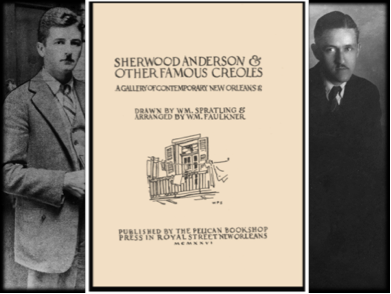
Auction Announcement: William Spratling and William Faulkner, Sherwood Anderson and Other Famous Creoles: A Gallery of Contemporary New Orleans

In American History, Arts & Letters, Books, History, Humanities, Literature, News and Current Events, News Release, Southern History, Southern Literary Review, The South, Writing on April 5, 2013 at 8:45 am

Famous Creoles

William Spratling and William Faulkner, Sherwood Anderson and Other Famous Creoles: A Gallery of Contemporary New Orleans, published by Pelican Bookshop Press, New Orleans, 1926, first edition, first issue, number 217 of 250, bound in green boards, with label on front cover, interior of back cover with a label printed “Rebound in L’ATELIER Le Loup” and dated in ink “1986”.

Provenance: From the collection of Stephanie Durant, by descent from the collection of Ray Samuel.

A special copy of a rare and fragile book described by The Booklover’s Guide to New Orleans as “one of the great literary curiosities in the city’s history.” The book comprises Spratling’s drawings of himself, Faulkner, and 41 of their acquaintances–artists, musicians, academics, preservationists, and socialites, “artful and crafty ones of French Quarter” with some of their uptown friends and patrons. One was novelist Sherwood Anderson, and Faulkner’s introduction parodies Anderson’s style.


The note above is taken from the catalog description of an extraordinary book that will be sold at auction on April 19.  The book has been given by Stephanie Durant of New Orleans to be sold for the benefit of the Ogden Museum of Southern Art, and the sale will be conducted by the New Orleans Auction Galleries, which will donate its commission to the museum as well.

This copy is uniquely valuable because it is signed by 41 of the 43 persons included,

in a few cases with personal notes to its original owner. (See below for a complete list.) That number of autographs is certainly a record: The only other copy I know with more than a dozen or so is one with 31, and it was stolen from a Charlottesville, Virginia, bookshop some time ago.

The catalog description is accurate as far as it goes, but there is a great deal more to be said about this odd little book, written by two young men who went on to become arguably the greatest American novelist and the greatest Mexican silver designer of the twentieth century.  Those depicted include both figures well-known at the time, like writer Grace King and artist Ellsworth Woodward, and some who would become well-known later, like artist Caroline Durieux and writer Hamilton Basso. The title, an obscure joke, refers to a book of caricatures entitled The Prince of Wales and Other Famous Americans, by Vanity Fair cartoonist Miguel Covarrubias (to whom Famous Creoles is dedicated). The “Pelican Bookshop Press” was a fiction: Spratling and Faulkner paid a local printer to produce 250 copies. Spratling (though, note, not Faulkner) signed and hand-tinted some images in 50, mostly for the friends who were included. There was a second printing of 150 copies, somewhat less valuable on the rare book market. The book was not at all sturdy, and it is not unusual to find copies that have been repaired or, like this one, rebound. Many copies have presumably fallen apart and been discarded. Musician Harold Levy’s hand-tinted copy was destroyed by Hurricane Katrina.

The original owner of this particular copy, Stella Lengsfield Lazard, signed her name in ink on inside front. In 1926 Mrs. Lazard was 43. Her husband, Henry Calme Lazard, was a stockbroker related by blood and marriage to several distinguished mercantile and financial families in New Orleans and elsewhere. The couple had one grown son, and lived with her parents uptown on St. Charles Avenue.  (Her father was a successful cotton factor.)

Mrs. Lazard had literary, historical, and musical interests.  In 1925 she wrote a series of feature articles for the Times-Picayune on the mayors of New Orleans, and a few years later she served as narrator for a weekly musical program on WDSU radio, “Sweet Mystery of the Air,” featuring a trio of local musicians: harpist, violinist, and tenor.  To judge by the inscriptions in her copy of Famous Creoles, she was friends with a number of those included.  For instance, one reads, “To Stella, the star, from the stellar Helen Pitkin Schertz”; Flo Field wrote “Love to my old staunch [?] friend”; and William “Cicero” Odiorne, who was in Paris, wrote “When are you coming over?”

Others who did more than simply sign their names include writers Sherwood Anderson and Roark Bradford; artists Conrad Albrizio, Marc Antony, and Virginia Parker Nagel; Tulane cheerleader Marian Draper; and Lillian Friend Marcus, managing editor of the Double Dealer magazine. The presidents of Tulane and of Le Petit Théatre, A. B. Dinwiddie and Mrs. J. O. Nixon, simply added their institutional affiliations.  Natalie Scott just signed the page with her picture on it, but a note in Mrs. Lazard’s hand identifies a building shown in the picture as the Court of Two Sisters (which Miss Scott owned).  One amusing addition: On an almost blank page Arthur Feitel, a 34-year-old bachelor architect, wrote “Me, too” and signed his name.  Feitel, whose picture was not included, was a Tulane graduate who had studied at the Ecole des Beaux Arts; he would later serve as president of both the Art Association of New Orleans and the board of the Delgado Museum.

Only two “Famous Creoles” did not sign Mrs. Lazard’s book. One is easily explained. By the time the book appeared Ronald Hargrave was pretty much incommunicado; he was painting in Majorca, and he never returned to New Orleans. But the other missing signature is that of William Faulkner. It seems to me that Mrs. Lazard went to a great deal of trouble to track down people to sign her book (William Odiorne signed it, and he was in Paris), so it is almost inconceivable that she didn’t ask Faulkner. He must have refused to sign, possibly just out of general cussedness — he was known for being moody and sometimes difficult, and he didn’t sign the 50 copies that Spratling hand-tinted either. In addition, however, Faulkner didn’t care for “artsy” uptown people he thought were dilettantes (unlike Spratling, who enjoyed their company), and he may have viewed Mrs. Lazard as one of them. Whatever the explanation, in some ways Faulkner’s absence may actually be more interesting than a perfunctory autograph would have been.

Mrs. Lazard’s copy was eventually acquired by Stephanie Durant’s father, J. Raymond Samuel, a well-known historian, collector and (in his retirement years) dealer in books and art. On his death the book passed to Mrs. Durant, who has now generously given it to benefit the Ogden Museum.


–John Shelton Reed, University of North Carolina at Chapel Hill,

Author of Dixie Bohemia: A French Quarter Circle in the 1920s


Inquiries about the auction should be directed to :


Jelena James

New Orleans Auction Galleries                                                        <jelena@neworleansauction.com>

801 Magazine Street                                                                          800-501-0277
New Orleans, Louisiana 70130                                                        504-566-1849


“Famous Creoles”

(with ages in 1926)

Signed Lazard copy

Conrad Albrizio, 27

New York-born, serious artist, Spratling’s neighbor, Arts and Crafts Club

stalwart

Sherwood Anderson, 50

“Lion of the Latin Quarter,” eminence gris, generous to respectful younger

writers

Marc Antony and Lucille Godchaux Antony, both 28

Love-match between heiress and lower-middle-class boy, local artists

Hamilton “Ham” Basso, 22

Star-struck recent Tulane grad, aspiring writer, good dancer

Charles “Uncle Charlie” Bein, 35

Director of Arts and Crafts Club’s art school; lived with mother, sister,

and aunt

Frans Blom, 33

Danish archeologist of Maya, Tulane professor, colorful resident of

Quarter

Roark Bradford, 30

Newspaperman, jokester, hit pay dirt with Negro dialect stories

Nathaniel Cortlandt Curtis, 45

Tulane architecture professor, preservationist, recorded old buildings

Albert Bledsoe Dinwiddie, 55

President of Tulane, Presbyterian

Marian Draper, 20

Ziegfeld Follies alum, Tulane cheerleader, prize-winning architecture

student

Caroline “Carrie” Wogan Durieux, 30

Genuine Creole, talented artist living in Cuba and Mexico, painted by Rivera

Flo Field, 50

French Quarter guide, ex-journalist, sometime playwright, single mother

Louis Andrews Fischer, 25

Gender-bending Mardi Gras designer, named for her father

Meigs O. Frost, 44

Reporter’s reporter; lived in Quarter; covered crime, revolutions, and arts

Samuel Louis “Sam” Gilmore, 27

Greenery-yallery poet and playwright, from prominent family

Moise Goldstein, 44

Versatile and successful architect, preservationist, active in Arts and

Crafts Club

Weeks Hall, 32

Master of and slave to Shadows-on-the-Teche plantation, painter, deeply

strange

R. Emmet Kennedy, 49

Working-class Irish boy, collected and performed Negro songs and stories

Grace King, 74

Grande dame of local color literature and no-fault history, salonnière

Alberta Kinsey, 51

Quaker spinster, Quarter pioneer, indefatigable painter of courtyards

Richard R. Kirk, 49

Tulane English professor and poet, loyal Michigan Wolverine alumnus

Oliver La Farge, 25

New England Brahmin, Tulane anthropologist and fiction-writer, liked

a party

Harold Levy, 32

Musician who ran family’s box factory, knew everybody, turned up

everywhere

Lillian Friend Marcus, 35

Young widow from wealthy family, angel and manager of Double Dealer

John “Jack” McClure, 33

Poet, newspaper columnist and reviewer, Double Dealer editor, bookshop

owner

Virginia Parker Nagle, 29

Promising artist, governor’s niece, Arts and Crafts Club teacher

Louise Jonas “Mother” Nixon, 70

A founder of Le Petit Theatre and its president-for-life, well-

connected widow

William C. “Cicero” Odiorne, 45

Louche photographer, Famous Creoles’ Paris contact

Frederick “Freddie” Oechsner, 24

Recent Tulane graduate, ambitious cub reporter, amateur actor

Genevieve “Jenny” Pitot, 25

Old-family Creole, classical pianist living in New York, party girl

Lyle Saxon, 35

Journalist, raconteur, bon vivant, host, preservationist, bachelor

Helen Pitkin Schertz, 56

Clubwoman, civic activist, French Quarter guide, writer, harpist

Natalie Scott, 36

Journalist, equestrian, real-estate investor, Junior Leaguer, social

organizer

William “Bill” Spratling, 25

Famous Creoles illustrator, Tulane teacher, lynchpin of Quarter

social life

Keith Temple, 27

Australian editorial cartoonist, artist, sometimes pretended to be

a bishop

Fanny Craig Ventadour, 29

Painter, Arts and Crafts Club regular, lately married and living in

France

Elizebeth Werlein, 39

Suffragette with colorful past, crusading preservationist,

businessman’s widow

Joseph Woodson “Pops” Whitesell, 50

Photographic jack-of-all-trades, French Quarter eccentric,

inventor

Daniel “Dan” Whitney, 32

Arts and Crafts Club teacher, married (two) students, beauty

pageant judge

Ellsworth Woodward, 65

Artistic elder statesman, old-fashioned founder of Newcomb art

department

Did not sign Lazard copy

William “Bill” Faulkner, 29

Needs no introduction, but wrote the one to Famous Creoles

Ronald Hargrave, 44

Painter from Illinois formerly active in Quarter art scene,

relocated to Majorca


From Dixie Bohemia: A French Quarter Circle in the 1920s,

© 2012, LSU Press.

Allen Mendenhall Interviews Julia Nunnally Duncan

In Arts & Letters, Creative Writing, Humanities, Literature, Poetry on April 3, 2013 at 8:45 am

Julia Nunnally Duncan

This interview originally appeared here at Southern Literary Review.

AM: Thank you for taking the time to do this interview, and congratulations on your forthcoming book, Barefoot in the Snow. This is, I believe, your third collection of poetry. How does this one differ from your earlier books of poetry?

JND: Barefoot in the Snow reflects a more mature vision and perspective of events and people because these poems were mostly written in the past two or three years. Some poems in this collection, such as “His Hands” and “My Uncle’s Grave,” took a longer time to germinate and more courage to share. I can’t imagine having tackled these poems earlier in my life.

AM: T.S. Eliot once said that genuine poetry can communicate before it is understood. Do you try to communicate with readers, or do you write for yourself? The answer to that is probably both, so let me rephrase the question this way: do you have a particular audience in mind as you write poetry, or are you more consumed with the craft, with “getting it right,” so to speak?

JND: Unless I am writing for a specific magazine theme or contest, such as the poem “My Mother’s Elm” that I wrote to submit to the Joyce Kilmer Poetry Contest (and for which I was thankfully named a winner), I write only with the intention of composing the most honest and polished piece I can. But even with “My Mother’s Elm,” the poem took over once I started it, and I forgot the contest until I finished it. My goal was, most importantly, to capture a particular tree’s place in my childhood and to select my most poignant associations with the tree.

AM: Why do you write poetry?

JND: To capture memories, to record reflections, and to work out intellectual and psychological puzzles and give them tangible form that others might recognize and be moved by.

AM: You have written in a variety of genres. Which comes easiest for you?

JND: A poem is easiest because, in general, it takes shape and is completed more quickly than a short story, an essay, or a novel. I have also discovered that my poems tend to find a readership more quickly too. My novels might have garnered me wider recognition and usually more regional response, but poems have allowed me more comfortable expression of what’s in my heart.

AM: Do you find that poetry demands a certain economy of language that sets it apart from other forms of writing?

JND: By the nature of the poetic form—the condensation of language and attention to rhythm and line structure—I would say yes. However, my poems are narrative, often telling stories, so they’re somewhat similar to my prose. I think my prose is lyrical, too.

AM: Who are the writers that have influenced you, and to which writer would you say you owe the greatest debt?

JND: My first response to this question is always D.H. Lawrence, mostly because of his novel Sons and Lovers, which was the first work of his that I read as a young teenager. At that time, I was moved by the romance, especially between Paul and Miriam, but now when I read it as an adult, it’s obvious that the relationship between the son and his parents and the dynamics between Paul’s parents are most compelling and what have affected me.

The English midlands setting of Lawrence’s work, especially as described in Sons and Lovers, has always reminded me of my Western North Carolina landscape, particularly as it was in my childhood. Lawrence’s boyhood coal mining village of Eastwood is reminiscent of the Clinchfield Cotton Mill village where my mother grew up.

As far as poetry goes, Dante Gabriel Rossetti’s “Alas, So Long!” is a favorite, and Poe’s “Annabel Lee,” with its internal rhyme and alliteration—devices I use in my poems—has no doubt influenced me.

AM: Tell our readers where they can buy your latest book.

JND: Readers can order Barefoot in the Snow from the publisher World Audience Publishers at www.worldaudience.org. Online distributors such as amazon.com will also offer my book. If readers are interested in getting a signed copy, they can check my web page at www.thereadonwnc.ning.com/profile/JuliaNunnallyDuncan for an ongoing schedule of my appearances in WNC.

AM: Thank you, Julia, for taking the time to do this interview, and best of luck with everything.

JND: Thank you, Allen, for allowing me to share this information about Barefoot in the Snow and for giving me the opportunity to reflect upon my life as a poet.

Plato and Natural Law Theory

In Arts & Letters, Communism, Humanities, Jurisprudence, Law, Literary Theory & Criticism, Literature, Philosophy, Western Philosophy on March 27, 2013 at 8:45 am

Allen Mendenhall

Natural law theory, at its essence, is not far removed, conceptually at least, from Plato’s theory of forms.  According to Plato, only the philosopher kings are equipped and trained intellectually to comprehend the true forms as opposed to the sensible forms that are readily understandable in the phenomenal world.  These philosopher kings can grasp the Form of the Good, for instance, which is the fountainhead from which flow all true forms, including knowledge, truth, and beauty.  But how are we to know who these philosopher kings are?  How are we to distinguish them from charlatans?  And why should the polis uncritically accept the supposedly sound judgments and determinations of those who cannot prove to us their purportedly superior faculties?

There is no ideal city, no Platonic Utopia, nor even a realm approaching the character of Magnesia.  Plato’s communistic fantasies have never been achieved,[1] and the disenchantment one senses in The Laws differs markedly from the tone and confidence exuded in The Republic. It is as if Plato, having aged, realized the dreaminess of his younger vision in The Republic and wished to correct the record, even though he did not go far enough.  At least in The Laws he acknowledged that the first principle of politics is to attain peace; the absence of military conflict ought to be the chief aim of the legislator; judges are another matter.

Plato seems to have continued to admire tyranny, despite his criticism of tyrants in The Laws, for elsewhere in that work he discusses how leaders ought to create an obedient disposition among the citizens.  Commonplace though that proposition may sound, it suggests that the State and its politicians should condition citizens to act for the good of the State.  The problem is that the State is made up of those who live off the citizens, so unchecked obedience to the State means that the citizens ensure their perpetual subordination to those who exploit citizen labor.  It is little wonder that the Platonic State devotes itself to educating the young, for the State must guarantee that there are future generations of uncritical followers to take advantage of.

This is not to suggest that Plato’s works are without truth, only that they are underdeveloped and often misguided.  Aristotle seems to have thought so, too.  The free polis is a multifaceted collection of networks bound together by the voluntary acts of free agents whose rules of habit and exchange exist separately from legislative fiat.


[1] Aristotle himself recognizes that Plato lacks a proper understanding of unity because Plato treats it in terms of property ownership because it is contracted by experience.  “[A]though there is a sense in which property ought to be common,” says Aristotle, “it should in general be private.  When everyone has his own separate sphere of interest, there will not be the same ground for quarrels; and they will make more effort, because each man will feel that he is applying himself to what is his own.” Aristotle, The Politics (Translated by Ernest Barker; Revised with an Introduction by R. F. Stanley). Oxford and New York: Oxford University Press, 1995. P. 47.

To Educate in the Permanent Things

In Arts & Letters, Books, Essays, Fiction, History, Humanities, Literary Theory & Criticism, Literature, Politics, Walt Whitman, Western Philosophy, Writing on March 20, 2013 at 8:18 am

Allen Mendenhall

This article originally appeared here in The American Spectator.

In his State of the Union address last month, President Obama proposed changes to preschool, high school, and college education, respectively. His proposals generated praise and condemnation from the predictable cheerleaders and naysayers. Some celebrated his efforts to expand early childhood education; others suggested that he should have focused more on the student loan crisis; still others, not to be outdone, pointed to school funding, teacher salaries, grading, standardized testing, technology, and foreign study as the pressing issues that he neglected to address with sufficient detail.

Everyone, it seems, has an opinion about how to improve American education from the top down. But positive change rarely happens through centralized design; it arises spontaneously through the interaction of human agents operating within and among social groups. The State cannot plan and then promulgate a proper education, and legislative enactments cannot reflect the mores and traditions of local groups with differing standards and expectations. The most prudent and humble proposals for improving education are not couched in statist, Platonic terms about civic education and human perfection; instead, they approach learning modestly, on the individual level. They entail the everyday interactions between teachers and students. They are not stamped with the approval of politicians, unions, think tanks, or interest groups.  They take place in the classroom, not the public square. A teacher anywhere, whatever his station, school, or background, can implement them in his course without disrupting the pace or provoking the ire of the educational establishment. The best of these, because it is so easily executed, is simply to teach what T.S. Eliot, and Russell Kirk after him, called “permanent things.”

The permanent things are the inherited principles, mores, customs, and traditions that sustain humane thinking and preserve civilized existence for future generations; their canonization in literary, philosophical, religious, and historical texts happened and is happening in slow degrees. We can trace the permanent things through curricula that emphasize the ultimate values of prosperous societies. An informed, laborious study of the perennial themes and archetypal patterns in what are variously denominated as the Great Works, the Western Canon, or the Classics can help us to organize and make sense of the permanent things. There are those who would object that this approach seems too hopeful and ideal. But no one has suggested it as a panacea, of which there are none, and anyway, is there a proposal that could be simpler, more straightforward, and more workable than assigning and discussing the Great Works?

As early as 1948, Eliot remarked that “there is no doubt that in our headlong rush to educate everybody, we are lowering our standards, and more and more abandoning the study of those subjects by which the essentials of our culture—of that part of it which is transmittable by education—are transmitted; destroying our ancient edifices to make ready the ground upon which the barbarian nomads of the future will encamp in their mechanized caravans.” It might be asked just who these barbarian nomads are and why we ought not to welcome their cultural practices and assumptions. The barbarian nomads could be, I think, any group lacking in historical perspective and mostly ignorant of the illuminating continuities that have guided our weightiest and most imaginative thinkers. The practices and assumptions of these nomads are not grounded in lived experience but aimed at utopian projects such as ensuring equality, creating fundamental rights, or eliminating poverty, and, to the extent that these practices and assumptions deviate from enduring norms, they cannot be said to have flourished ever.

To study the permanent things, on the other hand, is to consider the prevailing and profound ideas from certain times and schools in relation to other such ideas from various times and schools throughout successive eras. It is to map the course of perennial ideas to examine how they apply to different settings and generations. It is both sequential and diachronic in its approach. Its chief benefit is to put ideas into context, which is to say that it is to make us aware of our own presuppositions and perspectives that necessarily arise from our social, cultural, and historical situation.  Each thinker lives in his own specific era and place and cannot gain knowledge in a vacuum outside of time; our era and place shape the manner in which we think and restrict our ability to imagine conditions beyond our immediate and tangible experience.

This is not to submit that our ideas are determined for us, only that we enter into experience with certain perceptions that we have no control over. They are there because of the conditions present at the time and space in which we exist.  A sustained study of the permanent things will show us that our perceptions are not totally alien from those of our predecessors, although the respective perceptions are different. It also teaches us to compensate for our prejudices and to avoid thinking that our necessarily limited perspectives are unconditionally true and universally acceptable, even if they have verifiable antecedents. It reveals, as well, that schools of thought cannot simply be deemed later versions of earlier schools just because the two are in agreement about certain points. Finally, although we cannot escape those presuppositions that are embedded in our thought and culture, being alert to their probable existence can counteract their possible effect.

A rigorous study of the permanent things provides a lodestar for evaluating particular ideas against that which has been tested and tried before. Ideas that seem new always have traceable antecedents, and individuals equipped with a fundamental knowledge of the permanent things are able to situate purportedly novel ideas alongside their forerunners. These individuals recognize that change is not always progress; sometimes it is decline, deterioration, or decay. Only a sense of the continuities of history and thought can demonstrate the difference. Our political pedants in general and President Obama in particular insist on recognizing and implementing new institutions as if a radical departure from historic standards and established customs is itself the mark of good and lasting policy. Yet the permanent things show that even the most exceptional thinkers, those who represent the spirit of their age, whatever that might have been or might be, are part of a greater tradition.

It may be true that to study a particular thinker’s cultural milieu and biography is requisite to placing his ideas into their proper context and to highlighting the unacceptable premises of his philosophy; nevertheless, cautious interpreters ought to consider whether his thoughts necessarily lead to certain consequences, or whether the events that seem related to his thoughts arose accidentally, apart from his philosophy. Put another way, the cautious interpreter must carefully consider causation: whether theories actually generate particular circumstances, or whether those circumstances would have come to pass regardless of what the thinker spoke or wrote. Mussolini, for instance, praised William James, but it does not follow that anything James said or wrote endorses or enables fascism. He who would suggest otherwise betrays an ignorance of James’s work. The permanent things can help us to distinguish the true forms and implications of an individual’s thought from their appropriations by hostile forces.

By studying the permanent things, moreover, we learn that we cannot achieve the proper education through mere funding; nor does the solution to schooling gridlock and setbacks come from student aid, dress codes, student evaluations, tuition, or whatever. These issues begin to seem fleeting and trivial to one with an historical sense. They are at most temporary struggles, and although they are important, as all struggles are important, we are not to subordinate liberal learning to them. The best way to achieve the liberal learning necessary to make important and meaningful distinctions about our complex world is, as I have suggested and as it bears repeating, through a holistic, painstaking exploration of the permanent things. This means not only reading the Great Works for their content, but analyzing them in light of their place in history.

The beauty of this approach is that anyone can carry it out; the wisdom of it lies in its civilizing effects. Whether one is a homeschooling parent, a public school teacher, the leader of a local book club, or simply a curious-minded autodidact, the permanent things are available to him in texts, waiting to be sifted through and analyzed. It is true that there is disagreement as to what constitutes a Great Work and by what criteria, but it does not take more than research and commonsense empiricism to discern which pre-twentieth century texts have withstood the test of time. Teaching the permanent things does not require a large-scale, bureaucratic, administrative overhaul. It does not demand central planning or the implementation of mass, curricular programs; it can be accomplished through decentralized networks of concerned individuals. If parents would teach their children, friends their friends, colleagues their colleagues, and so on, we would in the aggregate become a more literate, astute, and informed society. And as our politicians lecture us about our duties even as they demand our money, we can take comfort in the proverb that these things too shall pass.